One-sentence answer
Marketing leaders should measure AI through three separate value branches, capacity, content performance and customer or commercial lift, because activity is widespread but no single impact measure explains the business case.
Marketing finding
Four in five respondents are beyond exploration, while reported impact divides almost evenly among workforce capacity, content speed and customer knowledge. The data does not support reducing marketing's AI business case to one universal measure.
What October adds
The status base is 230; no newer version of that question was fielded after the existing agentic cohort. The impact base is 218 across Marketing Measurement and Attribution in the AI Era and Partner Marketing and the New AI Ecosystem. The three leading measures are close: workforce capacity at 46 percent, content speed at 45 percent and customer knowledge at 43 percent.
What changed, and what did not
October brings the marketing status and impact results into the wider executive operating picture and adds title-seat cuts using the current classification rules. It also documents three separate open-text sets so the quantitative results can be read alongside the questions participants brought to each event.
It does not add a new CMO-only survey, measure a month-on-month movement or establish that one marketing outcome causes another. The 230-response status question and the 218-response impact question come from different but overlapping event populations. “Past exploration” is a sum of three mutually exclusive status categories; the impact question is multi-select, so its leading shares overlap. Neither should be treated as the denominator for the other.
The title analysis is also descriptive. CEO or founder, technology and other or unclassified groups are inferred from supplied titles using disclosed keyword rules. The technology rows have bases of 15 and 13 and are directional. Differences across seats can guide a measurement conversation, but they do not establish causal effects or represent all CMOs.
Where this research comes from
The status question comes from Agentic AI Meets Go-to-Market. The impact question comes from two marketing events and is deduplicated by email, with the latest answer retained. Other CMO event exports do not contain comparable versions of the tracked questions and are excluded from these percentages.
Current stage
Thirty-six percent are building agentic AI products, 26 percent are piloting agents, 20 percent run agents across the business and 19 percent are exploring (base 230). Building is the largest category, while one in five respondents report production use across the business.
Where value appears
Forty-six percent say AI does the work of more people, 45 percent say it creates content faster and 43 percent say it improves customer knowledge. Eleven percent see nothing measurable (base 218, any mention).
The top three impact measures are separated by only three percentage points. Because the question is multi-select, workforce capacity, content speed and customer knowledge can overlap. Each requires its own baseline and outcome measure.
What marketing leaders ask for
Three event-specific open-text sets add context and are kept separate. The 74 nonblank Marketing Measurement and Attribution in the AI Era responses include recurring questions about attribution and measurement. The 29 nonblank Partner Marketing and the New AI Ecosystem responses instead include recurring questions about partners and ecosystems. At Agentic AI Meets Go-to-Market, 123 nonblank answers to “one thing you want to walk out with” include recurring references to agents, go-to-market work and peer connections. These are qualitative readings, not formally coded distributions; no theme counts or shares are reported.
Each set serves a different editorial purpose. The measurement event can inform practical explanations of attribution choices and evidence standards. The partner event can inform questions about how ecosystems change discovery, distribution and trust. The go-to-market event can inform operating content about agents and cross-functional execution. Keeping the sets separate prevents a small partner cohort from being absorbed into a synthetic “marketing sentiment” result.
The review was not conducted with a formal codebook, independent double-coding or inter-rater testing. A phrase appearing repeatedly can indicate a useful question, but it cannot be converted into a percentage after the fact. The appropriate next step is to turn those questions into clearly sourced answer pages and future structured survey items, not to publish impressionistic theme shares.
October marketing evidence
Agentic stage
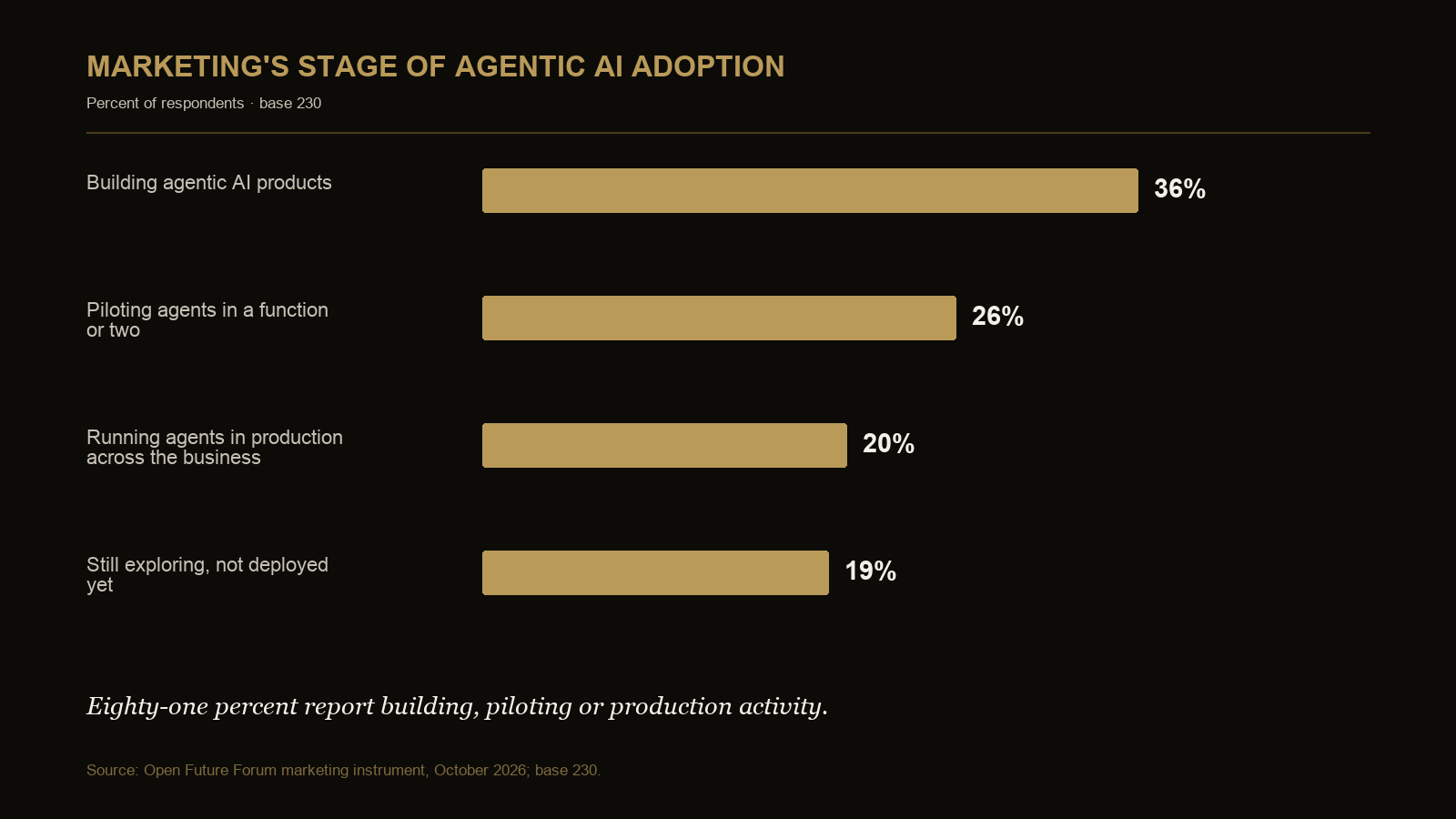
Marketing agentic stage
| Answer | Count | Share |
|---|---|---|
| Building agentic AI products | 82 | 36% |
| Piloting agents | 59 | 26% |
| Running agents in production | 46 | 20% |
| Still exploring | 43 | 19% |
Base 230.
In total, 187 of 230 respondents are beyond exploration: 82 are building products, 59 are piloting and 46 are running agents across the business. The stage distribution measures activity and deployment, not business value.
| Respondent seat | Base | Building | Piloting | Production | Exploring |
|---|---|---|---|---|---|
| CEO or founder | 74 | 49% | 19% | 23% | 9% |
| Technology | 15 | 40% | 13% | 27% | 20% |
| Other or unclassified | 129 | 27% | 32% | 19% | 22% |
Rows shown cover 218 of 230 respondents; omitted title categories total 12. Classification uses title keywords; the technology row is directional.
CEO and founder respondents are the largest classified group in the marketing instrument. Forty-nine percent report building agentic products, compared with 27 percent of other or unclassified respondents; reported production use is 23 and 19 percent respectively. The technology cut has a base of 15 and is directional. The title classification is shown because the marketing-event sample is not a CMO-only population.
The same table shows different stage profiles, not a simple early-versus-late ordering. Among other or unclassified respondents, piloting is the largest category at 32 percent. Among CEO and founder respondents, building products leads at 49 percent. Exploration is reported by 9 percent of CEO and founder respondents and 22 percent of other or unclassified respondents. The data does not reveal whether the difference comes from company type, event selection, title interpretation or actual operating behavior.
For the CMO, the implication is to document the unit of analysis. Building an AI product, piloting an agent in a function and running agents across the business are not interchangeable states. A company can build a product for customers while its own marketing operations remain at pilot stage. The response categories describe the respondent's selected status, not a verified enterprise maturity score.
Value drivers
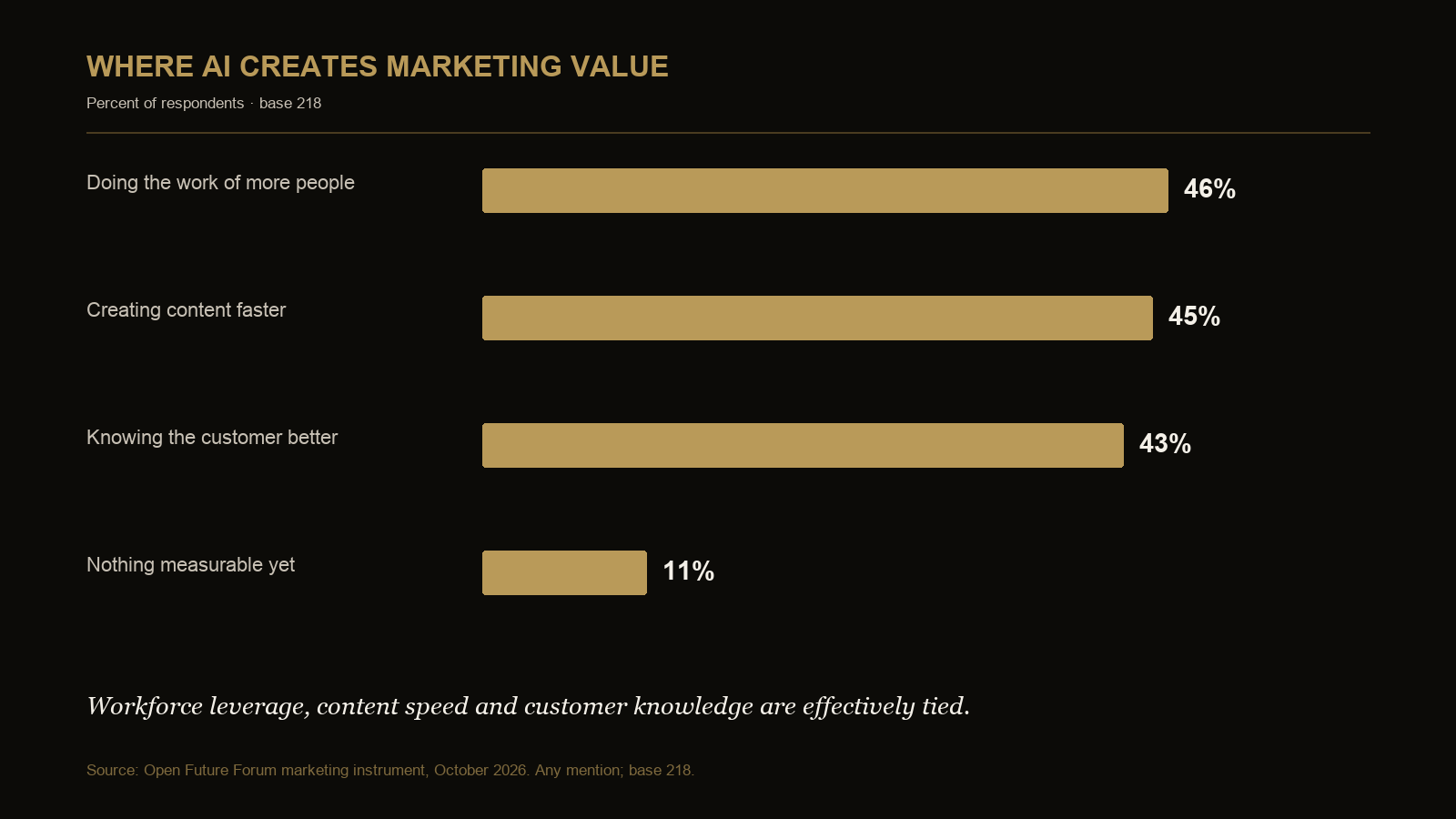
Reported marketing impact
| Answer | Count | Share |
|---|---|---|
| Doing the work of more people | 101 | 46% |
| Creating content faster | 99 | 45% |
| Knowing the customer better | 94 | 43% |
| Nothing measurable yet | 25 | 11% |
Base 218; any mention, so shares can sum above 100 percent.
The three leading impacts are within three percentage points. Workforce capacity, content speed and customer knowledge require different baselines, owners and evaluation windows, so one aggregate productivity measure will not describe all three.
Value by respondent seat
| Respondent seat | Base | Work of more people | Faster content | Better customer knowledge | Nothing measurable |
|---|---|---|---|---|---|
| CEO or founder | 89 | 46% | 48% | 42% | 6% |
| Technology | 13 | 46% | 69% | 46% | 8% |
| Other or unclassified | 96 | 46% | 39% | 48% | 16% |
Rows shown cover 198 of 218 respondents; omitted title categories total 20. Classification uses title keywords; the technology row is directional; any mention.
Among CEO and founder respondents, content speed is the most selected measure at 48 percent. Among other or unclassified respondents, customer knowledge leads at 48 percent. The technology cut has a base of 13 and is directional.
The separate impact question includes 25 “nothing measurable” responses, or 11 percent of its base. This is a reason to keep activity-stage and impact measures separate, not evidence about the same respondents' deployment.
Across the displayed seats, “doing the work of more people” is stable at 46 percent. The other measures vary: faster content is 48 percent for CEO and founder respondents and 39 percent for other or unclassified respondents, while better customer knowledge is 42 and 48 percent. The technology row reports 69 percent for faster content, but its base of 13 is too small for a headline and is labeled directional.
These differences suggest a reconciliation exercise, not a role ranking. The business owner may describe capacity, the content team may describe cycle time and the commercial team may describe customer knowledge. A CMO should ask whether those are three benefits from one workflow, three separate workflows, or three perceptions of the same activity. The scorecard should prevent the same output from being counted in multiple value branches without an explicit attribution rule.
External context
The CMO Survey's 2026 results also find AI adoption outpacing organizational readiness. The Open Future Forum data adds a value breakdown: workforce leverage, content speed and customer knowledge sit within three percentage points of one another, so no single impact measure describes marketing's AI case.
| Evidence source | Marketing question | What this report contributes | Comparison limit |
|---|---|---|---|
| The CMO Survey, 2026 results | How are marketing organizations experiencing AI gains and readiness pressure? | First-party status and multi-select impact distributions from OFF event instruments | Different samples and wording; percentages should not be combined |
| Open Future Forum marketing status instrument | Where do respondents place their agentic activity? | 230 deduplicated responses plus selected title-seat cuts | Activity stage is not verified value or a CMO-only estimate |
| Open Future Forum marketing impact instrument | Where do respondents report impact? | 218 deduplicated responses across three nearly tied impact branches | Multi-select perception measure, not audited commercial attribution |
The external comparison supports a broad management question about readiness and value. Open Future Forum adds a practical measurement split. It does not use the external study to validate a specific internal percentage or claim a market trend.
What this means for the CMO
Use three scorecards, not one: labor and throughput, content velocity and quality, and customer knowledge or commercial lift. Make each agent accountable to one primary scorecard and one business owner. If every agent is justified with generic productivity, the organization cannot tell which system is creating growth.
Measurement failure modes to prevent
- Output as outcome: counting assets, messages or variants without measuring approval, usefulness or audience response.
- Speed without quality: reporting shorter creation time while corrections, rejection, duplication or brand errors rise.
- Hours as cash: translating time released into savings even though staffing cost remains and redeployment is undocumented.
- Attribution after the result: choosing the comparison period or model only once performance is visible.
- Customer knowledge without action: producing more insights without recording whether a decision changed or a commercial measure improved.
- Double-counted lift: assigning the same conversion or pipeline effect to content, targeting and sales assistance without a declared rule.
- Activity presented as maturity: treating a live pilot or high output volume as proof of repeatable value.
The survey does not count these failure modes. They are recommended checks derived from the separation between status and impact measures.
Marketing AI measurement tree and scorecard
Start with the business outcome, then choose one primary value branch. Add a quality or risk guardrail and a cost measure before the workflow goes live. A workflow may contribute to more than one branch, but one branch should own the investment case so the same activity is not counted twice.
| Value branch | Primary question | Example outcome measures | Required baseline | Guardrail measures | Evidence source |
|---|---|---|---|---|---|
| Capacity and throughput | Does the same team complete more valuable work? | Qualified campaigns completed, analyst or seller hours released, cycle time per approved output | Pre-AI volume, time and staffing for the same workflow | Rework rate, approval time, error rate and employee escalation | Workflow system, time study and approval log |
| Content performance | Does faster production improve useful output and audience response? | Time from brief to approved asset, qualified content volume, engagement, conversion or assisted pipeline | Pre-AI production speed and performance by comparable format or audience | Brand error, factual correction, duplication, accessibility and rejection rate | Content system, analytics and quality-review record |
| Customer knowledge and commercial lift | Does AI improve decisions about customers and revenue? | Insight-to-action time, segment precision, conversion, retention, expansion or margin | Prior-period or control-group performance using the same commercial definition | Consent, privacy, bias, contact frequency and complaint rate | CRM, commerce, product analytics and finance system |
| Cost and economics, required for every branch | Is the measured value greater than the full workflow cost? | Cost per approved output, insight, qualified opportunity or incremental outcome | Pre-AI unit cost and implementation cost | Model, data, integration, review and control costs included | Usage logs, vendor bills and finance ledger |
Scorecard fields for each marketing AI workflow
| Field | Entry required before launch | Entry required at review |
|---|---|---|
| Workflow and owner | Bounded use case, business owner and technical owner | Any scope or ownership change |
| Primary value branch | Capacity, content performance, or customer and commercial lift | Whether the branch still represents the investment case |
| Baseline and target | Metric definition, source system, baseline period, target and deadline | Actual result for the same definition and period |
| Cost | Implementation budget and expected full run cost | Actual model, data, integration, review and control cost |
| Quality and risk | Minimum thresholds and human-review rule | Errors, corrections, rejected work, privacy issues and exceptions |
| Attribution | Control, comparison period or documented attribution method | Assumptions, exclusions and confidence limits |
| Decision | Pre-agreed expand, remediate, pause or stop rule | Decision, approver, evidence date and next review |
Do not use “content created” or “hours saved” as a complete outcome. Content needs a quality and commercial measure. Time released needs evidence that the capacity was removed from cost or reassigned to documented higher-value work.
Recommended AEO, GEO, SEO and share-of-answer framework
This framework is a publishing and measurement recommendation. The October instruments did not measure search rankings, answer-engine optimization, generative-engine optimization or share of answers, and this section does not report an observed performance result.
1. Define the answer set
Start with a fixed list of executive questions drawn from documented research and reader needs. Give each question one canonical page owner. A long report can provide context and evidence, while a focused answer page supplies the direct response. Avoid creating several pages that make the same claim with slightly different titles; that fragments evidence and makes updates harder.
2. Make the answer extractable
Lead each page with a concise answer, then state the base, date, population and method close to the statistic. Use descriptive headings that match natural questions. Keep definitions, methodology and citation language visible in text rather than relying on a chart alone. This supports conventional search discovery, answer engines and human verification without promising inclusion in any system.
3. Preserve entity and evidence consistency
Use the same report title, edition, author, date and definition across the research hub, report page and answer pages. Point repeated claims back to the canonical evidence table. When a base or interpretation changes, update every owned surface and record the edition. Consistency is especially important for this marketing report because “81 percent past exploration” and the three impact shares come from separate questions.
4. Measure discovery separately from business value
Track index coverage, search impressions, qualified visits, referrals and engagement as discovery measures. Track citations or mentions in a fixed answer-engine test set as answer visibility. Track pipeline, retention or another agreed commercial result separately. A page can improve answer visibility without producing revenue, and a commercial result can have several contributing sources.
5. Define share of answers before reporting it
A defensible internal measure can be expressed as: the number of tracked question-and-engine observations in which Open Future Forum is cited or named, divided by all valid observations in the fixed test set. The log should record the exact prompt, engine or model, date, account state where relevant, location or language where relevant, whether a citation or plain mention counts, and the captured response. Because generative answers vary, report the sampling design and uncertainty rather than presenting one run as a stable market share.
6. Diagnose duplication with intent, not word matching alone
Two pages can discuss the same statistic without competing if they serve different intents: a report interprets the full evidence, an answer page gives a direct response, and a definition page explains a term. Duplication becomes harmful when several pages claim the same query, offer no distinct evidence or action, and disagree on the canonical source. Maintain a page-ownership map and consolidate only when intent and content are genuinely redundant.
Suggested measurement register
| Field | What to record | Why it matters |
|---|---|---|
| Priority question | Exact tracked wording and intent | Keeps the test stable and assigns a canonical owner |
| Owned page | Canonical URL, report relationship and last update | Prevents internal competition and stale claims |
| Evidence block | Direct answer, statistic, base, date and source | Makes claims verifiable and extractable |
| Search observation | Query, position or impression, date and market | Separates conventional search visibility |
| Answer observation | Prompt, engine/model, response, citation or mention and timestamp | Makes generative visibility reproducible enough to audit |
| Quality outcome | Correction, rejection, duplication and factual-review result | Prevents visibility from outrunning trust |
| Commercial outcome | Agreed downstream measure and attribution rule | Separates discovery from business value |
| Decision | Maintain, update, differentiate, consolidate or retire | Turns measurement into content operations |
This register is not a claim that a specific tool, page type or schema guarantees ranking or citation. It creates a repeatable way to test whether useful, well-sourced answers are discoverable and whether that discovery contributes to the outcome the CMO actually owns.
Implications for adjacent roles
CFO: distinguish capacity, cost reduction and commercial lift, then reconcile the full workflow cost. CIO, CTO and AI leader: provide reliable workflow, usage and cost data and preserve version history when models or tools change. Sales and revenue leadership: agree on opportunity, conversion and revenue definitions before attributing lift. General counsel and privacy leaders: set data-use, claims, consent and retention boundaries. Brand and communications: define quality, originality and correction standards. Content and web teams: maintain canonical page ownership and update repeated evidence consistently.
The CMO owns the measurement architecture, but the evidence is distributed across systems and functions. The handoff fails when each team optimizes its own metric without agreeing on the primary value branch.
Definitions used in this report
Past exploration is the sum of building agentic products, piloting agents and running agents in production: 187 of 230 respondents, or 81 percent. It is an activity-stage measure, not proof of value.
Reported impact is a respondent's selection in a multi-select question. Shares can overlap and do not constitute audited attribution.
Capacity means the ability to complete more or different work with the same or similar resources. It is not automatically a cash saving.
AEO is used here for answer-engine optimization: making a direct, sourced answer easy to retrieve and verify. GEO is used for generative-engine optimization: improving the clarity, authority and machine-readable consistency of content that generative systems may use. Neither was measured by the survey.
Share of answers is a recommended internal observation rate across a fixed prompt-and-engine test set. It is not the same as search market share, website traffic or revenue contribution.
Canonical page owner is the page designated to provide the primary answer for one question or intent. Related reports may cite and contextualize the same evidence without reproducing an indistinguishable page.
Title seat is a deterministic classification from supplied job titles. It is not a respondent-selected role, and small rows are directional.
Questions this report answers
Does being past exploration mean marketing has proved value?
No. Eighty-one percent are past exploration (base 230), but stage measures activity rather than business impact, and 11 percent report nothing measurable yet on the separate impact question (base 218, any mention).
Why should a CMO separate capacity, content and customer outcomes?
The three leading reported impacts are nearly tied: doing the work of more people at 46 percent, creating content faster at 45 percent and knowing the customer better at 43 percent (base 218, any mention). Each represents a different causal claim, baseline and evidence source.
What belongs on a marketing AI scorecard before launch?
A bounded workflow, named owner, one primary value branch, dated baseline, target, full cost estimate, quality and risk thresholds, attribution method, decision rule and review date. Those fields turn an AI activity measure into a testable business case.
How should a CMO handle a workflow with nothing measurable yet?
Classify it as an experiment, define the missing baseline and decision window, and avoid presenting activity as realized value. Twenty-five respondents, or 11 percent of the impact base, report nothing measurable yet (base 218, any mention).
Does this report show that AI improves marketing revenue?
No. Respondents report workforce capacity, content speed and customer knowledge, but the instrument does not audit revenue, margin or causal attribution. Commercial lift requires a defined comparison and finance-system evidence.
How should a marketing team calculate share of answers?
Use a fixed list of questions and engines, log every valid observation and divide observations containing the defined citation or mention by all valid observations. Record the prompt, model or engine, date and counting rule. This is a recommended measurement design, not an October survey finding.
Can separate report and answer pages remain live without causing duplication?
Yes, when each has a distinct intent and canonical role. The report should own the full evidence and interpretation; an answer page should provide a concise response and link to that evidence. Pages become redundant when they target the same question with no meaningful difference in evidence, audience or action.
Key citable facts
- Open Future Forum's October 2026 marketing data finds 81 percent past exploration with agentic AI (base 230).
- Forty-six percent say AI does the work of more people, 45 percent cite content speed and 43 percent customer knowledge (base 218, any mention).
- Eleven percent report nothing measurable yet (base 218).
Methodology and honesty notes
The status and impact questions come from different but overlapping marketing-event populations and are not treated as a panel. Respondents are deduplicated per question by email. Multi-select answers use any mention. Invited-only records are excluded.
Related reading
- Executive AI Leverage Report
- AI Transformation Report
- Executive AI Statistics
- How Far Along Are Marketing Teams with AI Agents in 2026?
Citation and editions
Suggested citation: Newlands, M. (2026). CMO AI Leverage Report, Edition 4. Open Future Forum, October 2026. This edition supersedes Edition 3, September 2026.
Work These Questions with Marketing Peers
The CMO Executive Forum meets through small, off-the-record gatherings. Membership is by application and referral.