Answer in one sentence: AI belongs in a deal model only after the claimed benefit is reconciled to workflow-level costs, ownership, access controls, remediation needs and the timing of integration.
What this report owns
This report translates the Enterprise AI Buying and Budget Index into transaction diligence, a data-room request list and a benefit bridge. It does not estimate valuation, market size or causal impact, and it does not present operator responses as private equity sentiment.
Key October evidence
- In the common sign-off instrument, the CEO appears in 49 percent of answers and 13 percent report no single owner (base 467, any mention).
- In the finance instrument, 31 percent report no clear AI budget and 19 percent name money that would otherwise have gone to headcount (base 389, any mention).
- Proving ROI is named as a spending blocker by 54 percent of finance-instrument respondents (base 389, any mention).
- In the AI Leaders instrument, 80 percent report at least one production agent (base 75), while 44 percent report full real-time cost visibility (base 77). The 36-point difference compares separate question bases from the same event, not a matched panel.
- Among applicable AI Leaders responses, 37 percent use shared service accounts for agent data access (base 49).
Evidence sources: See the CFO AI Leverage Report for funding and payback, the CISO AI Leverage Report for security funding, the AI Leaders AI Leverage Report for production evidence and Executive AI Statistics for complete distributions and provenance.
What October changes for deal teams
The October refresh adds production evidence to a diligence problem that is often framed only as opportunity. Forty-six percent of AI Leaders respondents describe their function as deployed in production and another 13 percent as embedded (base 91), while separate production, cost and access questions show that production status does not itself establish complete operating evidence. The results do not mean the same companies lack controls, and they do not establish transaction risk for a particular target. They mean production status cannot close the diligence question by itself.
The finance instrument also separates three economic conditions that a management presentation may collapse: net-new funding, reallocation from existing spend and money that would otherwise have gone to headcount. Because the question is multi-select, those routes can coexist. A deal team should therefore ask how each claimed benefit is treated in the model rather than assuming that “AI savings” means cash removed from the run rate.
No private equity survey was fielded. This report applies separate operator instruments to transaction questions, with every base shown. Its conclusions concern evidence design, not private equity sentiment, valuation multiples or the prevalence of problems across targets.
Six-question AI deal screen
Use this screen before building a detailed upside or remediation case. A “yes” should point to a record that can be reviewed, not solely to an interview answer.
| Screen | Pass condition | If the answer is incomplete |
|---|---|---|
| 1. What is actually in production? | Material workflows are distinguished from pilots, demos and approved-but-unused tools | Exclude unverified deployments from the operating case and request a production inventory |
| 2. Who owns the operating result? | Sponsor, business owner, technical owner and control owner are named | Create a decision-rights exception and identify the post-close owner |
| 3. Is the benefit reproducible? | Baseline, result, period, source system and evidence owner reconcile | Hold the claim outside verified deal benefits until it can be reproduced |
| 4. Is full run cost visible? | Model, infrastructure, tools, integration, human review and controls are included | Build a cost range and sensitivity rather than assume the vendor bill is complete |
| 5. Can actions and data access be reconstructed? | Identity, privileges, logs, review and revocation apply to the deployed system | Price and sequence attribution, access or logging remediation |
| 6. Will the claim survive the transaction? | Contracts, data, systems, owners and dependencies have a viable target state | Treat disruption, migration and remeasurement as integration work |
The screen is intentionally binary only at the first pass. A partial answer should become a named diligence exception with an owner, evidence request and decision effect. It should not be averaged into a generic technology-risk rating.
The transaction diligence matrix
| Diligence question | October evidence | Base | What to verify |
|---|---|---|---|
| Who can authorize AI? | CEO 49%; finance 31%; no single owner 13% | 467 | Sponsor, operating owner and approval record |
| Where does the money come from? | 41% net-new; 31% no clear budget; 19% headcount-linked | 389 | Recurring run cost, displaced spend and benefit category |
| What blocks scale? | 54% name proving ROI | 389 | Baseline, measurement window and decision threshold |
| Is production cost visible? | 44% full; 39% partial; 17% none | 77 | Workflow-level cost and gross-margin sensitivity |
| How do agents access data? | 37% shared accounts among applicable answers | 49 | Attribution, privilege, logging and revocation |
| Is security funding explicit? | 68% name agent access as a problem; 34% name a dedicated budget line | 151 | Control roadmap and funded remediation |
The 34-point security comparison does not measure budget adequacy. Respondents could also report case-by-case funding or an existing security-budget carve-out, and the question was multi-select.
Private equity AI data-room request list
Request these records for every material production workflow and for any AI claim included in the investment case:
- The production inventory, including workflow, launch date, model or vendor and current operating status.
- The decision-rights record naming the executive sponsor, business owner, technical owner and control owner.
- The last twelve months of model, infrastructure, tooling, integration, review and control costs by workflow where available.
- The benefit file showing the pre-AI baseline, measurement window, result, source system and person accountable for the claim.
- The identity and access map, including shared credentials, approved data scope, action permissions, logs and revocation procedures.
- Material vendor contracts, data-processing terms, service commitments, model-change terms and termination assistance.
- The incident, override and exception log, plus open remediation items, owners, expected cost and target dates.
- The integration dependency map covering data, systems, models, people and contracts that would change under the value-creation plan.
This list is a practical diligence asset, not a statement that every respondent maintains these records.
EBITDA and benefit bridge
Do not move an AI claim directly from a management presentation into adjusted EBITDA. Reconcile the claim through a bridge that separates cash, capacity, revenue and recurring delivery cost.
| Bridge line | Evidence required | Treatment question |
|---|---|---|
| Claimed gross benefit | Workflow baseline, current result and measurement period | Is the change measured against a stable baseline? |
| Cash payroll saving | Payroll record and removed position or spend | Did cash cost actually leave the run rate? |
| Avoided hiring | Approved plan, unfilled role and capacity evidence | Is this avoided future spend rather than a current-period saving? |
| Redeployed capacity | Hours released and documented new output | Did capacity create a measurable result elsewhere? |
| Revenue or gross-profit contribution | Usage, conversion, price, retention and delivery-cost evidence | Is the result incremental and repeatable? |
| AI run cost | Model, infrastructure, tools and support by workflow | Does cost increase with usage or complexity? |
| Control and remediation cost | Security, legal, audit, data and monitoring work | Is the required control spend included in the case? |
| Net verified benefit | Reconciled benefit less recurring and required costs | Which portion is sufficiently evidenced for the deal model? |
Money that would otherwise have gone to headcount appears in 19 percent of finance-instrument answers (base 389, any mention). That response can describe cash savings, avoided hiring or redeployed capacity, which are not interchangeable. Separately, 13 percent of AI Leaders respondents describe AI as embedded enough that removing it would alter the cost structure or hiring plan (base 91). Neither figure establishes an EBITDA adjustment without company-level evidence.
Cost visibility and maturity
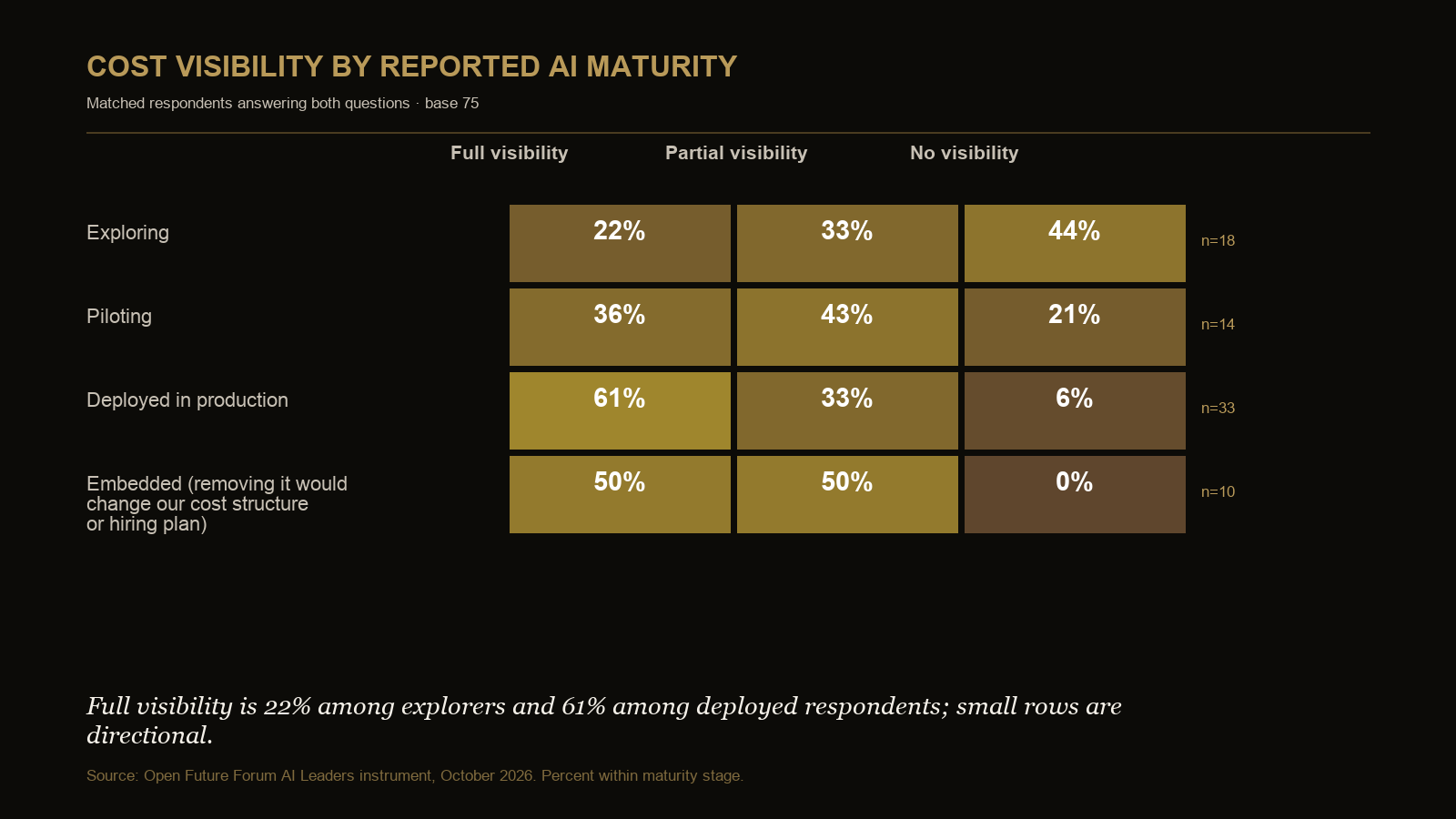
| Group | Base | Full visibility | Partial visibility | No visibility |
|---|---|---|---|---|
| Exploring | 18 | 22% | 33% | 44% |
| Piloting | 14 | 36% | 43% | 21% |
| Deployed in production | 33 | 61% | 33% | 6% |
| Embedded (removing it would change our cost structure or hiring plan) | 10 | 50% | 50% | 0% |
Matched respondents answering both questions; base 75. Small row bases are directional.
Full cost visibility is 22 percent among explorers and 61 percent among respondents with production deployments. Even in the production row, 39 percent report only partial or no real-time visibility. The sample is selective and the row bases are small, so this cut should shape diligence questions, not valuation assumptions.
The matched table shows a cross-sectional association, not a sequence or causal effect. Full visibility is more frequently reported in the deployed row than in the exploring row, but the survey does not establish how or when respondents moved between stages. Embedded status does not guarantee full visibility: five of ten embedded respondents report partial rather than full visibility. Because the embedded row contains only ten respondents, this observation is directional. It supports a diligence question (whether the target can trace cost at the workflow level), not an estimate of how mature companies generally perform.
Cost visibility also needs a declared boundary. “Full” may refer to model and infrastructure spend while omitting integration support, human review, observability, security, legal or data work. The target should state what is metered directly, what is allocated, what is estimated and what is excluded. A deal team can then run the same bridge under a base case, an upside case and a control-complete case.
Applying the evidence by deal type
Control buyout
In a control transaction, the investor can make ownership, reporting and remediation part of the operating model. The diligence output should therefore be specific enough to seed the first 100-day plan. Priorities include a material-workflow inventory, the benefit-and-cost bridge, an identity and access remediation queue, vendor and data dependencies, and the executive who will approve continue, change or stop decisions.
The key distinction is between underwriting evidence and future opportunity. A claim supported by a reproducible baseline and full cost can enter the verified case, subject to normal forecasting risk. A plausible but unmeasured workflow belongs in the value-creation pipeline. A system with unresolved attribution, contractual or data issues may require a funded remediation case before expansion. Keeping these lanes separate prevents upside from funding its own proof.
Growth or late-stage minority investment
In a minority investment, governance rights and information access may be narrower. The investor may not control the target's architecture, procurement or remediation sequence. The useful diligence output is therefore a concise covenant or information-rights schedule: which AI measures management will report, which material changes require notice, which incidents or exceptions escalate, and which evidence the board or investor can inspect.
For an AI product company, revenue and delivery-cost evidence may deserve priority. For an AI-enabled operating company, workflow benefits, avoided hiring and process dependencies may matter more. In both cases, the investor should avoid importing a control-deal remediation plan that it lacks the rights to implement. Instead, define reporting thresholds, decision forums and the evidence required before additional capital supports scale.
Add-on acquisition and integration
An add-on creates a different risk: the target's AI workflows may depend on a tenant, data environment, model contract or identity system that will change. A technically successful deployment can lose its evidence trail during integration. Preserve the pre-close inventory, logs, baseline and cost record; name the target-state owner; and decide whether each workflow continues, migrates, pauses or retires. Recalculate the benefit after the relevant systems and costs change.
Reading the October evidence in a deal model
The common sign-off finding (CEO named in 49 percent of answers) suggests senior approval is common in this selective sample. It does not show who owns delivery after approval. The 13 percent “no single owner” line is similarly not proof of weak governance; distributed authority may be deliberate. Diligence should establish whether the design is explicit and whether escalation works.
The finance finding that 54 percent name proving ROI as a blocker indicates that evidence of value is a central operating constraint in that instrument. It does not show that 54 percent of deals have unprovable returns. For a transaction, the practical response is to reproduce the target's largest claims and document the decision threshold used when a result falls short.
The 36-point difference between production-agent presence and full cost visibility compares separate questions with bases of 75 and 77. It is not a respondent-level gap and should never be presented as “36 percent of companies have agents without cost visibility.” The matched maturity table offers a narrower respondent-level view, with small and directional rows.
Finally, shared accounts among 37 percent of applicable responses identify an attribution question, not a finding of noncompliance. A shared account may sit behind strong workload-level logs and narrow privileges, or it may not. The target's actual implementation determines remediation need and cost.
Remediation and integration questions
Remediation before close
- Which shared accounts, excessive privileges or unlogged agent actions require immediate correction?
- Which control gaps are conditions to close, specific indemnities or funded post-close work?
- What is the estimated one-time remediation cost, recurring control cost, owner and completion evidence?
- Does the remediation plan depend on a vendor, model or data source that the buyer cannot control?
Integration after close
- Which production agents depend on systems, contracts or data that will change at close?
- Will identity, logging and data-retention controls survive tenant, platform or vendor consolidation?
- Which AI workflows are duplicated across the buyer and target, and which should continue, migrate or stop?
- What service or revenue claim changes if an agent is paused during integration?
- Who approves the target-state model, and when will the benefit bridge be remeasured?
These questions turn a generic technology workstream into priced, owned and testable deal actions.
Failure modes that distort AI diligence
- Benefit without a baseline: a current result is compared with an anecdote rather than a stable pre-AI measure.
- Gross benefit presented as EBITDA: avoided hiring, released capacity and cash savings are treated as interchangeable.
- Cost boundary drift: the forecast includes a low vendor rate while current operations require human review, integrations and controls that sit elsewhere.
- Pilot-to-production extrapolation: a successful narrow use is scaled without modeling data, compute, quality or review requirements.
- Control debt omitted from purchase price thinking: access, logging, contract or data remediation is left as an unspecified post-close task.
- Integration destroys comparability: systems and teams change, but the original benefit claim remains in the model without rebaselining.
- One score masks material exceptions: a portfolio or target-level maturity label hides a high-exposure workflow with weak evidence.
Each failure mode has the same remedy: return to the deployed workflow, state the evidence boundary and record how the answer affects underwriting, a condition to close, the 100-day plan or ongoing monitoring.
Stakeholder responsibilities
| Stakeholder | Primary decision | Evidence it should own or challenge |
|---|---|---|
| Deal partner | Whether an AI claim changes price, structure or investment case | Verified/open/excluded claim schedule |
| Operating partner | Which opportunities and gaps enter the value-creation plan | Workflow roadmap, owners, milestones and decision gates |
| Finance diligence | How benefit and cost enter the model | EBITDA and benefit bridge, cost boundary and sensitivities |
| Technology and security diligence | Whether production dependencies and controls are understood | Inventory, architecture, identities, logs, incidents and remediation |
| Legal diligence | Whether contracts and data rights support the target state | Vendor/customer terms, notices, change rights and evidence duties |
| Management | Whether each material workflow continues, changes or stops | Reproducible operating and outcome record |
Comparison with external research
| External source | Relevant context | Deal-team application |
|---|---|---|
| McKinsey on generative AI in private markets | AI-generated diligence can diverge from expert evidence on market size, pricing and margins | Reconcile every material portfolio-company claim to workflow, cost, identity and measured outcome |
This external research is context, not part of the Open Future Forum sample and not evidence about a particular target.
Questions this report answers
What belongs in a private equity AI data room?
Include the production inventory, decision rights, workflow cost ledger, benefit file, identity and access map, material contracts, incident and exception log, remediation plan and integration dependency map.
How should an AI benefit enter an EBITDA bridge?
Separate realized cash savings, avoided hiring, redeployed capacity, revenue or gross-profit contribution, recurring AI run cost and required remediation. Only the net amount supported by company-level evidence should inform the deal model.
Which AI issues can create post-close remediation or integration cost?
Shared credentials, incomplete logs, unclear ownership, weak cost allocation, vendor dependencies and data or system changes can all require funded work. The October data shows shared service accounts in 37 percent of applicable AI Leaders responses (base 49), but that operator statistic does not establish the condition of a specific target.
What are the six questions in an initial AI deal screen?
Ask what is in production, who owns the result, whether the benefit is reproducible, whether full run cost is visible, whether actions and data access can be reconstructed, and whether the claim will survive the transaction.
Should the same AI diligence plan be used for control and minority investments?
No. A control investor can place remediation and operating-model changes directly into the value-creation plan. A minority investor should align evidence requests with governance rights, information rights and escalation thresholds it can actually exercise.
Does production deployment prove an AI claim belongs in the deal model?
No. Production establishes operating status. The claim still needs a stable baseline, measured result, full cost, responsible owner and a test of whether it remains valid after integration.
How should a deal team treat an AI claim with missing evidence?
Classify it as an open hypothesis, state the missing record and run the model without assuming the benefit. Move it into the verified case only when the evidence can be reproduced.
Key citable facts
- Thirty-one percent report no clear AI budget (base 389, any mention).
- The share reporting at least one production agent exceeds the share reporting full real-time cost visibility by 36 percentage points across two questions from the same event (bases 75 and 77); it is not a matched-respondent statistic.
- Agent access named as a problem exceeds the dedicated-budget-line share by 34 points (base 151, any mention); this does not measure budget adequacy.
Methodology and limitations
This is a synthesis of operator data, not a survey of private equity professionals. It does not estimate market size, company valuation, EBITDA impact or causal effect. Bases from separate instruments are reported independently. Respondents are deduplicated by email for each question, invited-only rows are excluded, and multi-select questions use any mention. The data-room list, benefit bridge and deal questions are recommended diligence tools, not survey findings.
Related reading
- Investment Banking AI Report
- General Counsel AI Report
- Executive AI Statistics
- PE AI Due Diligence Questions for 2026
- Is AI Replacing Headcount in PE-Backed Companies?
Citation
Suggested citation: Newlands, M. (2026). Private Equity AI Report, October 2026. Open Future Forum.
Work These Questions with Dealmaking Peers
Forum Select meets through small, off-the-record gatherings. Membership is by application and referral.