Evidence directors can use now
- Eighty percent of AI Leaders respondents report at least one production agent (base 75).
- Forty-four percent report full real-time AI operating-cost visibility (base 77).
- Among the same 60 respondents running at least one production agent and answering the cost question, 30 report full visibility, 23 partial visibility and seven none.
- Thirty-seven percent of applicable agent-access responses use shared service accounts (18 of 49).
- Thirteen percent of common-instrument respondents report no single AI buying owner (base 467, any mention).
- Agent access is named as a security problem by 68 percent of CISO-instrument respondents, while 34 percent report a dedicated AI security line (base 151, any mention). The 34-point comparison describes problem prevalence and funding structure; it does not measure funding adequacy.
The underlying source exhibits and full question wording appear in the AI Leaders AI Leverage Report, CISO AI Leverage Report and Executive AI Statistics. They are not reproduced in full here so this Preview can concentrate on board use.
What changed since the September Preview
September organized oversight around ownership, demonstrated value and security funding. October adds direct operator evidence on agent fleet size, cost visibility and enterprise-data access. The new evidence makes it possible to specify what belongs in a recurring board dashboard, while the absence of a publishable board sample still prevents claims about directors' own priorities.
Definitions for board use
| Term | Meaning in this Preview | Important limit |
|---|---|---|
| Material production system | An AI system that crosses a company-defined financial, decision, data, autonomy, incident, concentration or workforce threshold | The October survey did not prescribe a universal materiality threshold |
| Accountable owner | The executive or business leader who can approve, pause, redesign or retire the system | Being named in a survey answer does not demonstrate that decision rights are documented |
| Full real-time cost visibility | The strongest cost-visibility option selected by an AI Leaders respondent | The survey did not test the cost taxonomy, accuracy or workflow allocation behind the answer |
| Applicable access response | A respondent who selected an access method rather than “not applicable yet” | The applicable base of 49 is not the full AI Leaders population or a company-level control audit |
| Embedded AI | AI whose removal would change cost structure or hiring plans | It is a stricter operating-model condition than production deployment, not a measure of quality or safety |
Four signals behind the governance case
The board dashboard is not based on a single risk percentage. It is a response to four different operating signals, each with its own source boundary.
1. Ownership is senior but not uniform
The common sign-off instrument names the CEO in 49 percent of answers and finance in 31 percent (base 467, any mention). Thirteen percent name no single owner. Because the question is multi-select, centralized and distributed answers can coexist.
The title-classified cut shows that respondents tend to name the role closest to their own seat: 80 percent of CEO or founder respondents name the CEO, 67 percent of finance respondents name finance, and 52 percent of the 25-person technology row name the CIO or CTO. This is descriptive evidence of perspective, not proof that a company has contradictory decision rights. The full heatmap, row bases and caveats appear in the Executive AI Leverage Report.
For a board, the implication is procedural: require a decision-rights record that states who proposes, funds, approves, operates, monitors and can stop each material system. The board should not infer that a popular survey answer resolves those responsibilities inside its own company.
2. Economics can lag operating scale
Among 60 matched respondents running at least one production agent, 30 report full real-time cost visibility, 23 partial visibility and seven none. The result does not establish poor financial management among the latter 30. It establishes that half did not select the strongest visibility option and gives the board a concrete reconciliation question.
The oversight test is whether management can connect model, infrastructure, data, review and exception costs to a material workflow and its claimed result. Aggregate AI spend alone cannot show whether a workflow is becoming more or less economic.
3. Identity is an operating control, not a policy slogan
Among 49 applicable access responses, 18 report shared service accounts and 24 per-agent credentials. The survey did not inspect permission scopes or logs, so it cannot classify either group as secure or insecure. It does show why the board dashboard should include identity method, privileged access and unresolved exceptions for material agents.
The board-level question is not whether every credential is technically unique. It is whether actions can be attributed, permissions can be limited to the workflow, access can be revoked, and a material exception has an owner and deadline.
4. Workforce dependence changes the oversight obligation
Twelve of 91 AI Leaders respondents select the embedded condition: removing AI would change cost structure or hiring plans. In a separate marketing impact instrument, 101 of 218 respondents name doing the work of more people (any mention). These are separate populations and cannot be joined into one workforce estimate.
Together, they identify the records a board should request when management makes a workforce claim: which tasks changed, which capacity or hiring assumption moved, how quality and workload are being monitored, and what contingency exists if the system is withdrawn or fails.
Evidence behind the dashboard
The October results justify asking for a dashboard; they do not populate a company's dashboard automatically. Management must supply the company-specific record.
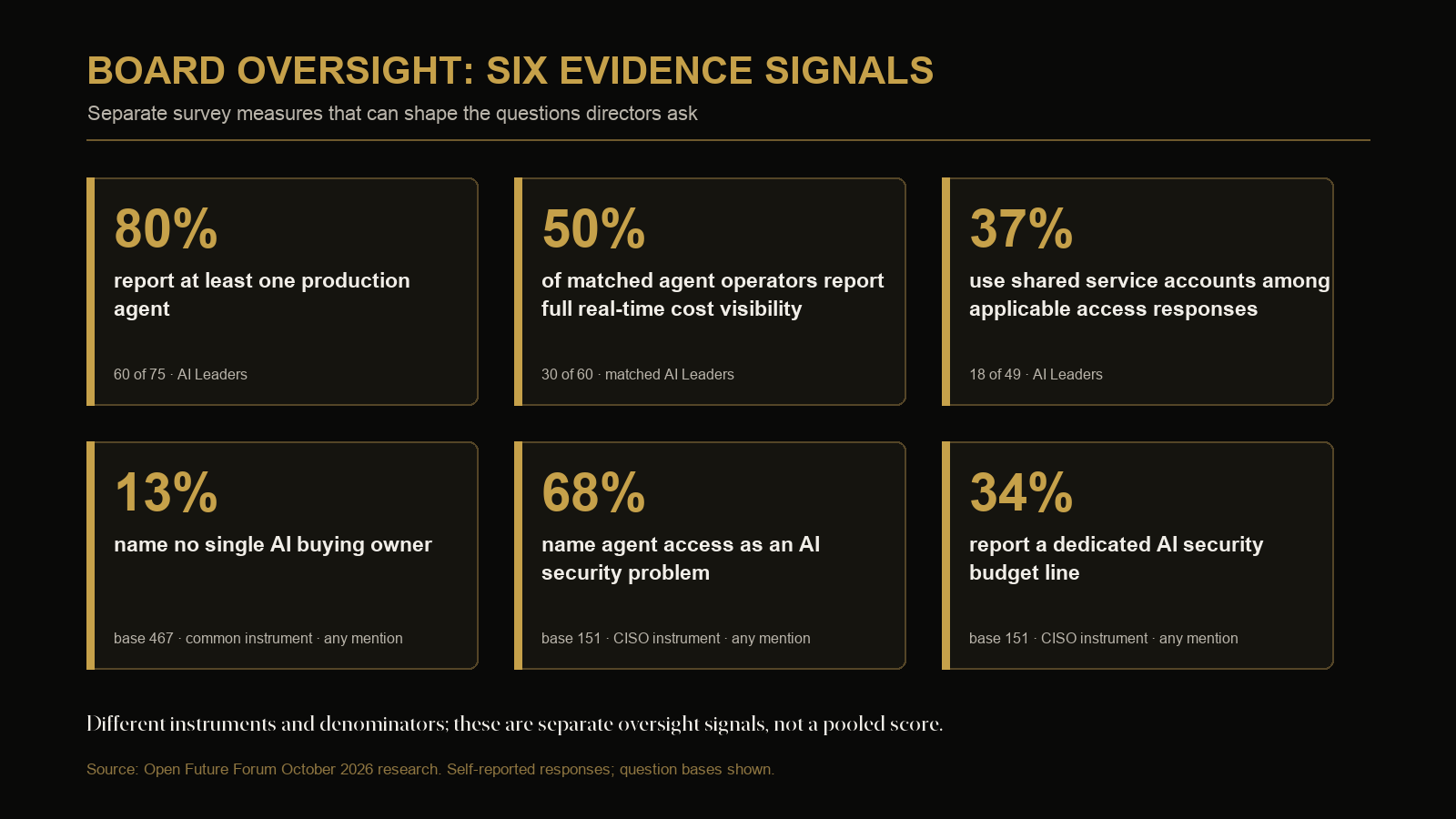
The six cards combine no denominators and create no score. They summarize separate ownership, production, cost, access and security questions so directors can see which company-specific records to request next.
| Dashboard question | October evidence that makes it relevant | Evidence the survey does not provide |
|---|---|---|
| Do we know every material production system? | 60 of 75 report at least one production agent; 22 report more than twenty | The respondent's actual inventory, materiality and completeness |
| Is ownership explicit? | 60 of 467 name no single owner, while role cuts differ | The company's approved decision rights and accountable individuals |
| Can economics be reconciled? | Only 30 of 60 matched agent operators report full visibility | Audited workflow cost, value attribution or approved return threshold |
| Are actions attributable and access bounded? | Shared service accounts are 18 of 49 applicable access answers | Permission scope, logging, revocation and exception quality |
| Has work or workforce planning changed? | 12 of 91 report the embedded condition; a separate 101 of 218 marketing respondents name workforce leverage | Company-specific role, capacity, hiring, employee-impact or continuity decisions |
This distinction prevents a common governance error: treating industry evidence as if it were company assurance. External and survey evidence can frame the questions. Only management's reconciled records can answer them for the enterprise.
The quarterly board dashboard
The board should receive the same fields each quarter, with the current result, prior-quarter result, management owner, threshold status and remediation date. The following is a governance template, not an additional survey finding.
| Dashboard domain | Quarterly board measure | Management owner | Board question |
|---|---|---|---|
| Inventory | Number of material production agents and material workflows | AI or technology executive | Is the inventory complete and reconciled to deployed systems? |
| Accountability | Share with named business and technical owners | CEO or designated AI executive | Who can approve, pause and retire each material system? |
| Economics | Spend, unit cost and visibility status by material workflow | CFO | Can value and operating cost be reconciled at workflow level? |
| Identity and access | Credential model, privileged access and unresolved exceptions | CISO | Are agent actions attributable, bounded and revocable? |
| Performance | Outcome, reliability and exception rate against an approved baseline | Business owner | Is the system delivering the result used to justify it? |
| Risk and incidents | Material incidents, near misses, overrides and open remediation | Chief risk, legal or security executive | Did any event cross the escalation threshold? |
| Workforce and operating model | Capacity, role or hiring decisions dependent on AI | CEO and CHRO | Which operating decisions would change if AI were removed? |
| Third parties | Material providers, concentration, change notices and exit readiness | Technology, procurement and legal | Can the company continue or exit if a provider changes terms or service? |
The dashboard should distinguish a count from a control. “Twenty agents in production” is an inventory statement. It becomes an oversight statement only when management can show which of those agents are material, what they cost, what they can access, how they perform and who owns the exception path.
Proposed materiality and escalation rules
These triggers are recommendations for a company to adapt to its risk appetite, regulatory duties and board charter. They are not empirical thresholds from the October survey.
| Trigger | Escalate when | Minimum board-level response |
|---|---|---|
| Financial materiality | Spend, loss exposure or value claim exceeds the board-approved materiality threshold | Require CFO reconciliation and a named accountable executive |
| Decision materiality | AI affects a consequential customer, employee, credit, safety or regulated decision | Review human control, testing, appeal and legal accountability |
| Data materiality | A system can reach sensitive, regulated or strategically material data | Review data scope, credential model, logging and revocation |
| Autonomy materiality | An agent can transact, publish, change records or invoke tools without prior human approval | Require bounded authority, monitoring, override and kill path |
| Incident materiality | Harm, unlawful access, material misinformation or service failure crosses the company's incident threshold | Notify the relevant committee promptly and track remediation to closure |
| Concentration materiality | A critical workflow depends on one model, platform or provider without a viable contingency | Review continuity, substitution and contractual protections |
| Workforce materiality | Management changes hiring, role design or capacity assumptions because of AI | Review the evidence, transition plan and employee-risk treatment |
Management should define the numerical or legal thresholds before an incident occurs. A threshold that is invented after the fact is not an escalation rule.
Committee ownership
Committee allocation should follow the company's charter. The matrix below offers a starting point and preserves full-board accountability for material strategy and risk.
| Oversight matter | Primary forum | Supporting forum | Management lead |
|---|---|---|---|
| AI strategy, material use cases and risk appetite | Full board | Relevant operating committee | CEO |
| Spend, cost visibility, value claims and financial reporting | Audit or finance committee | Full board | CFO |
| Cybersecurity, identity, access and resilience | Risk or audit committee | Full board | CISO or CIO |
| Regulatory, contractual and litigation exposure | Risk or audit committee | Full board | General counsel |
| Workforce redesign, incentives and leadership capability | Compensation or human-capital committee | Full board | CHRO and CEO |
| Model or vendor concentration | Risk or audit committee | Full board | CIO, procurement and general counsel |
| Material incident | Committee named in the incident protocol | Full board when the board threshold is met | Designated incident executive |
The purpose of committee allocation is not to split AI into disconnected topics. It is to ensure that financial, security, legal and workforce signals return to one full-board view when they affect the same material system.
Five questions for the next board meeting
- Which production AI systems meet our materiality definition, and is the list reconciled to finance, security and procurement records?
- Which material systems lack full workflow-level cost visibility or a named accountable owner?
- Which agents use shared or privileged credentials, and when will each exception be removed or formally accepted?
- Which claimed outcomes are supported by a baseline, a current result and a responsible business owner?
- Which incident, provider, workforce or regulatory condition triggers immediate committee or full-board escalation?
Tested against the record
The NIST AI Risk Management Framework provides a common structure for governing and managing AI risk. The October operator evidence makes that structure concrete for board reporting: production inventory, cost visibility and credential models can be attached to named systems and reviewed over time.
| External source | Governance context | Open Future Forum contribution | Boundary |
|---|---|---|---|
| NIST AI Risk Management Framework | A general structure for governing, mapping, measuring and managing AI risk | A board dashboard, escalation rules and operator measures that can be attached to a material system | The framework is not a survey benchmark or endorsement of this dashboard |
| IBM, Cost of a Data Breach 2026 | Context on agentic identity, access and auditability | An access-method distribution that makes identity exceptions a measurable board question | The survey did not measure breaches or independently test control quality |
| McKinsey, State of AI 2026 | Broader context on enterprise scaling and financial impact | Matched operator evidence linking production-agent use and reported cost visibility | Samples and wording differ; results should not be pooled |
These sources provide external context only. Their publishers are not affiliated with this report and do not endorse it.
What this means for directors
Ask for evidence at the system and workflow level. A strategy presentation can describe ambition, but the quarterly dashboard should show the board which material systems exist, who owns them, what they can access, what they cost, what value they produce and which exceptions have crossed an escalation threshold.
What the CEO should bring
The CEO should bring a reconciled list of material AI-enabled workflows, the accountable business and technical owners, the strategic result expected and the condition for pausing or retiring each system. Where management says AI is embedded, the CEO should identify the cost, capacity or hiring decision that now depends on it and the continuity response if that dependence is interrupted.
What the CFO should bring
The CFO should show cost visibility and value evidence at the workflow level, not only an enterprise AI total. The record should identify the budget source, current run rate, unit of work, review and exception cost, attribution method and unresolved allocation. Partial visibility should be labeled as such rather than converted into a precise return claim.
What the general counsel should bring
The general counsel should connect material systems to the applicable contract, data, decision and incident obligations. The board record should show provider terms, change notice, use and output rights, allocation of responsibility, required logging, incident escalation and exit assistance. Legal review should remain fact- and jurisdiction-specific; this Preview is a governance framework, not legal advice.
Questions this report answers
Is this a survey of board directors?
No. It is a Preview that translates separate operator instruments into an oversight framework. No board-specific instrument clears the 40-response publication floor.
What belongs on a quarterly AI board dashboard?
At minimum: material-system inventory, ownership, workflow economics, identity and data access, performance, incidents, operating-model dependence and material third parties.
When should an AI issue reach the board?
When it crosses a pre-approved financial, decision, data, autonomy, incident, concentration or workforce threshold. The company should define those thresholds in advance and align them with existing board and committee charters.
Which committee owns AI oversight?
No single committee owns every dimension. The full board retains oversight of material strategy and risk; audit, risk, finance and human-capital committees handle subjects within their charters and escalate when a full-board threshold is met.
Does a shared service account prove that an agent is uncontrolled?
No. The survey records the selected access method and does not inspect configuration, permission scope or logging. A shared account is a prompt to test attribution, least privilege, revocation and exception approval.
Can the board use these percentages as company benchmarks?
They are external reference points from selective, self-reported samples, not performance standards. Directors should use them to sharpen questions and require company-specific evidence, not to declare the company's controls adequate because a metric is above or below a survey share.
Key citable facts
- This Board Director AI Governance Report is an operator-data synthesis, not a board-director survey.
- Among 60 matched AI Leaders respondents running at least one production agent, 30 report full real-time cost visibility, 23 partial visibility and seven none.
- Shared service accounts represent 37 percent of applicable agent-access responses (18 of 49).
- Thirteen percent of common-instrument respondents report no single AI buying owner (base 467, any mention).
Methodology and honesty notes
The evidence combines separate operator instruments with separate bases. It does not imply that the same people answered finance, security and AI Leaders questions. The matched agent-and-cost result uses only respondents who answered both relevant AI Leaders questions.
The sign-off-by-seat table classifies self-reported titles with deterministic keyword rules and shows 265 of 467 respondents in four selected groups. The other or unclassified group and smaller categories are omitted, and the 25-person technology row is directional. The workforce-leverage answer comes from a separate marketing impact instrument and uses the any-mention convention; it is not matched to the AI Leaders embedded answer.
No claim is presented as a board-seat opinion, and no board trend is reported. Preview status applies until a board-specific instrument clears Open Future Forum's 40-response publication floor. The dashboard, thresholds and committee matrix are governance recommendations derived from the evidence, not survey responses.
Related reading
- AI Leaders AI Leverage Report: definitive production instrument and source exhibits
- CISO AI Leverage Report: security concerns, funding and agent access
- Executive AI Statistics: complete source tables and bases
- Who Signs Off on AI Purchases in 2026?
- What Prevents AI from Reaching Production in 2026?
Citation and editions
Suggested citation: Newlands, M. (2026). Board Director AI Governance Report, Preview Edition. Open Future Forum, October 2026.
Work These Questions with Board Peers
Forum Select convenes board directors and executives through small, off-the-record gatherings. Membership is by application and referral.