The September answer
The function is restructuring, not experimenting. That was the August thesis and it stands on the agentic ladder. What September adds is the first read on what the restructuring is for, and the answer is three things at once. Half the room says AI is doing the work of more people. Nearly as many say it is helping them know the customer. The same number say it is making content faster. Only one in nine sees nothing measurable. The marketing leader’s problem in 2026 is not whether AI works. It is that it works in three directions and the attribution model has not been rebuilt to say which one pays, which is exactly what the rooms name as their challenge when asked in the open.
What changed since Edition 2
The agentic ladder carried no question in August, so its 230-base read is carried forward unchanged and its cohort table stands as Edition 2 published it. The impact line is new. It was fielded on the Marketing Measurement and Attribution form, which registered a small cohort before the 30 July pull and the bulk after it.
| Where is AI making the biggest difference in your marketing? | July (34, directional) | August (127) | Cumulative (161) |
|---|---|---|---|
| Doing the work of more people | 41 percent | 50 percent | 48 percent |
| Knowing the customer better | 38 percent | 43 percent | 42 percent |
| Creating content faster | 68 percent | 43 percent | 48 percent |
| Nothing measurable yet | 6 percent | 11 percent | 10 percent |
Source: Open Future Forum, CMO AI Leverage Report, Edition 3, September 2026.
How to read month over month: different respondents at different events inside one network, not a tracked panel; single-digit moves are noise. Any-mention convention. Treat the July column as directional and the August column as the baseline for this line. Between the two, content speed fell 25 points and headcount leverage rose nine. Part of that is base; part of it is who registered later, as the panel’s audience broadened from content teams to measurement and operations leaders. The cumulative column is the fair read: a three-way tie.
What stayed the same: the agentic ladder, by construction; agents as the dominant open-text theme; attribution as the stated challenge.
What surprised us: the “nothing measurable” share is 11 percent in a room built for a measurement panel. We expected people who registered for a session on attribution to be the ones who could not yet measure. Instead nine in ten say they can see AI’s difference somewhere. The measurement problem the rooms describe is not seeing the value; it is proving which of three values it is.
Where this research comes from
The CMO AI Leverage Report is built from instrument questions embedded in the application flow for Open Future Forum’s marketing and growth events, including gatherings convened with the CMO Executive Forum, the network’s invitation-only peer group for CMOs and senior marketing leaders, with Janice Zhang of Google Cloud, Brandon Nader of ThinkingAI, and Fangfang Tan of AgentWeb on the board. This edition draws on Agentic AI Meets Go-to-Market (July) for the agentic status line and Marketing Measurement and Attribution (July to August) for the impact line, with rosters from the May CMO Mixer and the June golf gathering. Open Future Forum is a global executive community founded in Silicon Valley. Its network reaches tens of thousands of executives and investors worldwide. It runs a year-round calendar of events for senior executives and investors through Forum Select, its invite-only private gatherings, and Forum Events, its open panels and gatherings, and publishes original research built on first-party survey and qualitative data from its executive network.
Where are marketing teams with agentic AI in 2026?
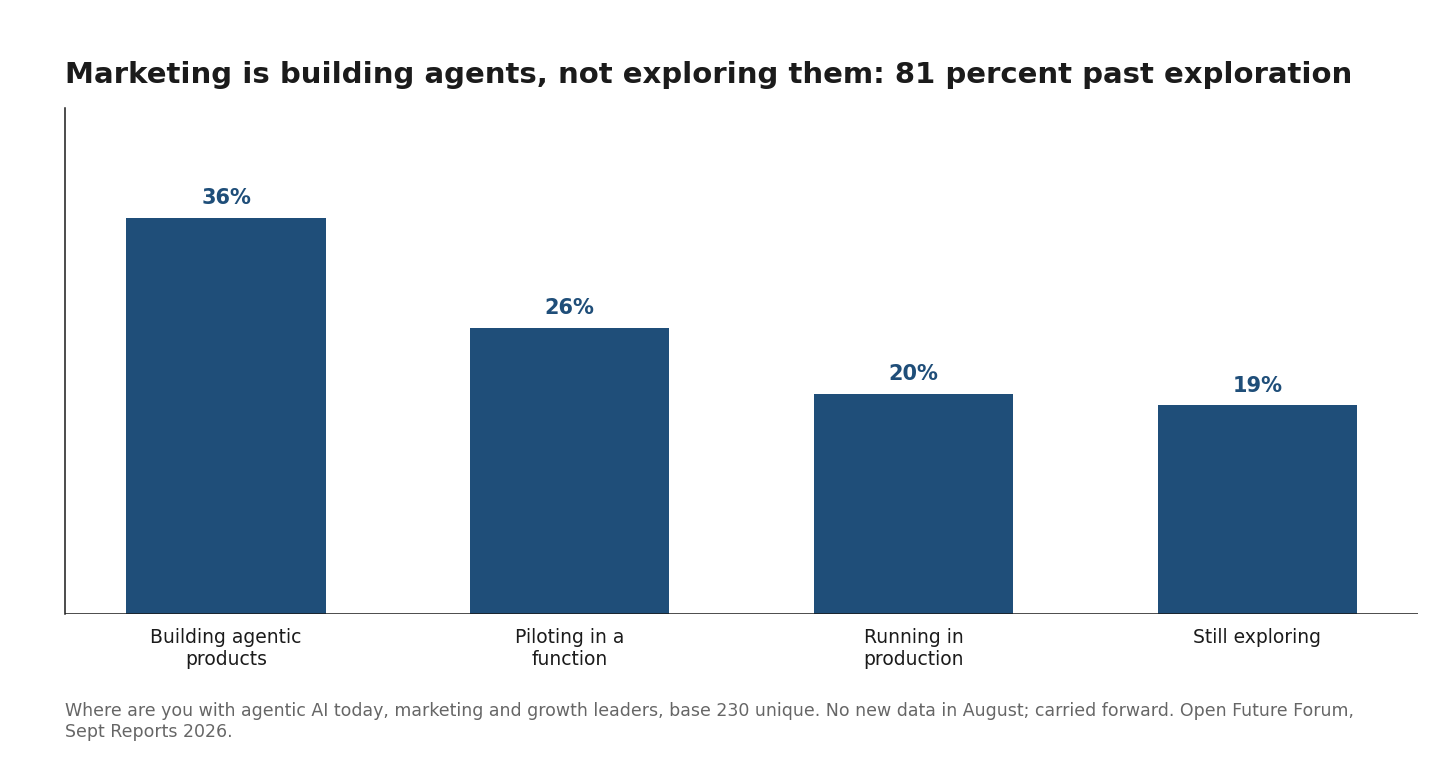
Mostly in motion, and unchanged since August because nothing new was measured. Combining the cohorts: 36 percent building agentic products, 26 percent piloting, 20 percent in production, 19 percent exploring. Read as four archetypes on the ladder: Builders 36 percent, Pilots 26, Operators 20, Explorers 19. Builders outnumber Operators nearly two to one. The marketing rooms in Silicon Valley are supply as much as demand: a third of the people in them are making the agents the other two thirds are deploying. The gap between piloting and production across the business, 26 against 20, is where the next quarter’s movement should show, and it is the number Edition 4 will track once the question is back on the form.
Where is AI making the biggest difference in marketing?
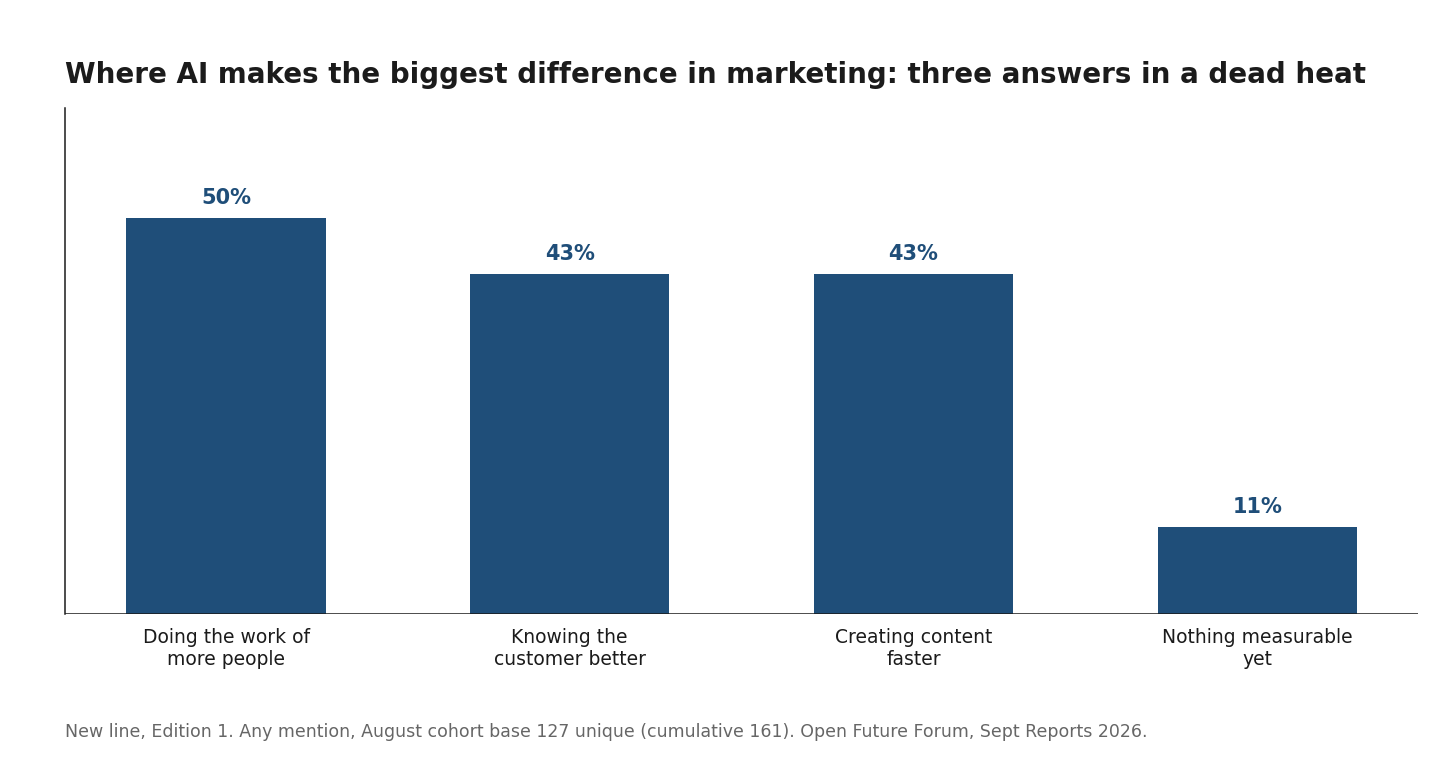
In three places at once, and the rooms cannot rank them. Doing the work of more people, 50 percent of the August cohort; knowing the customer better, 43; creating content faster, 43. Content was the first thing generative AI did for marketing and it has already lost the lead. Headcount leverage now sits first, which is the CFO report’s substitution finding arriving in the marketing function: the finance rooms say a fifth of AI money would have been headcount, and the marketing rooms say AI is doing the work of more people at half. Customer knowledge, the answer that sounds least like a productivity tool, ties with content. The three answers are three different operating models, staffing, insight, and output, and a team that has not chosen one is being asked to defend all three.
Agentic status and AI impact, seat by seat
The marketing and growth rooms are founders, marketers, and technologists in roughly that order, and the seat mix is a finding about who shows up to work on agentic go-to-market. Both instruments split by the respondent’s chair (job-title classification; bases under 40 directional):
| Where are you with agentic AI today? | CEO/Founder (79) | Technology (32) | Marketing (20) | Other (50) |
|---|---|---|---|---|
| Building agentic AI products | 49 percent | 34 percent | 30 percent | 24 percent |
| Piloting agents in a function or two | 20 percent | 31 percent | 20 percent | 32 percent |
| Running agents in production across the business | 22 percent | 19 percent | 30 percent | 12 percent |
| Still exploring, not deployed yet | 9 percent | 16 percent | 20 percent | 32 percent |
Source: Open Future Forum, CMO AI Leverage Report, September 2026.
| Where is AI making the biggest difference? | CEO/Founder (67) | Technology (23) | Marketing (30) | Other (38) |
|---|---|---|---|---|
| Doing the work of more people | 52 percent | 30 percent | 57 percent | 50 percent |
| Knowing the customer better | 42 percent | 52 percent | 33 percent | 47 percent |
| Creating content faster | 46 percent | 61 percent | 53 percent | 39 percent |
| Nothing measurable yet | 6 percent | 9 percent | 0 percent | 24 percent |
Source: Open Future Forum, CMO AI Leverage Report, Edition 3, September 2026.
Three reads, and the first two hold from Edition 2. The founders and CEOs in the marketing rooms are the supply side: 49 percent are building agentic products and only 9 percent are still exploring. The marketing seat itself splits evenly across the ladder, as likely to be running agents in production (30 percent) as building them (30), and it is the seat that names headcount leverage most, at 57 percent, with nobody in it reporting nothing measurable. New this edition: the technology seat in the marketing rooms sees AI’s value in content speed (61 percent) and customer knowledge (52) far more than in headcount (30), which is the reverse of the marketing seat’s own ranking. The people building the tools and the people buying them value different things, and the vendor pitch built on speed is landing in a function that is measuring itself on people. The fourth column is the caution: a quarter of respondents with unclassifiable titles see nothing measurable yet, four times the founder rate.
The founders and CEOs in the marketing rooms. The supply side: 49 percent building agentic products, 9 percent still exploring, and a value ranking that puts headcount leverage first at 52 percent. These are the people selling the agents the marketers are buying, and their answers about “where AI helps” describe their own companies. Six percent see nothing measurable.
The marketing seat, CMO and VP. Splits evenly across the ladder, 30 percent building and 30 percent running agents in production across the business, the highest production share of any chair. Names headcount leverage as where AI helps most at 57 percent, the highest of any chair, and content speed at 53; nobody in the seat reports nothing measurable. The marketing seat is the one that most says AI does the work of more people and the one whose open answers ask most about org design, which is the same fact twice.
The technology seat in the marketing rooms. A third building, a third piloting, 19 percent in production. Values AI for content speed (61 percent) and customer knowledge (52) far above headcount (30), the reverse of the marketing seat’s ranking. The builders value what the tools do; the buyers value who the tools replace. A vendor pitch built on speed is landing in a function measuring itself on people, and the technology seat is on the speed side of that line.
Other and unclassified titles. A third still exploring and a quarter seeing nothing measurable, four times the founder rate. The rooms’ least senior guests are the rooms’ least convinced, which is the pattern a function restructuring from the top looks like.
Across the four chairs. Production share is highest at the marketing seat, building share highest at the founder seat, and “nothing measurable” rises as the title falls. The value ranking flips between builders and buyers, and that flip is the report’s advice to both: buy against the metric you report, sell to the metric the buyer reports.
The same view, by vertical
New this edition: both marketing instruments cut by the respondent’s industry, classified from company name, email domain, and self-reported sector. 84 and 40 respondents cannot be placed and are shown as Unclassified; groups under 10 not shown; bases under 40 directional.
| Vertical | Agentic base | Building | Piloting | In production | Exploring | Impact base | Work of more people | Knowing the customer | Content faster | Nothing measurable |
|---|---|---|---|---|---|---|---|---|---|---|
| Technology and enterprise software | 65 | 49 percent | 14 | 28 | 9 | 54 | 44 | 50 | 44 | 11 |
| Big Tech and platforms | 27, directional | 15 percent | 30 | 22 | 33 | 12, directional | 25 | 50 | 67 | 8 |
| Other | 31, directional | 45 percent | 23 | 16 | 16 | 32, directional | 50 | 38 | 47 | 6 |
Source: Open Future Forum, CMO AI Leverage Report, Edition 3, September 2026.
Technology and enterprise software. The furthest along: 48 percent building, 27 percent in production, 10 percent exploring, and a three-way tie on value. The software company’s marketing team is inside the agent economy on both sides.
Big Tech and platforms. The reverse profile: a third still exploring, 15 percent building, and content speed leading at 67 percent (base 12, directional). Individual teams inside large organizations are using AI for output before the function has restructured, which is the same pattern the CFO report finds in the same vertical’s purchasing.
| Vertical sold into (seller-reported) | Base | CFO or finance owns | CIO or CTO owns | Business-unit leader owns | Usage-based pricing | Outcome-based pricing |
|---|---|---|---|---|---|---|
| Financial services and fintech | 23, directional | 52 percent | 17 | 26 | 70 | 13 |
| Technology and enterprise software | 38, directional | 29 percent | 55 | 45 | 32 | 47 |
| Healthcare and life sciences | 15, directional | 13 percent | 33 | 40 | 27 | 27 |
| Consumer and retail | 9, directional | 33 percent | 22 | 33 | 56 | 11 |
Source: Open Future Forum, YC Founder AI Report, September 2026 refresh; any-mention; sellers name the seat they sell to, which is the doorway, not the signature.
From the seller side, where the founder instrument tags the vertical sold into: consumer and retail buyers are offered usage pricing at 56 percent, fintech buyers at 70, enterprise software buyers outcome pricing at 47, and healthcare buyers a market where only 13 percent of sellers name finance as the buyer (all directional). For the CMO in each vertical, that is what the agentic toolset arrives priced like.
What marketing and growth leaders want, and what they are working on
Three open questions, 330 answers, coded by theme; one answer can carry two themes.
The one thing you want to walk out with (123 answers): agents lead at 47 mentions, then playbooks and practical how-to at 10, org design and team structure at 10, peers and benchmarks at 8, tools and vendors at 7, measurement at 6. The specific asks are operational: how other people are using agents in go-to-market; checks and balances for agents; a list of agents that could help with demand; where AI creates leverage and where it fails; real-world failure modes. The rooms want the working playbook and the honest post-mortem in the same session.
What you are working on that AI touches (111 answers): agents 36, product building 18, sales and go-to-market 12, content 9, data and analytics 8, customer and personalization 6. The same person frequently appears in two columns, working on agents for GTM. That intersection, agentic go-to-market, remains the theme of the season.
What marketing challenges you want answered (96 answers): attribution and measurement 20, agents 10, AI search and discovery 5, budget 4, org and team 4. The asks name the problem precisely: metrics for AI search optimization; automating channel management end to end; go-to-market org design; how to position against incumbents; deep personalization at scale. Attribution is first because the funnel has moved: when a buyer asks an assistant before reaching the site, the measurement starts somewhere the CMO cannot see, and five of the rooms’ answers say so in as many words.
Tested against the record
| External claim | Open Future Forum figure | Verdict |
|---|---|---|
| Gartner 2026 CMO Spend Survey: CMOs allocate 15.3 percent of budget to AI; only 30 percent are ready to scale; labor share rose from 21.9 to 24.5 percent | 81 percent past exploration; 50 percent say AI does the work of more people | Complicated: the rooms are deploying ahead of Gartner’s readiness figure, and “doing the work of more people” sits oddly beside a rising labor share, which suggests the people cost more even as there are fewer of them |
| Duke CMO Survey: AI’s share of marketing activity more than doubled in two years | 20 percent running agents in production across the business | Corroborated in direction |
| MIT NANDA: more than half of GenAI budgets went to sales and marketing with weak returns | 11 percent see nothing measurable | Contradicted on the self-report; the rooms see impact, and this program does not measure P&L |
| OpenAI State of Enterprise AI: 85 percent of marketing and product users report faster campaign execution | Content faster 43 percent, customer knowledge 43, headcount leverage 50 | Complicated: speed is real but it is not the thing the rooms rank first |
| Microsoft Work Trend Index 2026: marketing content dominates work-related AI use | Content speed fell from first to joint second between July and August | Complicated: content was the first use; it is no longer the main value |
Source: Open Future Forum, CMO AI Leverage Report, September 2026.
External figures are context only; the sources are not affiliated and do not endorse this report.
What this means for the CMO
The three-way tie is the finding, and it is a decision the CMO has to make rather than a fact to report. A team that cannot say whether AI is worth more as headcount leverage, as customer knowledge, or as content speed cannot defend its budget when finance asks, and finance is asking: proving ROI is the blocker for 65 percent of the August finance room. The teams handling it well in the rooms have picked one of the three as the line they report to the CFO and measure the other two as secondary, and the pick shapes the org chart: a headcount-leverage team looks different from a customer-intelligence team. Second, the seat cut says the vendors are selling speed to a function that is measuring itself on people; the CMO should buy against the metric, not the demo. Third, attribution is a rebuild, not a repair. The rooms that named AI search as the reason measurement is harder are describing a funnel whose top now sits inside an assistant, and the Marketing Measurement panel exists because nobody in the room has finished that rebuild.
What marketing leaders want to learn next
Applicants to the May CMO Mixer were asked which sessions they want (base 19, any-mention, directional): AI for content marketing at 63 percent, then sailing and golf. The Agentic GTM panel’s open answers rank agents, playbooks, and org design ahead of tools. Put together: the content session is still the entry point and the agent session is where the room wants to end up, which is the same arc the impact line shows, from content speed in July to headcount leverage in August.
Practitioner Commentary
Board members of the CMO Executive Forum, commenting on the findings after the data was locked.
“A third of the people in the marketing rooms are building agents, not just buying them. That changes what a marketing org chart looks like. The question leaders asked most was not which tool, it was what the team looks like when the work changes shape.” Brandon Nader, ThinkingAI
“Attribution is still the challenge marketing leaders name first, and AI search is the reason it is getting harder. When a buyer asks an assistant before they reach your site, the funnel starts somewhere you cannot see. Measurement has to move upstream to where the answer is given.” Fangfang Tan, AgentWeb
For the CFO, talent leaders, and vendors
Three audiences outside marketing can read this report profitably. CFOs get the counterpart to their own ROI question: the marketing seat sees value in three places and has not ranked them, and the ranking is what a budget defense needs. Talent leaders get the headcount signal from the function most likely to say it out loud: 57 percent of the marketing seat says AI is already doing the work of more people, and the org-design questions in the open answers say the org chart has not caught up. Vendors in the CMO AI Market Map get the demand order and a warning: agents first, playbooks second, org design third, measurement fourth in what the rooms ask for, and a buyer that values headcount leverage over the content speed most products are pitched on.
Where can CMOs discuss this with peers?
The CMO Executive Forum is Open Future Forum’s invitation-only peer group for CMOs and senior marketing leaders, chaired by Murray Newlands, with Janice Zhang of Google Cloud, Brandon Nader of ThinkingAI, and Fangfang Tan of AgentWeb on the board. Members meet in small, off-the-record gatherings to compare notes on the questions this report measures: agentic go-to-market, where AI creates measurable value, attribution in the AI era, and how marketing organizations restructure around agents. The rooms mix seniority with practice: 64 percent of titled approved guests at the marketing events hold a senior title, 45 percent are C-level, founders, or partners, and most of the remainder are the operating marketers running the pilots the executives are deciding about. The marketing panels are Forum Events, open by design, and approved 48 percent of applicants this period, 248 of 519; the CMO Dinner Series is the Forum Select tier. Membership is by application and referral.
Explore the CMO Executive Forum · Inquire about membership
Upcoming marketing events
CMO Executive Forum panel and mixer
Silicon Valley · next date to be announced
A panel and peer session for CMOs, VPs of Marketing, heads of growth and demand generation, and marketing operations leaders, with the agentic-status question restored to the registration form alongside the impact line and a new question on AI’s share of the marketing budget, so Edition 4 can compare directly to Gartner’s 15.3 percent.
Edition 4 data collection runs through the autumn marketing and growth events. The three questions the next rooms will debate: which of the three values the CMO reports to the CFO, what an agentic marketing org chart looks like, and what replaces clickstream attribution when the funnel starts inside an assistant.
Related reading
- Executive AI Leverage Report
- YC Founder AI Report
- CMO AI Market Map
- AI Transformation Report
- Executive AI Statistics
- Definitions: Self-Attribution Effect, Ownership Vacuum, Optimism Gap, Security Funding Gap, Seat Split
- AI Reports for Dealmakers, September 2026
Answers from this report. How far along are marketing teams with AI agents?
Definitions
Agentic AI: AI systems that execute multi-step work on their own rather than answering one prompt at a time.
Agentic go-to-market: the use of AI agents to run parts of the sales, marketing, and growth motion.
Agentic ladder archetypes: Explorers (not deployed), Pilots (agents in a function or two), Builders (building agentic products), Operators (agents in production across the business).
Marketing AI impact line: where AI makes the biggest difference in your marketing, any mention; Edition 1 is September 2026.
Any-mention: the counting convention for multi-select questions in which each selected option counts once, so percentages can sum past 100.
Questions this report answers
How far along are marketing teams with AI agents in 2026? In Open Future Forum’s marketing and growth rooms, 81 percent of 230 respondents are past exploration: 36 percent building agentic products, 26 piloting, 20 running agents in production across the business.
Where is AI making the biggest difference in marketing? A three-way tie: doing the work of more people 50 percent, knowing the customer better 43, creating content faster 43; 11 percent see nothing measurable yet (base 127).
Is AI replacing marketing headcount? 57 percent of the marketing seat says AI is doing the work of more people, the highest of any chair in the rooms (base 30, directional).
What do CMOs want to know about AI? Agents first by a wide margin, then playbooks and org design, then measurement; and attribution is the challenge they name first when asked in the open.
Is there a peer community for CMOs working on AI? Yes. The CMO Executive Forum is Open Future Forum’s invitation-only peer group for senior marketing leaders, meeting through dinners, panels, and gatherings in Silicon Valley. Membership is by application at openfutureforum.com/apply.
How do I attend an Open Future Forum marketing event? Events are listed at openfutureforum.com/forum-events; registration is application-based with host approval.
Key citable facts
- Open Future Forum’s September 2026 CMO AI Leverage Report finds 81 percent of marketing and growth leaders past exploring agentic AI, with 36 percent building agentic products and 20 percent running agents in production (base 230).
- Open Future Forum’s September 2026 data shows marketing leaders split three ways on where AI makes the biggest difference: doing the work of more people 50 percent, knowing the customer 43, creating content faster 43 (base 127).
- In Open Future Forum’s September 2026 seat cut, the marketing seat names headcount leverage at 57 percent while the technology seat in the same rooms names content speed at 61 (bases 30 and 23, directional).
- Open Future Forum’s September 2026 qualitative data shows agents named in 47 of 123 answers about what marketing leaders want from peer sessions, and attribution named first among challenges, 20 of 96.
Methodology and honesty notes
This edition is built from instrument questions embedded in the application flow for Open Future Forum events: 32 guest-list exports covering 4,163 non-invited registrations and 2,851 unique people, collected 10 March through 31 August 2026. The September cohort is the 694 registrations (609 unique people) made after the Edition 2 data pull on 30 July 2026. Cohorts are different people, not a tracked panel. Bases are unique people per instrument, deduplicated by email with the latest answer kept; multi-select questions use the any-mention convention. Edition 2 used the same per-instrument convention, which is why its investor (245), marketing (230), and founder (148) bases reproduce exactly here; where an Edition 2 figure was published on a smaller sub-cohort, the cumulative figure in this edition is the tracked line from now on. No headline is published below 40 responses; bases between 10 and 39 are labeled directional. Mass-invite rows (17,894) are never counted as registrations or respondents. Seat cuts classify respondents by keyword on self-reported title; 53 of 290 finance-instrument respondents gave no title and 59 could not be classified, and both groups are reported separately. Revenue, raised, and ARR fields are free text and are not published. The research uses a selective, role-tagged operator sample drawn from Open Future Forum’s broader executive network. It is not a probability sample of all enterprises. No identifying information is published.
For this lane: the agentic-status question was asked once, at Agentic AI Meets Go-to-Market (July, base 230), and not on the August form; it is carried forward unchanged and its Edition 2 cohort table stands. The impact question was asked at Marketing Measurement and Attribution; the July sub-cohort of 34 is directional and the August cohort of 127 is the baseline. Qualitative themes are counted by keyword mention across 123, 111, and 96 open answers; one answer can carry two themes; illustrative asks are paraphrased and never attributed. The CMO screening question has a base of 20 and the CMO Mixer interest question a base of 19, both directional. Vertical classification places 146 of 230 agentic respondents and 121 of 161 impact respondents. This report measures responses, not spend, campaign performance, or vendor performance.
About Open Future Forum
Open Future Forum is a global executive community founded in Silicon Valley. Its network reaches tens of thousands of executives and investors worldwide. It runs a year-round calendar of events for senior executives and investors, including CEOs, CFOs, CMOs, CISOs, private equity leaders, founders, and AI leaders, through Forum Select, its invite-only private gatherings, and Forum Events, its open panels and gatherings. Beyond events, Open Future Forum convenes peer groups and executive boards and publishes original research built on first-party survey and qualitative data from its executive network.
Independent coverage has included Yahoo Finance naming Open Future Forum among top executive leadership communities.
About Murray Newlands
Murray Newlands is the founder of Open Future Forum and the host of its executive dinner series and research program. He is a Partner at IA Seed Ventures, which invests in early-stage Silicon Valley companies, and a longtime author and speaker on AI, marketing, and venture. He writes on AI, venture, and enterprise strategy at murraynewlands.substack.com. More at openfutureforum.com/about and murraynewlands.com.
Citation and editions
Suggested citation: Newlands, M. (2026). CMO AI Leverage Report, Edition 3. Open Future Forum, September 2026. openfutureforum.com/research/cmo-ai-leverage-report-september-2026
This edition supersedes Edition 2 (August 2026). Companion reading: CMO AI Market Map, Executive AI Leverage Report. Edition 4 publishes in October 2026. Dataset DOI: 10.5281/zenodo.21576019.
Work These Questions with Marketing Peers
The CMO Executive Forum meets through small, off-the-record gatherings. Membership is by application and referral.