The September answer
Founders are moving their price toward the customer’s outcome and their sales motion has not moved with it. The Pricing Index says usage leads, outcome and flat tie, per seat is last. The batch cut says the move is generational: the older the company, the more it charges for access or consumption; the newer, the more it charges for results. And the buying-doorway data says founders still enter through the business unit and the CTO in equal measure while the operators they sell to say the CEO signs and the CFO increasingly co-signs. A founder pricing on outcomes is making a promise to the seat that measures outcomes, which is finance, through a door that finance rarely opens. Closing that distance is the founder’s version of the Optimism Gap.
What changed since Edition 2
Nothing in the pricing or buyer lines, because the August form did not ask. What changed is the base convention, the cuts, and the cohort: 195 founders and guests registered for the Summer Mixer and answered batch and sector, which deepens the vertical and batch reads without moving the Index.
| Question | Answer | Early July (100) | Late July (48) | Change | Cumulative (148) |
|---|---|---|---|---|---|
| How do you charge today? | Usage-based | 42 percent | 44 percent | +2 | 43 percent |
| Outcome-based | 21 percent | 29 percent | +8 | 24 percent | |
| Flat subscription | 26 percent | 21 percent | -5 | 24 percent | |
| Per seat | 20 percent | 19 percent | -1 | 20 percent | |
| Who owns the buying decision inside your customer? | Business-unit leader | 40 percent | 38 percent | -2 | 39 percent |
| CIO or CTO | 41 percent | 25 percent | -16 | 36 percent | |
| CFO or finance | 21 percent | 42 percent | +21 | 28 percent |
Source: Open Future Forum, YC Founder AI Report, September 2026 refresh.
Any-mention convention. How to read: the July cohorts are different founders at two gatherings a month apart, not a panel; the late cohort is under 40 and directional. The cumulative column is the tracked line from this edition. Edition 2 published outcome pricing at 29 percent, the late-cohort figure; on the full base it is 24, and 24 is the number the series carries forward.
What stayed the same: usage as the leading model, the business unit as the most-named doorway, per seat as the least common way to charge.
What surprised us: the CFO’s share of the doorway doubled inside July and the CIO or CTO’s fell by sixteen points, on a directional base. If the October form reproduces it, the founders’ view of the buyer will have caught up with the operators’ view of the signer inside a quarter.
Where this research comes from
The YC Founder AI Report is built from instrument questions embedded in the application flow for Open Future Forum’s founder gatherings: YC Founders on the Bay (June), YC Founders Wine and Cocktails (July), and the YC Founders Summer Mixer (August), convened with Silicon Valley Bank and Foley & Lardner as partners. The pricing and buyer questions were asked in July; batch and sector at all three. These are Open Future Forum events for founders from Y Combinator batches and their guests; the research is independent and not affiliated with or endorsed by Y Combinator. Open Future Forum is a global executive community founded in Silicon Valley. Its network reaches tens of thousands of executives and investors worldwide. It runs a year-round calendar of events for senior executives and investors through Forum Select, its invite-only private gatherings, and Forum Events, its open panels and gatherings, and publishes original research built on first-party survey and qualitative data from its executive network.
How do AI startups price in 2026?
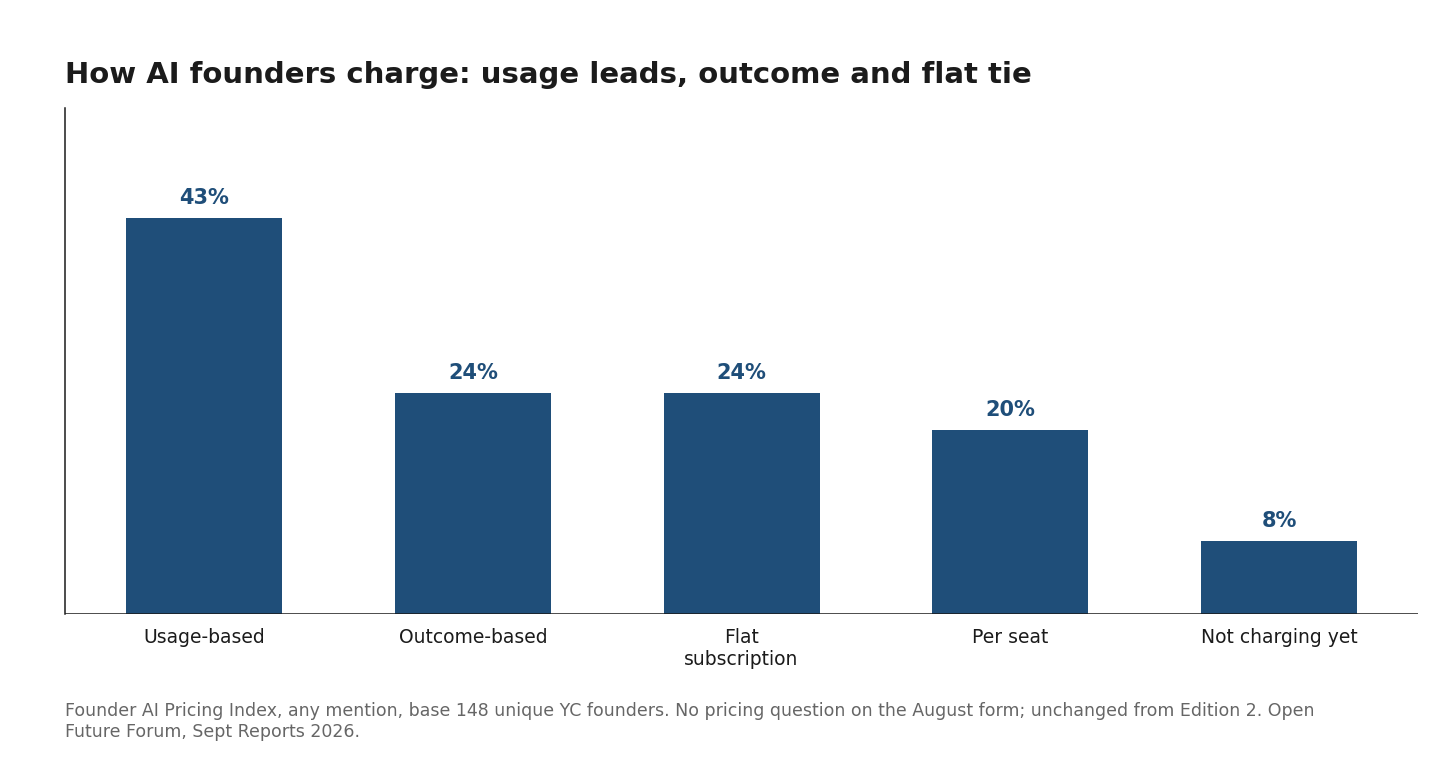
By usage first. Forty-three percent of 148 founders mention usage-based pricing, and it leads in every cut except one. Outcome-based and flat subscription tie at 24 percent each, per seat trails at 20, and 8 percent are not charging yet. The Founder AI Pricing Index tracks the usage figure as its flagship because usage is the model that makes the bill auditable: a seat tells the buyer who has access, usage tells them what was consumed, outcome tells them what they received. The market is moving from the first toward the third, and the founders in these rooms are a quarter of the way there.
Pricing by batch: the generational read
New this edition: the pricing question cut by the founder’s YC batch, grouped into three generations (bases under 40 directional; 44 founders did not state a batch and are shown separately).
| How do you charge today? | W24 and earlier (50) | 2025 batches (23) | 2026 batches (31) | Batch not stated (44) |
|---|---|---|---|---|
| Usage-based | 52 percent | 30 percent | 48 percent | 34 percent |
| Outcome-based | 14 percent | 35 percent | 29 percent | 25 percent |
| Flat subscription | 32 percent | 26 percent | 19 percent | 18 percent |
| Per seat | 8 percent | 26 percent | 23 percent | 27 percent |
| Not charging yet | 12 percent | 4 percent | 0 percent | 11 percent |
Source: Open Future Forum, YC Founder AI Report, September 2026 refresh.
The oldest cohort charges for consumption or access: 52 percent usage, 32 percent flat, 8 percent per seat, 14 percent outcome. The 2025 and 2026 batches charge for results: outcome at 35 and 29 percent, more than double the older group. Two readings. First, companies founded into the agent era priced for agents from the start, where the unit of value is the task completed, not the login. Second, older companies carry the pricing they launched with, and repricing an installed base toward outcomes is harder than launching that way. Note the per-seat line: nearly absent in the old cohort and a quarter of the new. That is not a contradiction. The newest companies are the ones most likely to be selling a copilot to individual users, and per seat is how a copilot is sold until it becomes an agent.
Who owns the buying decision inside the customer?
Three seats, nearly equally: the business-unit leader at 39 percent, the CIO or CTO at 36, the CFO or finance at 28, individual users at 11, and 4 percent still figuring it out. There is no CEO option on the founder instrument, which is deliberate: founders describe the seat they sell to, and the CEO is rarely that seat. What the operators say is that the CEO signs at 47 percent and the CFO at 34, rising to 43 in August. The founder’s doorway and the operator’s signature are different seats. This report names the distance the Seat Split.
| Who owns the buying decision? | W24 and earlier (50) | 2025 batches (23) | 2026 batches (31) | Batch not stated (44) |
|---|---|---|---|---|
| Business-unit leader | 32 percent | 35 percent | 35 percent | 52 percent |
| CIO or CTO | 34 percent | 43 percent | 48 percent | 25 percent |
| CFO or finance | 32 percent | 17 percent | 29 percent | 27 percent |
| Individual users | 6 percent | 17 percent | 13 percent | 11 percent |
Source: Open Future Forum, YC Founder AI Report, September 2026 refresh.
The older cohort sells three ways evenly; the 2026 batches sell to the CTO first at 48 percent. New companies enter through the technical evaluator because that is who can evaluate a new thing; older companies have found their way to the budget holder. The newest founders are furthest from the signature.
Pricing and the customer seat, together
New this edition: the pricing model cut by the seat the founder sells to (bases 41 to 58, all directional).
| How do you charge? | Sells to the CFO (41) | Sells to the CIO or CTO (53) | Sells to the business unit (58) |
|---|---|---|---|
| Usage-based | 46 percent | 43 percent | 47 percent |
| Outcome-based | 27 percent | 38 percent | 29 percent |
| Flat subscription | 29 percent | 21 percent | 26 percent |
| Per seat | 22 percent | 25 percent | 19 percent |
Source: Open Future Forum, YC Founder AI Report, September 2026 refresh.
The founders who price on outcomes most sell to the CTO, at 38 percent, not to the CFO, at 27. That is the Seat Split in a single row. Outcome pricing is a promise about measured value, and in the buyer’s company finance measures value, and the founders making that promise are making it to the chair that evaluates the technology. When the CFO co-signs, as the finance rooms say is happening, the outcome definition in the contract will be read by a seat that was not in the room when it was written.
Pricing by customer relationship: the SVB cut
Founders who bank with Silicon Valley Bank (base 26, directional) price by usage at 50 percent and by outcome at 12; founders who do not (base 122) price by usage at 41 and outcome at 26. The banked cohort skews to established, revenue-generating companies, which is consistent with the batch finding: the further along the company, the more it charges for consumption and the less for results.
The same view, by vertical
The founder instrument tags the vertical sold into. Bases: enterprise software 38, fintech and financial services 23, healthcare and life sciences 15, consumer and retail 9; all directional.
| Vertical sold into | Base | CFO or finance owns | CIO or CTO owns | Business-unit leader owns | Usage-based | Outcome-based |
|---|---|---|---|---|---|---|
| Financial services and fintech | 23 | 52 percent | 17 | 26 | 70 | 13 |
| Technology and enterprise software | 38 | 29 percent | 55 | 45 | 32 | 47 |
| Healthcare and life sciences | 15 | 13 percent | 33 | 40 | 27 | 27 |
| Consumer and retail | 9 | 33 percent | 22 | 33 | 56 | 11 |
Source: Open Future Forum, YC Founder AI Report, September 2026 refresh.
Fintech and financial services. The most settled market: the CFO is the named buyer in a majority of accounts and usage pricing dominates at 70 percent. The vertical closest to the money has migrated its purchase furthest toward finance, and it buys by the unit consumed, which is how finance likes to be billed. Outcome pricing is rare here at 13 percent, because a finance buyer wants a predictable line, not a shared upside.
Technology and enterprise software. The outcome-pricing lab: 47 percent of founders selling here price on results, the highest in the data, and they sell to the CTO at 55 and the business unit at 45. The contested vertical in the operator data is the experimental vertical in the seller data, and the two are the same fact from opposite sides.
Healthcare and life sciences. The earliest market: finance is nearly absent from the buying decision at 13 percent, the business unit leads at 40, and pricing splits evenly. Validation cycles run ahead of budget cycles, and the CFO here is the last to see the contract.
Consumer and retail. No owner yet on a small base, and usage pricing at 56 percent: the founder charges for consumption because nobody inside the customer has agreed what an outcome would be.
What founders are working on, and what surrounds them
The founder instrument carries no open question, so the qualitative layer comes from the rooms around it. In the marketing and growth rooms, where 79 founders answered the agentic-status question, 49 percent are building agentic products and 9 percent are still exploring; in the security rooms, the founders are largely building the tools the CISOs are evaluating, and they name agent access as the top problem at 59 percent. The founder in these rooms is the supply side of every other report in the Index. Sector across the three gatherings (base 171 unique): enterprise 127, fintech 59, healthcare and life sciences 51, consumer 35. Batches: S26 31, W24 27, W26 23, S24 20, P26 19, S23 17, S25 12.
What this means for the founder
Price for the seat that signs, not the one that evaluates. Outcome pricing is being adopted fastest by founders selling to the CTO, and the outcome definition will be read by the CFO; write it for the CFO. Second, the doorway is not the signature. The operators say the CEO signs at 47 percent and the CFO’s share rose to 43 in August; a sales motion that ends at the business-unit leader ends at a pilot. Third, if you are a 2026-batch company selling to the CTO on outcomes, you are in the most common position in the data and the furthest from the money; the fintech playbook, usage pricing to the finance buyer, is what settled looks like. Fourth, the customer’s Optimism Gap is your renewal risk: the CEO who bought expects payback in six months and the CFO who renews expects it in six to twelve.
For buyers, investors, and procurement
Buyers get the sellers’ hand: usage and outcome pricing are what founders prefer, at 43 and 24 percent and rising with each batch, so payback-linked terms are available to any buyer who asks, and a seat-license default leaves that leverage on the table. Investors get a diligence frame for AI companies: pricing model by batch age is a proxy for how modern the product is, and the customer seat is a proxy for how far the company is from the signature; the Investor AI Report finds portfolio owners naming the CEO at 51 percent, which is not a seat any founder in this data sells to. Procurement and counsel get the contract question: outcome pricing moves the definition of success into the agreement and usage pricing moves the bill into the hands of whoever configured the agent; the general counsel edition of the Sept Reports reads both.
Tested against the record
| External claim | Open Future Forum figure | Verdict |
|---|---|---|
| ICONIQ, July 2026: outcome-based pricing rising for a second wave; vertical AI 43 percent of products; 52 percent gross margins | Outcome 24 percent overall, 47 in enterprise software, 35 and 29 in the 2025 and 2026 batches | Corroborated in direction; the newest companies carry it |
| Menlo Ventures, 2025: 76 percent of enterprise AI solutions are purchased rather than built; product-led motions convert faster | The business unit is the most-named doorway at 39 percent | Corroborated: bought, and bought first by the team that uses it |
| a16z: enterprise AI procurement now mirrors traditional software buying | Founders sell to the CTO at 36 percent; operators say the CEO signs at 47 and the CFO at 34 | Complicated: the procurement is traditional, the seller’s aim is not |
| Ramp AI Index: VC-backed firms adopt AI fastest, Anthropic 66 percent vs OpenAI 59 among them | The founder rooms are that population: 40 of 100 CEO-dinner applicants are VC-funded | Corroborated on who the rooms are |
| Bessemer, State of AI: supernova companies price on value and expand inside accounts | Outcome pricing highest among founders selling to the CTO, 38 percent | Complicated: the value price is being set with the wrong seat |
Source: Open Future Forum, YC Founder AI Report, September 2026.
External figures are context only; the sources are not affiliated and do not endorse this report.
Where can founders discuss this with peers?
Open Future Forum’s YC founder gatherings bring founders from current and recent batches together with the operators, investors, and partners who buy from, fund, and bank them, through mixers and outings in Silicon Valley convened with Silicon Valley Bank and Foley & Lardner. The rooms run founder-heavy: 88 percent of titled approved guests are founders, C-level, or partners, and the founder gatherings approved 52 percent of 588 applicants this period. Founders selling into finance, security, or marketing are also welcomed into the role forums as speakers and sponsors, where the buyers this report describes meet. Not affiliated with Y Combinator.
Explore the YC founder gatherings · Inquire about membership
Upcoming founder events
YC founder gathering
Silicon Valley · next date to be announced
The next gathering carries the pricing and buyer-owner questions plus the six-question common core, a gross margin band, model-provider count, and ARR band, so Edition 3 can compare margins to ICONIQ’s 52 percent and price to the customer’s actual signer.
Edition 3 publishes on the first founder form that clears 40 pricing responses. The three questions the next rooms will debate: whether outcome pricing survives contact with the CFO, how a company founded on per-seat copilots reprices for agents, and which seat a founder should sell to first when the CEO signs and the CFO co-signs.
Related reading
- Investor AI Report
- CFO AI Leverage Report
- CMO AI Leverage Report
- Executive AI Leverage Report
- Executive AI Statistics
- Definitions: Self-Attribution Effect, Ownership Vacuum, Optimism Gap, Security Funding Gap, Seat Split
- AI Reports for Dealmakers, September 2026
Answers from this report. How do AI startups price? · How do AI companies price, and what does it mean for revenue quality? · What AI gross margins do buyers expect?
Definitions
Founder AI Pricing Index: the share of AI founders charging on usage, tracked every edition as the flagship metric; 43 percent in September 2026 (base 148).
The Seat Split: the distance between the doorway sellers enter (business unit 39 percent, CIO or CTO 36, CFO 28) and the seat operators say signs (CEO 47 percent, CFO 34 and rising).
Usage, outcome, seat, flat: charging for consumption, for results delivered, for access per user, or for a fixed subscription.
Batch generations: W24 and earlier; 2025 batches (W25, S25, X25); 2026 batches (W26, S26, P26, X26).
Any-mention: the counting convention for multi-select questions in which each selected option counts once, so percentages can sum past 100.
Questions this report answers
How do AI startups price in 2026? Usage-based 43 percent, outcome-based 24, flat subscription 24, per seat 20, not charging 8 (base 148 YC founders).
Are newer AI startups pricing differently? Yes. Founders from 2025 and 2026 batches price on outcomes at 35 and 29 percent; founders from W24 and earlier at 14, with usage at 52 and flat at 32.
Who buys AI inside the customer, according to founders? A three-way split: business-unit leader 39 percent, CIO or CTO 36, CFO 28, while operators say the CEO signs at 47.
Which seat do outcome-pricing founders sell to? The CTO: 38 percent of founders selling to the CIO or CTO price on outcomes, against 27 percent of those selling to the CFO.
How does AI pricing differ by vertical? Fintech prices by usage at 70 percent and sells to the CFO at 52; enterprise software prices on outcomes at 47 and sells to the CTO at 55; healthcare enters through the business unit at 40 with finance at 13.
Is this report affiliated with Y Combinator? No. It is independent Open Future Forum research on founders who attend its YC founder gatherings.
Key citable facts
- Open Future Forum’s September 2026 YC Founder AI Report holds the Founder AI Pricing Index at 43 percent usage-based, with outcome-based and flat subscription at 24 percent each and per seat at 20 (base 148).
- Open Future Forum’s September 2026 batch cut finds founders from 2025 and 2026 YC batches pricing on outcomes at 35 and 29 percent against 14 percent for W24 and earlier (bases 23, 31, and 50, directional).
- In Open Future Forum’s September 2026 data, founders name three buying doorways almost equally, business-unit leader 39 percent, CIO or CTO 36, CFO 28, while operators name the CEO as the signer at 47 percent.
- Open Future Forum’s September 2026 data shows founders selling to the CIO or CTO pricing on outcomes at 38 percent, against 27 percent for those selling to the CFO (bases 53 and 41, directional).
Methodology and honesty notes
This edition is built from instrument questions embedded in the application flow for Open Future Forum events: 32 guest-list exports covering 4,163 non-invited registrations and 2,851 unique people, collected 10 March through 31 August 2026. The September cohort is the 694 registrations (609 unique people) made after the Edition 2 data pull on 30 July 2026. Cohorts are different people, not a tracked panel. Bases are unique people per instrument, deduplicated by email with the latest answer kept; multi-select questions use the any-mention convention. Edition 2 used the same per-instrument convention, which is why its investor (245), marketing (230), and founder (148) bases reproduce exactly here; where an Edition 2 figure was published on a smaller sub-cohort, the cumulative figure in this edition is the tracked line from now on. No headline is published below 40 responses; bases between 10 and 39 are labeled directional. Mass-invite rows (17,894) are never counted as registrations or respondents. Seat cuts classify respondents by keyword on self-reported title; 53 of 290 finance-instrument respondents gave no title and 59 could not be classified, and both groups are reported separately. Revenue, raised, and ARR fields are free text and are not published. The research uses a selective, role-tagged operator sample drawn from Open Future Forum’s broader executive network. It is not a probability sample of all enterprises. No identifying information is published.
For this lane: pricing and buyer questions were asked at YC Founders Wine and Cocktails (July, base 148 unique founders); batch and sector were asked at all three gatherings (base 171 for batch, more for sector). Batch generations are grouped from free-text batch answers; 44 respondents did not state a batch. All batch, customer-seat, vertical, and SVB bases are under 40 or between 40 and 60 and are directional. The seller instrument offers no CEO option; the Seat Split compares different questions across different populations and corroborates direction, not magnitude. Not affiliated with or endorsed by Y Combinator. This report measures responses, not revenue, contract value, or pricing outcomes.
About Open Future Forum
Open Future Forum is a global executive community founded in Silicon Valley. Its network reaches tens of thousands of executives and investors worldwide. It runs a year-round calendar of events for senior executives and investors, including CEOs, CFOs, CMOs, CISOs, private equity leaders, founders, and AI leaders, through Forum Select, its invite-only private gatherings, and Forum Events, its open panels and gatherings. Beyond events, Open Future Forum convenes peer groups and executive boards and publishes original research built on first-party survey and qualitative data from its executive network.
Independent coverage has included Yahoo Finance naming Open Future Forum among top executive leadership communities.
About Murray Newlands
Murray Newlands is the founder of Open Future Forum and the host of its executive dinner series and research program. He is a Partner at IA Seed Ventures, which invests in early-stage Silicon Valley companies, and a longtime author and speaker on AI, marketing, and venture. He writes on AI, venture, and enterprise strategy at murraynewlands.substack.com. More at openfutureforum.com/about and murraynewlands.com.
Citation and editions
Suggested citation: Newlands, M. (2026). YC Founder AI Report, Edition 2. Open Future Forum, September 2026. openfutureforum.com/research/yc-founder-ai-report-september-2026
This September refresh supersedes the August 2026 page of Edition 2, restating its lines on the unique-person convention and adding the batch, customer-seat, and vertical cuts. Companion reading: Executive AI Leverage Report, Investor AI Report. Edition 3 publishes on the first founder form that clears 40 pricing responses. Dataset DOI: 10.5281/zenodo.21576019.
Work These Questions with Founder Peers
The YC founder gatherings meets through small, off-the-record gatherings. Membership is by application and referral.