The September answer
The CEO seat is the most certain seat in the building. It claims the signature at 70 percent, it expects the money back inside six months at 70 percent, and it is willing to trade headcount for AI at a third. Every seat that reports to it is less certain on every line, and the further from the CEO’s chair a respondent sits, the less certain they are. The CEO’s position is confirmed from three sides: operators, investors, and the CEO seat itself. What this report exists to track is the distance between the CEO’s confidence and everyone else’s, because that distance is where the accountability structure has to be built, and in August the finance seat started building it.
What changed since Edition 2
Edition 2 read the CEO seat on a base of 43 and found 84 percent naming the CEO, zero reporting an unowned decision, and 72 percent expecting fast payback. Edition 3 pools every CEO-and-founder respondent on the finance instrument, 80 people across four events.
| Question | Answer | Edition 2 (43) | Edition 3 (80) | Change |
|---|---|---|---|---|
| Who signs off | CEO | 84 percent | 70 percent | -14 |
| CFO or finance | not published | 30 percent | ||
| CIO or CTO | not published | 15 percent | ||
| No single owner yet | 0 percent | 2 percent | +2 | |
| ROI window | Under 6 months | 72 percent | 70 percent | -2 |
| Not sure | not published | 4 percent | ||
| AI budget source | Money that would have gone to headcount | 33 percent | 34 percent | +1 |
| Net-new money | not published | 39 percent | ||
| Not sure / no AI budget yet | not published | 19 percent |
Source: Open Future Forum, CEO AI Leverage Report, Edition 3, September 2026.
Any-mention convention. How to read edition over edition: Edition 3 pools Edition 2’s respondents with 37 more, so this is a larger base, not a later cohort; treat the moves as the figure settling rather than the seat changing its mind.
The direction holds and the magnitude is more modest. Self-attribution at 70 rather than 84 is a sturdier number on nearly twice the base; the Ownership Vacuum’s invisibility from the top (2 percent) and the Optimism Gap (28 points) are unchanged in shape. The headcount-substitution line barely moved, 33 to 34, which on a doubled base reads as a real figure: a third of the CEO seat treats AI money and hiring money as the same money. Lines Edition 2 did not publish for the seat are marked, not back-filled.
What stayed the same: the CEO seat’s payback confidence, its headcount substitution, and its near-zero reporting of an unowned decision.
What surprised us: 30 percent of the CEO seat names the CFO as a co-signer, a line Edition 2 did not publish. The consolidation the finance rooms reported in August is visible from the CEO’s chair too, which suggests it is not only finance claiming the pen; some CEOs are handing it over. October’s CEO-only question will show whether that share moves.
Where this research comes from
There is still no CEO-only instrument question in this data, so this edition reads the seat the only honest way available: through the cross-lane instrument fielded in the finance, security, founder, and investor rooms, cut by the respondent’s chair; through the CEO Private Dinner rosters, three dinners in Los Altos Hills for founders and CEOs of companies that have raised $10M or crossed $10M ARR; and through what every other seat says about the CEO. The first CEO-only questions go on the October dinner form. The CEO Executive Forum is Open Future Forum’s peer group for chief executives, alongside the public board member track co-hosted with Shing Pan of XTVue. Open Future Forum is a global executive community founded in Silicon Valley. Its network reaches tens of thousands of executives and investors worldwide. It runs a year-round calendar of events for senior executives and investors through Forum Select, its invite-only private gatherings, and Forum Events, its open panels and gatherings, and publishes original research built on first-party survey and qualitative data from its executive network.
Does the CEO own the AI decision in 2026?
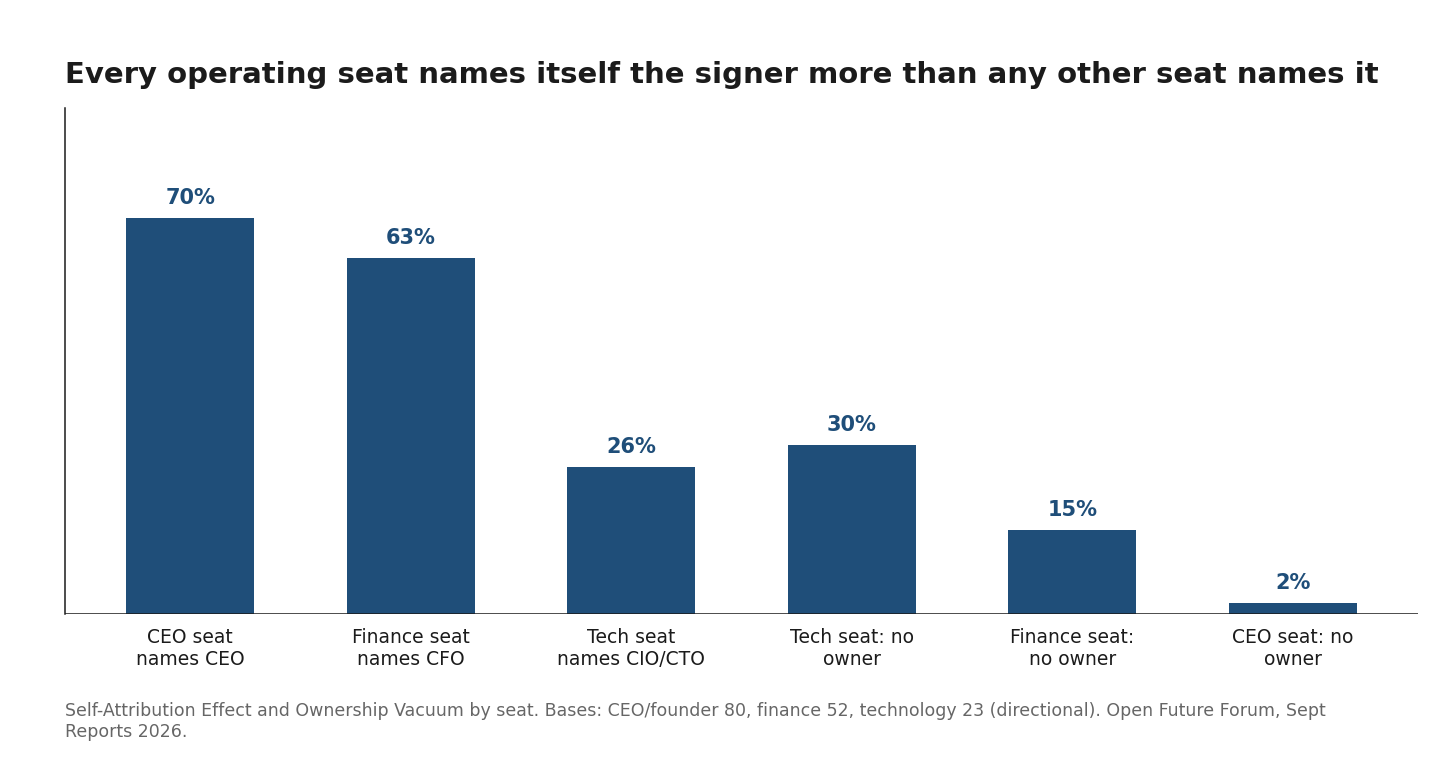
By every read, yes, and the CEO believes it more than anyone else does. The triangulation:
| Vantage point | Question | CEO share | Base |
|---|---|---|---|
| The CEO seat | Who signs off on a new AI purchase? | 70 percent | 80 |
| Operators, all seats | Who signs off on a new AI purchase? | 47 percent | 290 |
| The August finance room | Who signs off on a new AI purchase? | 50 percent | 54 |
| Investors, across portfolios | Who increasingly owns the AI buying decision? | 51 percent | 245 |
| Sellers, inside their customers | Who owns the buying decision? | No CEO option; business unit 39, CIO or CTO 36, CFO 28 | 148 |
Source: Open Future Forum, CEO AI Leverage Report, Edition 3, September 2026.
Three populations, three question wordings, one direction from every side that can see the CEO. The fourth, the sellers, cannot see the CEO because the instrument does not offer the seat; what they report is the doorway they enter, not the signature at the end. That is the Seat Split, and it is the most useful finding in this report for a chief executive: the vendors selling into your company are aiming at your business-unit leaders and your CTO, and the signature they eventually need is yours. Signing is not deciding, and this report keeps the two apart on purpose. A signature can ratify a call made two levels down. What the data shows is accountability concentrating at the top even where the evaluation has not.
How fast does the CEO expect AI to pay back, and who agrees?
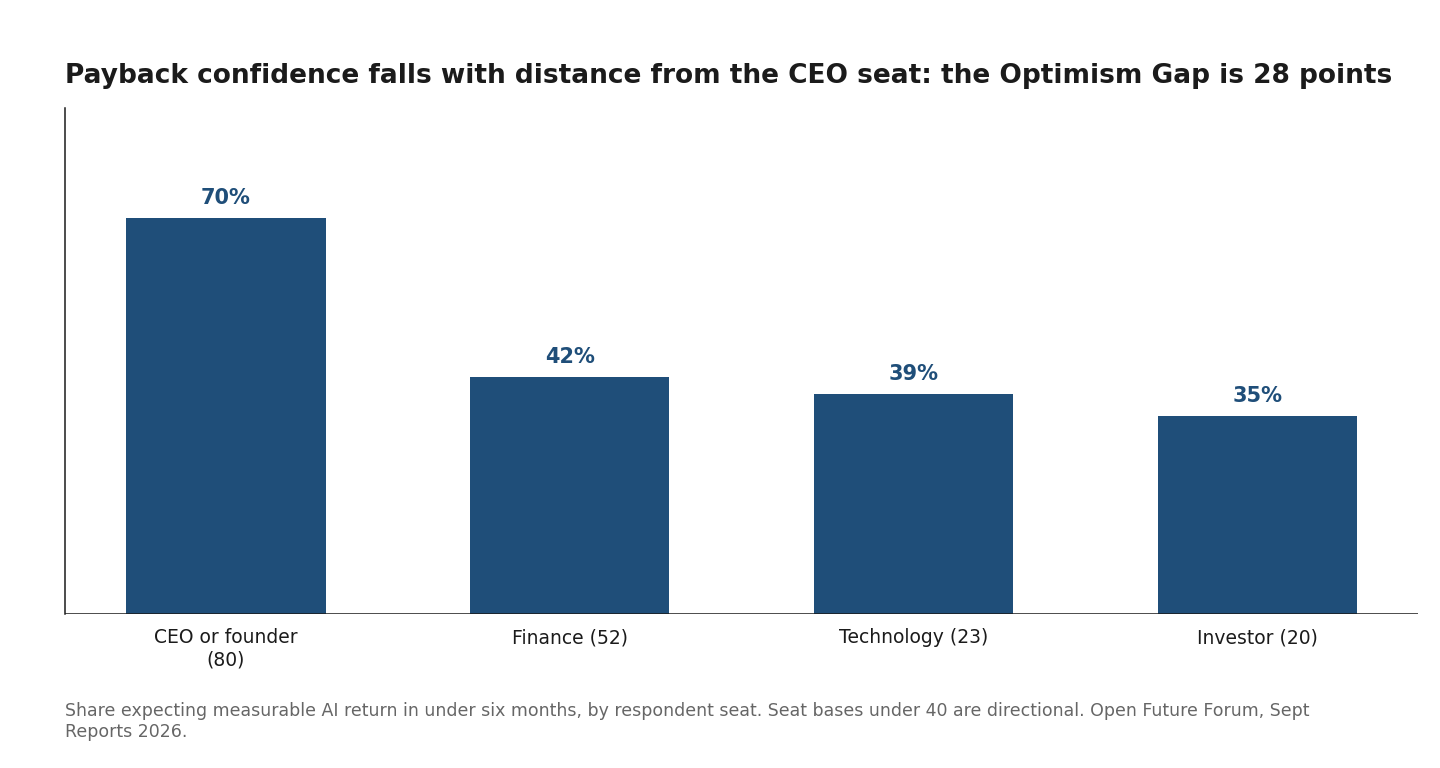
Seventy percent of the CEO seat expects measurable return inside six months. Forty-two percent of the finance seat agrees, 39 percent of the technology seat, 35 percent of investors. Confidence falls with every step from the signature, and the seat that will build the thing sits with finance, not with the CEO. Four percent of the CEO seat is unsure; 12 percent of finance, 26 of technology, and 25 of investors are. The finance seat’s most common answer is six to twelve months, at 46 percent.
| How soon do you expect measurable return? | CEO/Founder (80) | Finance (52) | Technology (23) | Investor (20) |
|---|---|---|---|---|
| Under 6 months | 70 percent | 42 percent | 39 percent | 35 percent |
| 6 to 12 months | 24 percent | 46 percent | 26 percent | 25 percent |
| Not sure | 4 percent | 12 percent | 26 percent | 25 percent |
Source: Open Future Forum, CEO AI Leverage Report, Edition 3, September 2026.
This is the Optimism Gap in one row, 28 points, and the report’s standing warning to the seat that signs: the number in the board deck is the CEO’s number, and the number the finance function will be asked to prove is finance’s.
How every seat sees the CEO
The CEO’s authority read from each chair that was asked, with the CEO seat’s own answer first.
| Who names the CEO as the AI signer or owner | Share | Base |
|---|---|---|
| The CEO and founder seat, about itself | 70 percent | 80 |
| The finance seat | 31 percent | 52 |
| The technology seat | 26 percent | 23, directional |
| Investors, about their own firms | 35 percent | 20, directional |
| Investors, across their portfolios | 51 percent | 245 |
| All finance-lane operators | 47 percent | 290 |
| The August finance room | 50 percent | 54, directional |
| Founders, inside their customers | no CEO option offered; business unit 39, CIO or CTO 36, CFO 28 | 148 |
Source: Open Future Forum, CEO AI Leverage Report, Edition 3, September 2026.
The CEO seat’s claim is larger than any other seat’s read of it, and the gap is the Self-Attribution Effect from the other side: 70 percent at the CEO’s own chair, 31 at finance, 26 at technology. The two views that agree with the CEO are the two that sit outside the building, investors across portfolios at 51 and operators pooled at 47. The seats that work for the CEO name the CEO least. Signing and deciding are different acts, and the seats below are describing the second.
| Where does the AI money come from? | CEO/Founder (80) | Finance (52) | Technology (23) | Investor (20) |
|---|---|---|---|---|
| Net-new money | 39 percent | 44 percent | 35 percent | 35 percent |
| Money that would have gone to headcount | 34 percent | 19 percent | 22 percent | 10 percent |
| Reallocated from other software | 15 percent | 19 percent | 30 percent | 15 percent |
| Not sure / no AI budget yet | 19 percent | 25 percent | 26 percent | 50 percent |
Source: Open Future Forum, CEO AI Leverage Report, Edition 3, September 2026.
| What is the main thing stopping more AI spend? | CEO/Founder (80) | Finance (52) | Technology (23) | Investor (20) |
|---|---|---|---|---|
| Proving ROI | 54 percent | 60 percent | 70 percent | 45 percent |
| Integration with existing systems | 24 percent | 13 percent | 9 percent | 15 percent |
| Data readiness | 18 percent | 33 percent | 26 percent | 5 percent |
| Security and compliance | 15 percent | 17 percent | 9 percent | 50 percent |
Source: Open Future Forum, CEO AI Leverage Report, Edition 3, September 2026.
The CEO seat is the only chair whose second blocker is integration rather than data, security, or proof. The chief executive’s AI problem is getting it to fit; every seat below has a problem with showing it paid.
Where does the CEO’s AI money come from?
Net-new money at 39 percent, headcount money at 34, reallocated software at 15, no clear budget at 19. The headcount line is the one that distinguishes the seat. A third of CEO-and-founder respondents say this year’s AI money would otherwise have been headcount spend; the finance seat, which has to plan the hiring, says 19 percent. The seat most confident about payback is also the seat most willing to trade people for it, and the seat that writes the workforce plan does not yet agree with the number. Blockers follow the same shape: the CEO seat names proving ROI at 54 percent, the lowest of any operating chair, and integration at 24, the highest; the CEO’s problem is getting AI to fit, the finance seat’s problem is proving it paid.
Three archetypes at the CEO seat
From the sign-off and payback answers of the 80 CEO-seat respondents:
- Deciders, who name themselves the signer and expect payback inside six months: the majority of the seat, and the group the finance rooms are negotiating with.
- Ratifiers, who name themselves the signer but expect a longer or unknown payback: a CEO who signs a decision made below, and knows it.
- Delegators, who name another seat: 30 percent name the CFO, 14 percent the CIO or CTO, 5 percent a business unit.
October’s CEO-only questions (do you personally make the AI purchase decision; AI spend as a share of revenue; does your board push faster or slower than you) will let the three be sized, and will let the Ratifiers be separated from the Deciders for the first time.
The CEO seat, by vertical
The 80 CEO-and-founder respondents on the finance instrument, cut by the industry of their company (classified from company name, email domain, and self-reported sector; bases under 40 directional; groups under 10 not shown).
| Vertical | Base | Names the CEO | Names the CFO | No single owner | Payback under six months | Funds from headcount money |
|---|---|---|---|---|---|---|
| Other | 15, directional | 60 percent | 20 | 7 | 80 | 27 |
| Technology and enterprise software | 36, directional | 72 percent | 28 | 3 | 75 | 31 |
Source: Open Future Forum, CEO AI Leverage Report, Edition 3, September 2026.
The CEO seat is most self-attributing in technology and enterprise software, where the vertical’s CEOs name themselves the signer, expect fast payback, and substitute headcount money at the highest rates in the data. Outside technology the CEO base is too thin to cut; the October instrument and the vertical question on every form change that.
Technology and enterprise software. The vertical where the CEO seat is most itself: the highest self-attribution, the fastest expected payback, and the highest headcount substitution in the data, on the one CEO-seat base that clears ten. Eighteen of the 36 approved guests at the CEO Private Dinners come from this vertical, all C-level.
Every other vertical. Consumer, infrastructure, healthcare, financial services, and VC-backed CEOs are one or two people each at the dinners and under ten on the instrument, so no figure is published. From the operator data the CEO seat outside technology is read only indirectly: Big Tech and platform respondents report no single owner at 50 percent and professional services report no clear budget at 47, both directional, which is the environment those CEOs sign in.
What October adds. The CEO-only questions and the vertical dropdown on the dinner form let the seat be cut by industry for the first time; until then the vertical read for CEOs is technology and enterprise software, and this section says so.
Who is in the CEO rooms
Three CEO Private Dinners in the period, in Los Altos Hills: 193 registrations, 37 approved, 144 declined, an approval rate of 19 percent, the most selective in the network. 97 percent of titled approved guests hold a senior title and 90 percent are C-level, founders, or partners. Of 100 applicants who stated how their company is funded, 40 are VC-funded, 38 self-funded, 8 public, 5 PE-backed. Asked which other sessions they want (base 41, any-mention, directional): AI for researching investors at 66 percent, AI for competitive research at 63, AI for marketing at 59. The chief executives in these rooms want AI pointed outward, at capital and competitors, before they want it pointed at their own functions.
Tested against the record
| External claim | Open Future Forum figure | Verdict |
|---|---|---|
| BCG AI Radar 2026: 72 percent of CEOs say they are the main AI decision maker, double the prior year | 70 percent of CEO-seat respondents name the CEO | Corroborated almost exactly |
| BCG: about 90 percent of CEOs expect agents to deliver measurable ROI in 2026 | 70 percent expect payback inside six months | Corroborated in direction, lower in magnitude |
| BCG, May 2026: 61 percent of CEOs say boards are moving faster than readiness supports | not yet asked; October instrument | Gap acknowledged |
| PwC 29th CEO Survey: 30 percent confident in revenue growth; 56 percent see no AI benefit yet | 2 percent of CEO-seat respondents report an unowned AI decision; 70 percent expect fast payback | Complicated: Silicon Valley CEOs in these rooms are far more confident than PwC’s global sample |
| Cisco, 2,511 CEOs: agent deployment is a top-three priority | 34 percent of the CEO seat funds AI from headcount money | Corroborated in direction |
| McKinsey State of Organizations 2026: 23 percent of leaders are “AI Pioneers” | Deciders are the majority of the CEO seat here | Complicated: a selective sample of a selective city |
Source: Open Future Forum, CEO AI Leverage Report, September 2026.
External figures are context only; the sources are not affiliated and do not endorse this report.
What CEOs are asking coming into the rooms
The CEO Private Dinner form carries no open question, so the qualitative read comes from what the CEO seat asked elsewhere and what it wants next. Asked which other sessions they want (base 41, any-mention, directional), the chief executives at the dinners chose AI for researching investors at 66 percent, AI for competitive research at 63, AI for marketing at 59, and AI for customer research at 51: outward, at capital, competitors, and customers, before inward at their own functions. In the marketing rooms, where 79 founders and CEOs answered the agentic question, they are the supply side, 49 percent building agents, and their open answers about current work are agents for go-to-market almost without exception. In the security rooms the founders at the table name agent access at 59 percent and are the best-funded chair. The CEO seat in these rooms is not asking whether to adopt AI. It is asking how to point it at the market, and it is the seat least likely to ask who owns it.
What this means for the CEO
The signature is yours by every read. The proof is not. Start with the fact that 42 percent of your finance seat agrees with your payback date and 15 percent of it says nobody owns the decision you think you own; settle which named metric vindicates the purchase and whether your CFO agrees with the date, before the board asks. Second, the vendors selling into your company are aiming at your business units and your CTO, not at you; a pilot that reaches your desk for signature was decided two levels down, and the Ratifier archetype is the one to avoid becoming. Third, a third of your peers are already funding AI with hiring money and their finance seats are counting it differently; if the workforce plan and the AI budget are separate documents, the data says they will not stay that way, and it is better to write the reconciliation than to be asked for it.
For boards, CFOs, and investors
Boards get three questions, all answerable from this report: who owns the AI purchase (the CEO says the CEO; the CTO reports an unowned decision at 30 percent); what number vindicates it (the CEO expects it inside six months; finance expects it in six to twelve); and where the security budget line sits (the CISO report says a third have one). BCG’s May 2026 finding that 61 percent of CEOs think their boards are moving faster than readiness supports is the outside frame; the October instrument asks the CEO seat the same question directly. CFOs get the mirror: the CEO seat names the CFO as co-signer at 30 percent and rising, so the mandate is arriving whether or not the budget line has. Investors get the gap between the CEO’s confidence and the operating seats’ as a diligence number: 28 points, and the technology seat sits with finance.
Where can CEOs discuss this with peers?
The CEO Executive Forum is Open Future Forum’s peer group for chief executives, meeting through the CEO Private Dinner Series: ten to fifteen founders and CEOs of companies that have raised $10M or crossed $10M ARR, one table, Chatham House rules, in Los Altos Hills. The public board member track, co-hosted with Shing Pan of XTVue, meets separately. Membership is by application and referral, and the rooms decline four applicants in five.
Explore the CEO Executive Forum · Inquire about membership
Upcoming CEO events
CEO Private Dinner
Los Altos Hills, CA · next date to be announced
Ten to fifteen founders and CEOs, one table, off the record, with the first CEO-only questions on the registration form: whether you personally make the AI purchase decision, AI spend as a share of revenue in bands, and whether your board pushes faster or slower than you on AI.
Edition 4 data collection runs through the autumn CEO dinners and the board track. The three questions the next rooms will debate: whether the CEO decides or ratifies, what the CFO needs to see to agree with the CEO’s date, and how much of next year’s hiring plan is already AI.
Related reading
- Executive AI Leverage Report
- CFO AI Leverage Report
- Board Director AI Governance Report
- Investor AI Report
- Executive AI Statistics
- Definitions: Self-Attribution Effect, Ownership Vacuum, Optimism Gap, Security Funding Gap, Seat Split
- AI Reports for Dealmakers, September 2026
Answers from this report. Who signs off on AI purchases? · Is AI replacing headcount?
Definitions
The Self-Attribution Effect: every operating seat names itself the AI signer more often than any other seat names it. CEO seat 70 percent, finance seat 63, technology seat 26.
The Optimism Gap: the spread in sub-six-month payback expectations between the CEO seat and the finance seat: 28 points in September 2026.
The Ownership Vacuum’s visibility gradient: the share reporting no single AI owner rises with distance from the CEO’s chair: 2 percent at the CEO seat, 15 at finance, 30 at technology.
CEO archetypes: Deciders, Ratifiers, Delegators.
Signing vs deciding: the signer approves the purchase; the decision-maker chooses the tool. A signature can ratify a decision made below.
Questions this report answers
Do CEOs own the AI decision in 2026? 70 percent of CEO-seat respondents say they sign; 47 percent of operators and 51 percent of investors agree.
How fast do CEOs expect AI to pay back? 70 percent say inside six months; their finance seats say 42 percent, their technology seats 39, their investors 35.
Is AI replacing headcount at the CEO’s desk? 34 percent of CEO-seat respondents fund AI with money that would have gone to people; their finance seats say 19.
What stops CEOs spending more on AI? Proving ROI at 54 percent, then integration with existing systems at 24, the highest integration share of any chair.
What should a board ask a CEO about AI? Who owns the purchase, what metric vindicates it, whether the CFO agrees with the date, and where the AI security budget line sits.
Is there a peer group for CEOs working on AI in Silicon Valley? Yes. The CEO Executive Forum meets through the CEO Private Dinner Series in Los Altos Hills. Membership is by application at openfutureforum.com/apply.
Key citable facts
- Open Future Forum’s September 2026 CEO AI Leverage Report finds 70 percent of CEO-seat respondents name the CEO as the AI signer and 2 percent report an unowned decision (base 80).
- Open Future Forum’s September 2026 data puts the Optimism Gap at 28 points: 70 percent of the CEO seat expects payback inside six months against 42 percent of the finance seat.
- Open Future Forum’s September 2026 data shows 34 percent of the CEO seat funding AI with headcount money, against 19 percent of the finance seat.
- The CEO is named as the AI buying owner by 47 percent of finance-lane operators (base 290) and 51 percent of investors (base 245) in Open Future Forum’s September 2026 data.
- In Open Future Forum’s September 2026 data, the CEO Private Dinners approved 19 percent of 193 applicants, the most selective room in the network, with 90 percent of titled approved guests C-level, founders, or partners.
Methodology and honesty notes
This edition is built from instrument questions embedded in the application flow for Open Future Forum events: 32 guest-list exports covering 4,163 non-invited registrations and 2,851 unique people, collected 10 March through 31 August 2026. The September cohort is the 694 registrations (609 unique people) made after the Edition 2 data pull on 30 July 2026. Cohorts are different people, not a tracked panel. Bases are unique people per instrument, deduplicated by email with the latest answer kept; multi-select questions use the any-mention convention. Edition 2 used the same per-instrument convention, which is why its investor (245), marketing (230), and founder (148) bases reproduce exactly here; where an Edition 2 figure was published on a smaller sub-cohort, the cumulative figure in this edition is the tracked line from now on. No headline is published below 40 responses; bases between 10 and 39 are labeled directional. Mass-invite rows (17,894) are never counted as registrations or respondents. Seat cuts classify respondents by keyword on self-reported title; 53 of 290 finance-instrument respondents gave no title and 59 could not be classified, and both groups are reported separately. Revenue, raised, and ARR fields are free text and are not published. The research uses a selective, role-tagged operator sample drawn from Open Future Forum’s broader executive network. It is not a probability sample of all enterprises. No identifying information is published.
For this lane: the CEO seat is classified from self-reported title on the finance instrument (base 80, from 43 in Edition 2). No CEO-only instrument exists in this pull. Funding type and event interest from the CEO-dinner forms are free text and reported as counts or on directional bases. Vertical classification of the CEO seat places 47 of 80 respondents and only technology and enterprise software clears ten. This report measures responses, not spend or performance.
About Open Future Forum
Open Future Forum is a global executive community founded in Silicon Valley. Its network reaches tens of thousands of executives and investors worldwide. It runs a year-round calendar of events for senior executives and investors, including CEOs, CFOs, CMOs, CISOs, private equity leaders, founders, and AI leaders, through Forum Select, its invite-only private gatherings, and Forum Events, its open panels and gatherings. Beyond events, Open Future Forum convenes peer groups and executive boards and publishes original research built on first-party survey and qualitative data from its executive network.
Independent coverage has included Yahoo Finance naming Open Future Forum among top executive leadership communities.
About Murray Newlands
Murray Newlands is the founder of Open Future Forum and the host of its executive dinner series and research program. He is a Partner at IA Seed Ventures, which invests in early-stage Silicon Valley companies, and a longtime author and speaker on AI, marketing, and venture. He writes on AI, venture, and enterprise strategy at murraynewlands.substack.com. More at openfutureforum.com/about and murraynewlands.com.
Citation and editions
Suggested citation: Newlands, M. (2026). CEO AI Leverage Report, Edition 3. Open Future Forum, September 2026. openfutureforum.com/research/ceo-ai-leverage-report-september-2026
This edition supersedes Edition 2 (August 2026). Companion reading: CFO AI Leverage Report, Executive AI Leverage Report. Edition 4 publishes in October 2026. Dataset DOI: 10.5281/zenodo.21576019.
Work These Questions with CEO Peers
The CEO Executive Forum meets through small, off-the-record gatherings. Membership is by application and referral.