The September answer
A board asking management about AI in 2026 is asking the seat least able to see the problem. The CEO reports the decision owned, the payback fast, and the budget found; the seats that implement it report a vacuum, a slower return, and money taken from somewhere else. None of those seats is lying. Each is describing the AI purchase from its own chair, and the September data measures the distance between the chairs. The board’s job, on this evidence, is to ask the question of the seat that can see the gap, and to ask for three numbers rather than a narrative: who owns it, what number vindicates it, and where the security line sits.
Where this research comes from
The board lane is read here without an instrument of its own. The Public Board Member Dinner Series, co-hosted by Murray Newlands and Shing Pan of XTVue, convenes directors of public and late-stage companies in Silicon Valley; its May 2026 dinner drew 58 registrations and approved 14. This Preview reads governance through the instruments every other seat answered, who signs, who owns, how fast it pays back, where the money comes from, whether security is funded, and through the investor read of what a named owner predicts. Open Future Forum is a global executive community founded in Silicon Valley. Its network reaches tens of thousands of executives and investors worldwide. It runs a year-round calendar of events for senior executives and investors through Forum Select, its invite-only private gatherings, and Forum Events, its open panels and gatherings, and publishes original research built on first-party survey and qualitative data from its executive network.
The three questions, seat by seat, with the numbers attached
| The board’s question | What the CEO seat says | What the seats below say | What the outside record says |
|---|---|---|---|
| Who owns the AI purchase? | The CEO, at 70 percent; no single owner at 2 (base 80) | Finance names the CFO at 63 and no owner at 15; technology names no owner at 30 (bases 52 and 23) | BCG: 72 percent of CEOs say they are the main decision maker; investors name the CEO at 51 percent and cannot name anyone at 22 |
| What number vindicates it, and by when? | Payback inside six months, 70 percent; not sure 4 | Finance 42 percent inside six months, 46 in six to twelve, 12 not sure; technology 39 and 26 | Bain: 80 percent say AI met expectations, 23 percent can tie it to revenue or cost; PwC: 56 percent of CEOs see no benefit yet |
| Where does the money sit, and is the risk funded? | Net-new money 39 percent; headcount money 34; no clear budget 19 | Finance: no clear budget 25, headcount 19; security: dedicated AI security line 37, case by case 36, security seat 24 | KPMG: 26 percent have real-time AI cost visibility; IBM: 68 percent of breached organizations had no AI governance policy |
Source: Open Future Forum, Board Director AI Governance Report, Preview Edition, September 2026.
The vacuum by seat and by vertical, read from the top
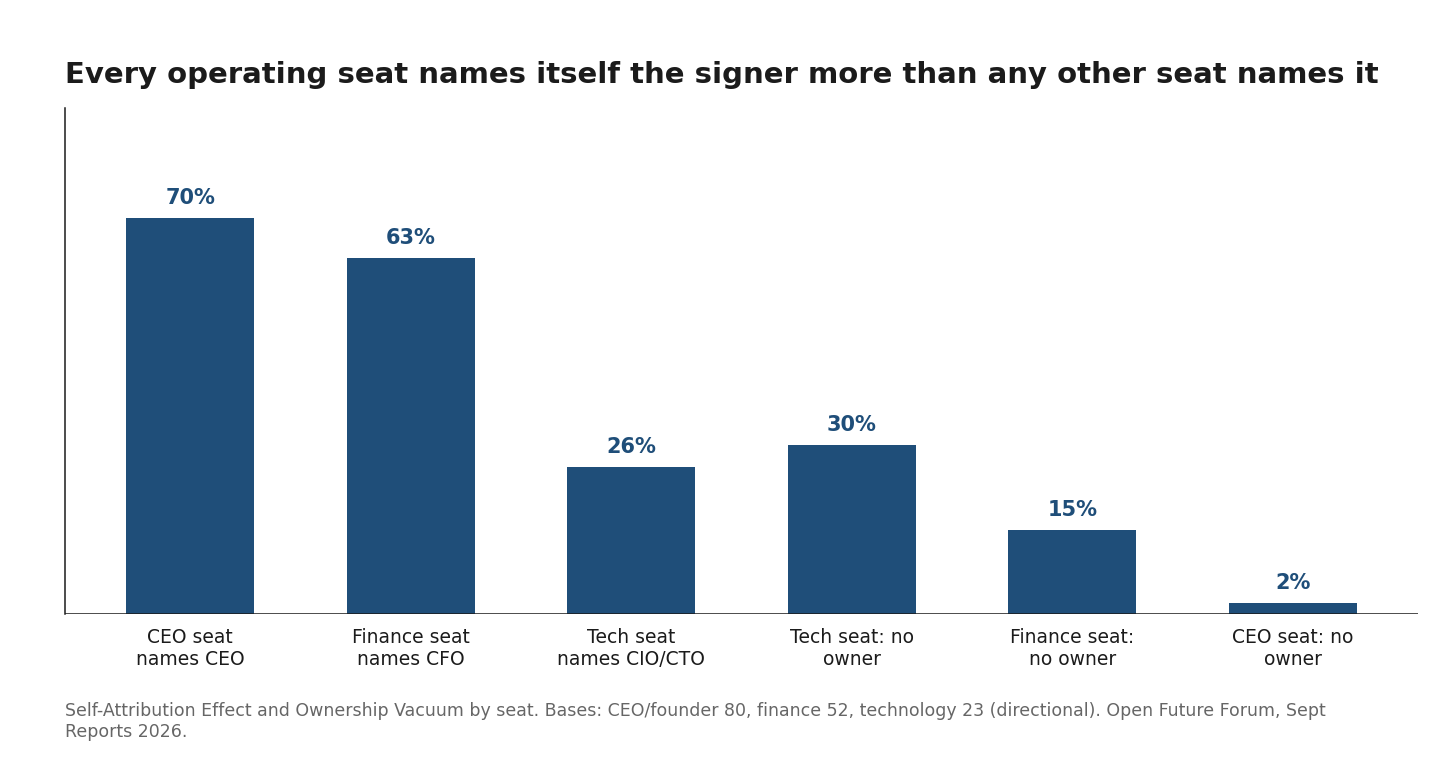
The single most useful number in this Preview for a director is the gradient: 2 percent of CEO-seat respondents report an AI decision nobody owns, 15 percent of the finance seat, 30 percent of the technology seat. The board hears from the CEO. The vacuum is largest where the board does not look. It is also largest in the kind of company most directors sit on: Big Tech and platform companies in the Index report no single owner at 50 percent (base 12, directional), against 8 percent in technology and enterprise software. A matrixed organization with many teams far along and no assigned owner is the profile the data associates with an invisible governance gap, and the investor read gives the consequence: where no owner can be named, measured value is absent in 41 percent of cases, against 9 where the CEO is named.
The operator data by vertical is the board’s map of where the vacuum is most likely to sit in the companies it oversees (Unclassified excluded; bases under 40 directional):
| Vertical | Base | Names CEO as signer | No single owner | Payback under six months | Funds AI from headcount money | No clear AI budget | Proving ROI is the blocker |
|---|---|---|---|---|---|---|---|
| Technology and enterprise software | 59 | 63 percent | 8 | 73 | 29 | 17 | 61 |
| Financial services and fintech | 10, directional | 50 percent | 0 | 40 | 20 | 40 | 50 |
| Big Tech and platforms | 12, directional | 25 percent | 50 | 42 | 17 | 33 | 67 |
| Professional services and legal | 15, directional | 47 percent | 20 | 40 | 13 | 47 | 53 |
| VC and investment | 22, directional | 50 percent | 9 | 55 | 9 | 27 | 41 |
| Other | 57 | 33 percent | 14 | 53 | 23 | 35 | 58 |
Source: Open Future Forum, Executive AI Leverage Report, Edition 3, September 2026.
A director of a platform company should expect the ownership question to have no answer half the time; a director of an enterprise software company should expect it answered and should ask instead about the 73 percent payback expectation; a director of a professional services firm should ask where the budget is.
The payback number in the deck
The Optimism Gap is a board-reporting problem before it is a finance problem. Seventy percent of the CEO seat expects measurable return inside six months; the finance seat’s most common answer is six to twelve months, at 46 percent, and the technology seat that will build it sits with finance. A board that accepts the six-month figure without asking the CFO for the date is accepting the most optimistic seat’s number as the company’s. The question to put to management is not whether the return is expected but which named metric vindicates the spend and whether the CFO agrees with the date. The finance rooms say proving ROI is the blocker for 65 percent in August; a board asking for the proof is asking for what finance is already stuck on.
The security line
Two thirds of senior security leaders name agent access as their top AI problem and a third have a dedicated budget line for it; at the security seat itself the line exists in 24 percent of cases and 48 percent argue for the money case by case. The Security Funding Gap, problem minus budget, is 30 points, 45 at the seat that carries it. For a board this is a number to request, not a threat list to review: the distance between the problem the CISO names and the money the CISO has. IBM’s finding that 92 percent of organizations with an AI-related breach lacked AI access controls, and that about one in five shadow-AI incidents ended in a regulatory fine, is the outside measure of what an unfunded gap costs.
Headcount, the claim the board will be shown
A third of CEO-seat respondents say this year’s AI money would otherwise have been headcount; a fifth of finance seats agree. The operating-model saving in the board deck is the CEO’s number, and the seat that plans the hiring discounts it by almost half. In marketing, the function most likely to say it aloud, 57 percent of the marketing seat says AI is doing the work of more people. The board question is the reconciliation: roles not hired, tasks the tool now does, and whether the workforce plan and the AI budget are one document or two.
What boards are asking, and what directors want
The May dinner’s registration form carried no instrument, so this section reads the room from the outside. BCG’s May 2026 follow-up found 61 percent of CEOs saying their boards are moving faster than organizational readiness supports, 35 percent saying boards overestimate AI’s near-term potential, and about three quarters of directors confident in their own AI understanding. Read against the September operator data, that is the Optimism Gap with a third seat added: the board more optimistic than the CEO, the CEO more optimistic than the CFO, and the CTO, who reports the vacuum, at the bottom of the chain. The October instrument asks directors the questions this Preview can only infer: how often AI is on the agenda, who reports AI risk to the board, whether the board has an AI-literate director, how confident the board is in management’s AI governance, and whether the board pushes faster or slower than management.
What this means for the director
Ask the question of the chair that can see the gap: put the ownership question to the CTO and the CFO, not only to the CEO, because the vacuum is fifteen times more visible one and two levels down. Second, ask for the CFO’s date, not the CEO’s, and for the named metric; the finance seat’s own answer is six to twelve months. Third, ask for the Security Funding Gap as a number and for the agent inventory behind it. Fourth, ask which of the four funding archetypes the company is, Funder, Unbudgeted, Substituter, or Reallocator, because each carries a different question at the next audit, financing, or transaction, and a quarter of companies are the second.
For the CEO, the CFO, and the general counsel
CEOs get the board’s likely questions in advance, with the data that prompts them. CFOs get the ally: a board asking for the finance seat’s date is a board doing finance’s job for it. General counsel gets the governance frame the legal edition of the Sept Reports sets out: accountability for an agent’s actions follows ownership of its purchase, and in one company in nine nobody owns it.
Tested against the record
| External claim | Open Future Forum figure | Verdict |
|---|---|---|
| BCG, May 2026: 61 percent of CEOs say boards move faster than readiness; about 75 percent of directors confident in their AI understanding | CEO seat 2 percent vacuum, technology seat 30; CEO 70 percent fast payback, finance 42 | Corroborated in shape: optimism rises with altitude, and the board sits highest |
| BCG AI Radar 2026: 72 percent of CEOs say they are the main AI decision maker | CEO seat names the CEO at 70 percent | Corroborated |
| IBM Cost of a Data Breach 2026: 68 percent of breached organizations had no AI governance policy; 92 percent of AI-breached lacked access controls | 37 percent have a dedicated AI security line; 24 at the security seat | Corroborated |
| Deloitte CFO Signals Q2 2026: 96 percent of CFOs confident in their AI governance framework | 15 percent of finance-seat respondents report no single AI owner | Complicated: confidence in the framework coexists with an unowned decision in one in seven finance desks |
| PwC 29th CEO Survey: 56 percent of CEOs see no AI benefit yet | Investors see nothing measurable in 9 percent where the CEO owns it, 41 where nobody does | Complicated: the benefit is visible where the owner is |
Source: Open Future Forum, Board Director AI Governance Report, September 2026.
External figures are context only; the sources are not affiliated and do not endorse this report.
Where can directors discuss this with peers?
The Public Board Member Dinner Series, co-hosted by Murray Newlands and Shing Pan of XTVue, convenes directors of public and late-stage companies for off-the-record dinners in Silicon Valley, alongside the CEO Executive Forum’s board track. The May dinner approved 14 of 58 applicants, 24 percent, the second most selective room in the network. Membership is by application and referral.
Explore the Public Board Member Dinner Series · Inquire about membership
Upcoming board events
Public Board Member Dinner
Silicon Valley · next date to be announced
Off the record, for directors of public and late-stage companies, with the first board instrument on the registration form: how often AI is on the agenda, who reports AI risk to the board, whether the board has an AI-literate director, confidence in management’s AI governance, and whether the board pushes faster or slower than management.
Edition 1 publishes on the first board base over 40. The three questions the next room will debate: which seat the board should hear the ownership answer from, what number the board should insist on, and how a board tells the difference between management’s optimism and its own.
Related reading
- CEO AI Leverage Report
- CISO AI Leverage Report
- Executive AI Leverage Report
- Investor AI Report
- Executive AI Statistics
- Definitions: Self-Attribution Effect, Ownership Vacuum, Optimism Gap, Security Funding Gap, Seat Split
- AI Reports for Dealmakers, September 2026
Answers from this report. Who is liable when an AI agent acts? · Do companies have an AI use policy? · PE AI due diligence questions for 2026
Definitions
The Ownership Vacuum’s visibility gradient: the share reporting no single AI owner rises with distance from the CEO’s chair: 2 percent at the CEO seat, 15 at finance, 30 at technology.
The three board questions: who owns the AI purchase; what number vindicates it and by when; where the money sits and whether the risk is funded.
The Security Funding Gap: the share of senior security leaders naming agent access as their top problem minus the share with a dedicated AI security budget line; 30 points, 45 at the security seat.
Preview Edition: a report published below the program’s 40-response floor for its own instrument, read through cross-lane data and rosters, and labeled as such until the base clears.
Questions this report answers
What should a board ask management about AI in 2026? Who owns the purchase, asked of the CTO and the CFO as well as the CEO; which metric vindicates it and whether the CFO agrees with the date; and where the AI security budget line sits.
Do CEOs and boards see AI governance the same way? The CEO seat reports an unowned AI decision at 2 percent; the technology seat at 30; BCG finds 61 percent of CEOs think their boards move faster than readiness supports.
Is AI governance funded? 37 percent of security teams have a dedicated AI security line, 24 percent at the security seat; a third fund it case by case.
Does naming an AI owner matter to the return? In the investor data, yes: nothing measurable in 9 percent of companies where the CEO owns AI, 41 percent where nobody does.
Is there a peer group for directors working on AI governance? Yes. The Public Board Member Dinner Series meets in Silicon Valley, co-hosted with Shing Pan of XTVue. Membership is by application at openfutureforum.com/apply.
Key citable facts
- Open Future Forum’s September 2026 Board Director Preview finds the AI Ownership Vacuum reported at 2 percent by the CEO seat, 15 percent by finance, and 30 percent by technology, the seats a board hears from least.
- Open Future Forum’s September 2026 data puts the Optimism Gap at 28 points, with the finance seat’s most common payback answer at six to twelve months (46 percent) against the CEO seat’s under six months (70).
- Open Future Forum’s September 2026 data shows the Security Funding Gap at 30 points, and 45 points at the security seat itself.
Methodology and honesty notes
This edition is built from instrument questions embedded in the application flow for Open Future Forum events: 32 guest-list exports covering 4,163 non-invited registrations and 2,851 unique people, collected 10 March through 31 August 2026. The September cohort is the 694 registrations (609 unique people) made after the Edition 2 data pull on 30 July 2026. Cohorts are different people, not a tracked panel. Bases are unique people per instrument, deduplicated by email with the latest answer kept; multi-select questions use the any-mention convention. Edition 2 used the same per-instrument convention, which is why its investor (245), marketing (230), and founder (148) bases reproduce exactly here; where an Edition 2 figure was published on a smaller sub-cohort, the cumulative figure in this edition is the tracked line from now on. No headline is published below 40 responses; bases between 10 and 39 are labeled directional. Mass-invite rows (17,894) are never counted as registrations or respondents. Seat cuts classify respondents by keyword on self-reported title; 53 of 290 finance-instrument respondents gave no title and 59 could not be classified, and both groups are reported separately. Revenue, raised, and ARR fields are free text and are not published. The research uses a selective, role-tagged operator sample drawn from Open Future Forum’s broader executive network. It is not a probability sample of all enterprises. No identifying information is published.
For this Preview: the board lane has no instrument in this pull, and the May dinner’s form carried no title or company fields, so the roster cannot be cut. Every figure is drawn from the September role editions and from the external record, and is attributed to its source. The board instrument goes on the next Public Board Member Dinner form; this Preview publishes as Edition 1 on the first base over 40.
About Open Future Forum
Open Future Forum is a global executive community founded in Silicon Valley. Its network reaches tens of thousands of executives and investors worldwide. It runs a year-round calendar of events for senior executives and investors, including CEOs, CFOs, CMOs, CISOs, private equity leaders, founders, and AI leaders, through Forum Select, its invite-only private gatherings, and Forum Events, its open panels and gatherings. Beyond events, Open Future Forum convenes peer groups and executive boards and publishes original research built on first-party survey and qualitative data from its executive network.
Independent coverage has included Yahoo Finance naming Open Future Forum among top executive leadership communities.
About Murray Newlands
Murray Newlands is the founder of Open Future Forum and the host of its executive dinner series and research program. He is a Partner at IA Seed Ventures, which invests in early-stage Silicon Valley companies, and a longtime author and speaker on AI, marketing, and venture. He writes on AI, venture, and enterprise strategy at murraynewlands.substack.com. More at openfutureforum.com/about and murraynewlands.com.
Citation and editions
Suggested citation: Newlands, M. (2026). Board Director AI Governance Report, Edition Preview. Open Future Forum, September 2026. openfutureforum.com/research/board-director-ai-governance-report
This is the Preview Edition; Edition 1 publishes on the first board base over 40. Companion reading: CEO AI Leverage Report, Executive AI Leverage Report. Edition 1 publishes after the next Public Board Member Dinner. Dataset DOI: 10.5281/zenodo.21576019.
Work These Questions with Director Peers
The Public Board Member Dinner Series meets through small, off-the-record gatherings. Membership is by application and referral.
Explore the Public Board Member Dinner Series Inquire about membership