Executive Summary
The CMO AI market has moved from interest to execution. Among the 39 marketing buyers in an Open Future Forum marketing and growth session, 29 were already piloting or running agents in production, and only 10 were still exploring. AI in marketing is no longer a future topic for this community. The harder work is proof and ownership.
One feature of the room shapes the whole reading. It mixed marketing and growth buyers with founders building AI products. Sixteen of the 55 responses were building agentic products, so every buyer finding in this report sets them aside and reports them separately. Supply is the vendor map. Demand is the survey overlay. The two are kept on separate pages by design.
The open-text answers make the demand concrete. Asked what they wanted to walk out with, people asked to see a marketing agent working in production, the metric it moved, and where it broke. This is a workflow map, not a ranking. Vendors are categorized by the job they do, not scored, ranked, or placed on axes.
Part One: The CMO AI Market Map
The taxonomy follows the CMO workflow: make the content, produce the creative, run the campaigns, get found in search and in AI answers, measure what worked, run the lifecycle, manage social, and coordinate the agents that now cross all of it. The goal is to show the shape of supply and pair it with the demand signal in the first-party data.
How to read the map
Start with workflow fit. A marketing buyer usually frames AI through work the marketing team already owns. Then test proof. The demand overlay in this edition is a read on agentic deployment across the room, not a category-by-category budget signal, so treat category demand as work the vendor still has to prove.
1. Content generation and copywriting
Marketing copy, long-form and blog content, briefs, messaging, and content repurposing.
| Tool | Tier | What it does | Source |
|---|---|---|---|
| HubSpot Content Hub | Incumbent | AI content creation and CMS that lets teams create, repurpose, and manage blog posts, podcasts, and marketing content in one place through its Breeze AI assistant. | V01 |
| Grammarly Business | Incumbent | AI writing assistance for teams that offers grammar, clarity, and tone suggestions inside existing tools and applies a company style guide and voice profile across written communication. | V02 |
| Jasper | Category leader | AI platform built for marketing that generates copy for websites, ads, emails, and social channels, with a brand intelligence layer that applies brand voice and style rules to outputs. | V03 |
| Writer | Category leader | Enterprise AI platform, built on its own Palmyra models, that generates on-brand marketing copy and business content while applying style guides, banned-term lists, and governance controls. | V04 |
| Copy.ai | Category leader | Go-to-market AI platform that automates content creation and marketing workflows, including blog posts, social copy, email, and ad copy through prebuilt templates and workflows. | V05 |
| Anyword | Emerging | AI copywriting tool that scores generated ad, email, and landing-page copy with performance predictions drawn from a dataset of ad impressions before publishing. | V06 |
| Typeface | Emerging | Enterprise generative AI platform that creates on-brand marketing content and visuals, trained on a company’s own style, tone, and asset library across marketing and sales use cases. | V07 |
| Surfer | Emerging | Content platform that generates outlines and full articles while giving real-time SEO and AI-search guidance, including a content score, term suggestions, and heading structure. | V08 |
2. Creative, brand and design
Image and video generation, ad creative, and brand asset production.
| Tool | Tier | What it does | Source |
|---|---|---|---|
| Adobe Firefly | Incumbent | Generative AI application for images, video, audio, and vectors that combines Adobe’s own commercially safe models with partner models in a single app, plus Firefly Boards for collaboration. | V09 |
| Canva Magic Studio | Incumbent | Set of AI-powered design features inside Canva, including text-to-image and video generation, background removal, and format resizing, across free and paid plans. | V10 |
| Midjourney | Category leader | AI image and video generator that turns text prompts into images, with image prompts, style references, and omni references to guide composition, style, and recurring characters. | V11 |
| Runway | Category leader | AI image and video generation platform whose Gen-4 models produce video with consistent characters, locations, and objects across scenes from reference images and text prompts. | V12 |
| Synthesia | Category leader | AI video platform that turns scripts, documents, or links into videos featuring AI avatars speaking in more than 160 languages, with editing, collaboration, and one-click translation. | V13 |
| Descript | Emerging | AI video and podcast editor that lets users edit footage by editing its transcript, with an AI co-editor for writing, filler-word removal, and voice or visual generation. | V14 |
| Bria | Emerging | Enterprise visual generative AI platform, delivered through APIs, SDKs, and source code, that trains only on licensed data and offers copyright indemnity for enterprise outputs. | V15 |
| Pencil | Emerging | Generative AI platform, part of The Brandtech Group, that lets brands generate, test, and scale ad creative, bringing multiple model providers into one orchestration layer. | V16 |
3. Campaign and performance marketing
Paid media buying, ad optimization, campaign orchestration, and creative testing.
| Tool | Tier | What it does | Source |
|---|---|---|---|
| Google Performance Max | Incumbent | Goal-based Google Ads campaign type that uses Google AI to automate bidding, targeting, and creative across Search, YouTube, Display, Discover, Gmail, and Maps from one campaign. | V17 |
| Meta Advantage+ | Incumbent | Suite of AI and automation products for Facebook and Instagram ads that handles targeting, creative optimization, budget allocation, and bidding across campaign types. | V18 |
| Adobe GenStudio for Performance Marketing | Incumbent | Application that generates on-brand copy, image, and video ad variants using models such as Firefly, and activates approved ads and emails to platforms including Meta, LinkedIn, and Google CM360. | V19 |
| The Trade Desk | Category leader | Programmatic media buying platform whose Kokai release applies AI across the buying process, scoring ad impressions and optimizing budgets across the media mix. | V20 |
| Skai | Category leader | Omnichannel advertising platform for commerce media that centralizes spend and performance across paid search, paid social, retail media, apps, display, and CTV, with its Celeste AI for insights. | V21 |
| Smartly | Category leader | AI advertising platform spanning creative production, media management, and intelligence that deploys and optimizes campaigns across social, programmatic, and CTV channels. | V22 |
| VidMob | Emerging | Creative data platform that connects creative decisions to campaign performance across partner platforms, scoring ads before and during flight and recommending optimizations. | V23 |
| Madgicx | Emerging | AI ad platform for Meta that audits ad accounts, automates campaign optimization and creative generation, and surfaces analytics and recommended next actions. | V24 |
4. SEO, GEO and AEO
Search optimization plus generative-engine and answer-engine optimization, getting brands found and cited inside AI answers.
| Tool | Tier | What it does | Source |
|---|---|---|---|
| Semrush AI Visibility Toolkit | Incumbent | Shows how brands appear in AI-generated answers and measures visibility beyond traditional search across engines including ChatGPT, Gemini, and Google. | V25 |
| Adobe LLM Optimizer | Incumbent | Part of Adobe Experience Manager, it helps brands monitor and improve how they are represented and cited across AI assistants and answer engines. | V26 |
| Conductor | Category leader | Organic marketing platform that tracks and improves brand presence across search and AI answer engines. | V27 |
| Ahrefs | Category leader | SEO toolset for keyword research, backlink analysis, site audits, and rank tracking, with Brand Radar to track brand mentions across AI assistants and search. | V28 |
| Profound | Category leader | Helps brands gain visibility in AI-generated answers and manage their presence in LLM-based answer engines in a zero-click world. | V29 |
| Scrunch AI | Emerging | Monitors brand presence and citations across large language models and delivers AI-optimized content to agents through its agent experience platform. | V30 |
| AthenaHQ | Emerging | AEO and GEO platform used by commercial and enterprise businesses to track and improve how their brand appears in AI search. | V31 |
| Peec AI | Emerging | Tracks, analyzes, and improves a brand’s performance across AI search platforms and compares results against direct competitors. | V32 |
5. Marketing analytics and attribution
Marketing measurement, attribution, marketing mix modeling, and autonomous analytics agents.
| Tool | Tier | What it does | Source |
|---|---|---|---|
| Google Meridian | Incumbent | Google’s open-source marketing mix modeling framework, with a no-code scenario planner interface for budget planning. | V33 |
| Adobe Marketo Measure | Incumbent | Multi-touch attribution that connects marketing activity to revenue across channels and campaigns. | V34 |
| Northbeam | Category leader | Multi-touch attribution, incrementality, and media mix modeling for marketing measurement built on first-party data. | V35 |
| Recast | Category leader | Bayesian marketing mix modeling platform that measures the incremental impact of marketing spend across channels. | V36 |
| Mutinex | Category leader | Marketing mix modeling platform that measures channel performance and guides budget allocation decisions. | V37 |
| Prescient AI | Category leader | Media mix model that measures each channel’s incremental impact, including halo effects, and refreshes campaign-level performance daily. | V38 |
| Paramark | Emerging | Measures the incremental impact of marketing across channels using experiments and marketing mix modeling. | V39 |
| ThinkingAI | Emerging | Self-hosted AI agents that detect signals, make decisions, and execute actions around the clock without manual intervention or moving data out of a company’s own infrastructure. | V40 |
6. Lifecycle, email and CRM marketing
Email and SMS, lifecycle automation, CRM-driven campaigns, and personalization.
| Tool | Tier | What it does | Source |
|---|---|---|---|
| Salesforce Marketing Cloud | Incumbent | Manages personalized email, SMS, and journey campaigns using unified CRM customer data. | V41 |
| Oracle Eloqua | Incumbent | Marketing automation platform for lead management, segmentation, and cross-channel B2B campaign orchestration. | V42 |
| Klaviyo | Category leader | B2C CRM that unifies data, marketing, service, and analytics to power data-driven email and SMS messaging. | V43 |
| Braze | Category leader | Omnichannel messaging, real-time personalization, and automation for customer engagement and lifecycle marketing. | V44 |
| Iterable | Category leader | AI customer engagement platform that unifies data and coordinates real-time, personalized experiences across channels. | V45 |
| Customer.io | Category leader | Turns customer data into personalized messaging across email, SMS, push, and in-app channels. | V46 |
| Brevo | Emerging | CRM platform for multichannel marketing and automation across email, SMS, and WhatsApp from a single dashboard. | V47 |
| Attentive | Emerging | AI-powered SMS and email marketing platform that builds audiences and personalizes messages for consumer brands. | V48 |
7. Social and community
Social media management, scheduling, listening, influencer, and community management.
| Tool | Tier | What it does | Source |
|---|---|---|---|
| Brandwatch | Incumbent | Consumer intelligence and social listening product, part of Cision, that monitors mentions across online sources, classifies sentiment, and detects themes about a brand. | V49 |
| Sprinklr | Incumbent | Unified customer experience platform for social media management, listening, and customer service across channels, with AI across workflows. | V50 |
| Sprout Social | Category leader | Social media management platform for publishing and engagement, customer care, automated workflows, and social listening across major networks. | V51 |
| Hootsuite | Category leader | Dashboard to plan, schedule, and publish content across social networks, respond to messages from a single inbox, and monitor conversations with social listening. | V52 |
| CreatorIQ | Category leader | Influencer marketing platform for creator discovery, campaign management, measurement, and creator payments, built for enterprise programs. | V53 |
| Buffer | Category leader | Tool to plan, schedule, and share content across Instagram, TikTok, Facebook, X, Pinterest, LinkedIn, and Google Business Profile from one dashboard, with analytics. | V54 |
| Metricool | Emerging | Social media management tool for creators and businesses to schedule content across networks, track real-time analytics, and generate automated reports. | V55 |
| Circle | Emerging | All-in-one platform for online communities that brings discussions, live streams, events, chat, courses, and payments under a brand’s own name. | V56 |
8. Agentic and copilot layer
Cross-workflow marketing agents, autonomous marketing operators, and marketing copilots that run multi-step work.
| Tool | Tier | What it does | Source |
|---|---|---|---|
| Salesforce Agentforce Marketing | Incumbent | AI agents that help marketers plan, create campaigns and content, optimize, and orchestrate customer experiences across channels, built on the Salesforce platform with Data 360. | V57 |
| HubSpot Breeze | Incumbent | AI agents that handle time-consuming tasks across marketing, sales, and service, installable from a marketplace and customizable to a team’s workflows within the HubSpot CRM. | V58 |
| Adobe GenStudio Content Production Agent | Incumbent | Conversational agent that takes a campaign goal and turns it into personalized ad and email creative, which can be pushed to Meta, LinkedIn, TikTok, Amazon, and Google CM360. | V59 |
| Jasper Agents | Category leader | Marketing agents that execute work across the content pipeline, from plan to activate to optimize, using embedded brand context and governance and orchestrated by people. | V60 |
| Copy.ai GTM AI | Category leader | Go-to-market AI platform with a no-code workflow builder and content agents that chain multi-step processes such as company research, contact finding, and outreach at scale. | V61 |
| Relevance AI | Emerging | Platform to design, deploy, and operate AI agents that perform work across marketing, GTM, and operations, with pre-built agents for social media, SEO content, and email. | V62 |
| Lindy | Emerging | No-code platform to build custom AI agents that automate multi-step tasks such as lead generation, outreach, CRM updates, and email management across thousands of apps. | V63 |
| Emma by AgentWeb | Emerging | AI marketing operator that learns a brand, audience, and company knowledge to create campaigns, research, content, and lead-generation workflows across the go-to-market loop into the CRM. | V64 |
Table 1. CMO AI Market Map. Source: public vendor pages listed in the source register. Inclusion is editorial. No vendor paid for placement. Vendors are categorized only, not scored or ranked.
Sponsor disclosure: ThinkingAI (V40) and Emma by AgentWeb (V64) are Open Future Forum sponsors, and the first-party demand data in this report was collected around a marketing and growth session they supported. Sponsorship is separate from this report. It did not buy placement, did not influence inclusion or categorization, and neither company had editorial input. Both were assessed against the same public-page standard as every other vendor.
Part Two: The Buying Reality
This edition carries two findings from the session instrument: one single-select question on agentic deployment stage, and one open-text question coded to themes. Budget, sign-off, blocker, and return-window questions were not fielded, so those findings and the buyer cohort chart are held for a later edition. Each finding states its base on its face and is directional at these base sizes.
Finding 1: Marketing buyers are deployed, not exploring
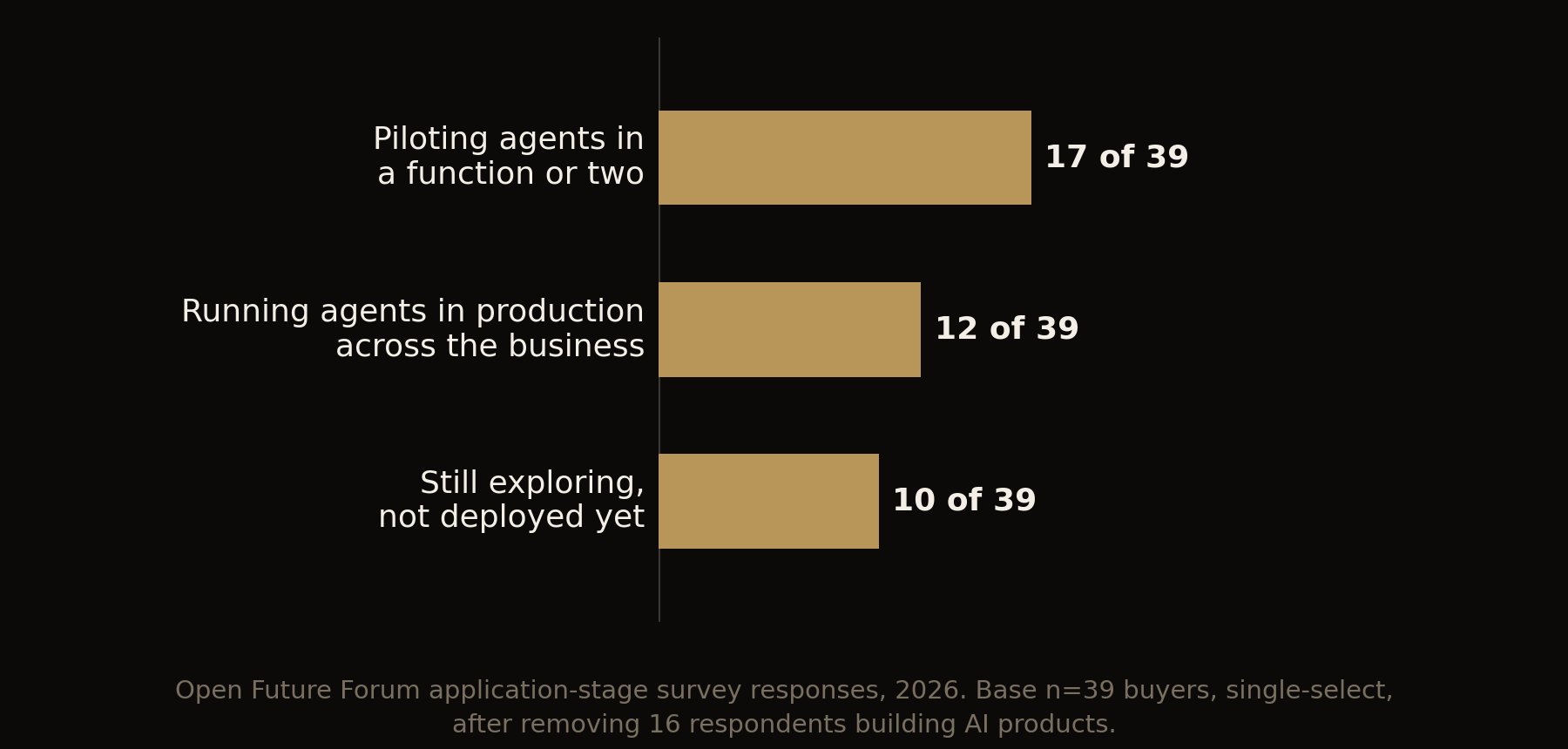
Among the 39 buyers, 29 were already piloting or running agents in production, and 10 were still exploring. This community does not need to be told marketing AI exists. It wants to see a workflow working. The 16 builders set aside are the supply side of the same room, which is exactly why a market map keeps supply and demand on separate pages.
Finding 2: The room asked for proof, not a pitch
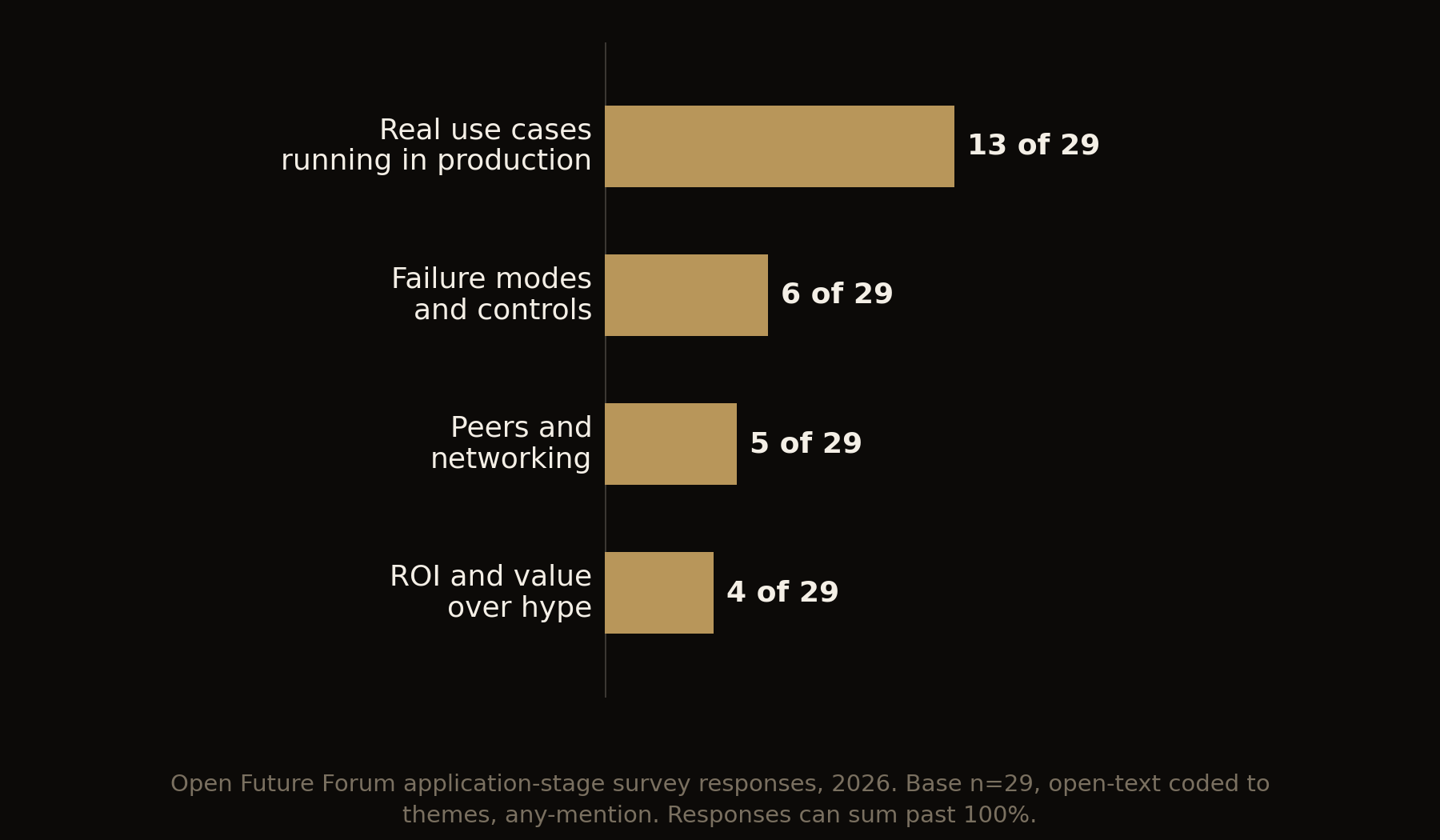
Asked what they wanted to walk out with, 13 of 29 open-text answers pointed to real use cases running in production, more than any other theme. Failure modes and controls appeared in 6, peers and networking in 5, and ROI or value over hype in 4. The through-line is proof. This community is not asking to be convinced that marketing AI exists. It wants to see one workflow working, understand where it breaks, and hear it from a peer rather than a pitch.
Market Debate
Is CMO AI becoming a new software category?
One side says yes. AI-native products are being built around marketing work that older suites handled slowly, from answer-engine visibility to autonomous analytics to marketing operators that run the whole loop. Menlo Ventures reported that enterprise generative AI spend reached $37 billion in 2025, up from $11.5 billion in 2024. The CMO Survey reported that AI and machine learning now power close to a quarter of marketing activities, up sharply year over year. These signals support a category view. Sources: E01, E03.
Or is CMO AI being absorbed into existing platforms?
The other side says also yes. Adobe, Salesforce, Google, HubSpot, and Meta are embedding AI and agents into the content, creative, campaign, lifecycle, and analytics tools marketing teams already run. Gartner reported that CMOs allocate 15.3 percent of marketing budgets to AI, while only about 30 percent feel ready to scale it, which points to spend flowing through existing platforms rather than a clean new line. That supports a feature-layer view. Sources: V41, V57, V17, V58, E02.
External sources are cited for context. They are not affiliated with this report and do not endorse it.
What the Numbers Look Like Inside the Rooms
The conversation was practical. People were not asking for more AI enthusiasm. They asked to see one marketing agent working in production, the metric it moved, and where it broke. Several asked directly for the difference between the benefit and the hype.
The strongest pattern was a demand for proof before scale. Asked what they wanted to walk out with, people named real use cases, ROI, best practices, and failure modes. When asked what they are working on that AI touches, the marketing-relevant answers clustered in agentic workflows and automation, content and outbound, and campaigns and lifecycle, which maps onto the map’s categories. A meaningful share of answers were broad or sat outside marketing, from trading models to cybersecurity, which is a second reminder that this room mixed marketing buyers with builders.
The agentic layer drew the most energy and the most caution at once. The caution was not about whether a model can write. It was about control: who reviews the work, what data the agent reads, and who is accountable when an agent acts on a customer.
No participant names, company names, or identifying details are included. This section follows the Chatham House Rule.
How CMOs and Vendors Should Use This Report
For CMOs
Use the map to find workflow coverage across the eight categories, then map each candidate tool to a single job the marketing team already owns. Ask where the tool sits in the stack, what data it reads, and how output is reviewed before it reaches a customer. Separate builder pitches from buyer tools — a vendor building agents to sell is not the same as a tool ready to run in your team. Demand a short proof plan before spend: baseline, owner, data source, control step, and the metric that will move in two quarters.
For vendors
Do not sell a broad AI story. Name the one marketing workflow the tool improves and the team that owns it. Show the integration path into the existing martech stack and the review step before anything ships to a customer. Bring a proof path: one workflow, the owner, the metric it moves, and where the agent hands back to a person. End on a proof path, not a feature list — prove the workflow, then earn the platform conversation.
Questions This Report Answers
What is the CMO AI Market Map?
It is a workflow-based map of AI tools that serve CMO and marketing team needs in 2026.
Is this a vendor ranking?
No. Vendors are grouped by category. They are not scored, ranked, or placed on axes.
How were vendors selected?
Vendors were selected editorially from public information based on relevance to CMO workflows.
What is the demand overlay?
It is a first-party read of application-stage survey responses from an Open Future Forum marketing and growth session in 2026.
Why are there only two findings?
This session instrument fielded one deployment-stage question and open-text prompts. Budget, sign-off, blocker, and return-window questions return in a later edition.
What is the Enterprise AI Buying & Budget Index?
It is an Open Future Forum research series tracking how AI buying, budget, proof, and sign-off are changing inside executive communities.
Can vendors pay to be included?
No. No vendor paid for placement. Two vendors in the map, ThinkingAI and Emma by AgentWeb, sponsor Open Future Forum, but sponsorship does not buy inclusion, categorization, or placement, and neither had editorial input into this edition.
Methodology and Disclosure
First-party source: one application-stage survey instrument fielded around an Open Future Forum marketing and growth session in 2026. Sample: 55 reportable application-stage responses to the agentic-stage question after restricting analysis to survey-answer fields. These are not attendees and not registrations. Base variation: agentic deployment stage n=55, single-select; open-text on what respondents wanted to walk out with n=29, coded to themes and reported any-mention; open-text on what respondents are working on that AI touches n=27; job title supplied by 34 respondents. Budget, sign-off, blocker, and return-window questions were not fielded in this instrument, so those demand reads are not published in this edition. Open-text coding: free-text answers were grouped into themes by hand and reported as any-mention, so shares can overlap. Mixed audience: the session included both marketing and growth buyers and founders building AI products, and among the 34 respondents who gave a title most were founders or C-level, so the deployment-stage reading blends buyers and builders and is reported as such. Small bases: n=55 is small and directional, and decimal precision is avoided. Privacy: no participant names, emails, company sizes, exact identifying counts, tenures, or identifying achievements are published. The underlying identity data is held privately. Limits: the data measures application-stage responses. It does not measure attendance, spend, contract value, deployment success, or vendor performance. External sources and vendor pages are used for context and vendor descriptions and are not affiliated with this report.
Vendor Inclusion Note
Vendor inclusion is editorial. The map is based on public information. No vendor paid for placement. Categorization is not an endorsement. The map does not score, rank, or evaluate vendor quality. Disclosure: ThinkingAI (V40) and Emma by AgentWeb (V64) are sponsors of Open Future Forum, and the first-party demand data in this report was collected around a marketing and growth session they supported. Their sponsorship is separate from this report. It did not buy placement, did not influence inclusion or categorization, and neither company had editorial input into this edition. Both were assessed against the same public-page standard as every other vendor in the map. No other vendor in the map was identified as a portfolio company or advisory client of the author. Each vendor in the map had an active public product or company page during source review. No shut-down vendor was knowingly included. Where a vendor sits inside a larger parent, such as Pencil within The Brandtech Group or Brandwatch within Cision, it is included as an operating product and labeled accordingly.
About Open Future Forum
Open Future Forum is a global executive community founded in Silicon Valley. Its network reaches tens of thousands of executives and investors worldwide. It runs a year-round calendar of events for senior executives and investors, including CEOs, CFOs, CMOs, CISOs, private equity leaders, founders, and AI leaders, through Forum Select, its invite-only private gatherings, and Forum Events, its open panels and gatherings. Beyond events, Open Future Forum convenes peer groups and executive boards and publishes original research built on first-party survey and qualitative data from its executive network. The CMO AI Market Map is part of its Enterprise AI Buying & Budget Index, alongside the CFO AI Market Map, the CISO AI Market Map, the CFO, CMO, CISO, and CEO AI Leverage Reports, the Executive AI Leverage Report, and the AI Transformation Report.
Sources
External sources are cited for context. They are not affiliated with this report and do not endorse it. URLs were live at the time of source review.
Vendor sources
External context sources
| Key | Source | URL |
|---|---|---|
| E01 | Menlo Ventures, State of Generative AI in the Enterprise 2025 | https://menlovc.com/perspective/2025-the-state-of-generative-ai-in-the-enterprise/ |
| E02 | Gartner 2026 CMO Spend Survey press release | https://www.gartner.com/en/newsroom/press-releases/2026-05-11-gartner-2026-cmo-spend-survey-finds-cmos-allocate-15-point-3-percent-of-marketing-budgets-to-ai-but-only-30-percent-are-ready-to-scale-ai-capabilities |
| E03 | The CMO Survey, AI in Marketing | https://cmosurvey.org/category/ai-in-marketing/ |
| E04 | McKinsey, The State of AI 2025 | https://www.mckinsey.com/capabilities/quantumblack/our-insights/the-state-of-ai |
Entity and press sources
| Key | Source | URL |
|---|---|---|
| P01 | Speak About AI profile for Murray Newlands | https://speakabout.ai/speakers/murray-newlands |
| P02 | Yahoo Finance coverage featuring Murray Newlands and Open Future Forum | https://finance.yahoo.com/news/ceos-are-surprise-victims-of-the-loneliness-epidemic-your-peers-are-gone-and-youre-the-only-one-left-073425355.html |
| P03 | Inc., 21 Thought Leaders Every Entrepreneur Should Follow in 2016 | https://www.inc.com/chirag-kulkarni/21-thought-leaders-every-entrepreneur-should-follow-in-2016.html |
| P04 | Programming Insider coverage of Open Future Forum executive communities | https://programminginsider.com/why-open-future-forum-has-become-one-of-the-top-executive-communities/ |
| P05 | HuffPost, The Top 10 People to Know in Silicon Valley | https://www.huffpost.com/entry/the-top-10-people-to-know_b_8435302 |
External benchmarks are used for context only. They are not affiliated with this report and do not endorse it.
This report is for informational purposes only. It is not investment, legal, tax, accounting, or procurement advice. Vendor inclusion is not an endorsement. External sources are cited for context only and do not endorse this report.
© 2026 Open Future Forum. All rights reserved. The CMO AI Market Map and the Enterprise AI Buying & Budget Index are works of Open Future Forum. No part may be reproduced or redistributed for commercial purposes without permission. Quotation for journalism, research, and commentary is welcome with attribution to Open Future Forum.

Join the CMO Dinner Series
Private invitation-screened dinners for marketing leaders navigating AI budget decisions and vendor evaluation. Off the record. No vendors. No agenda.