The September answer
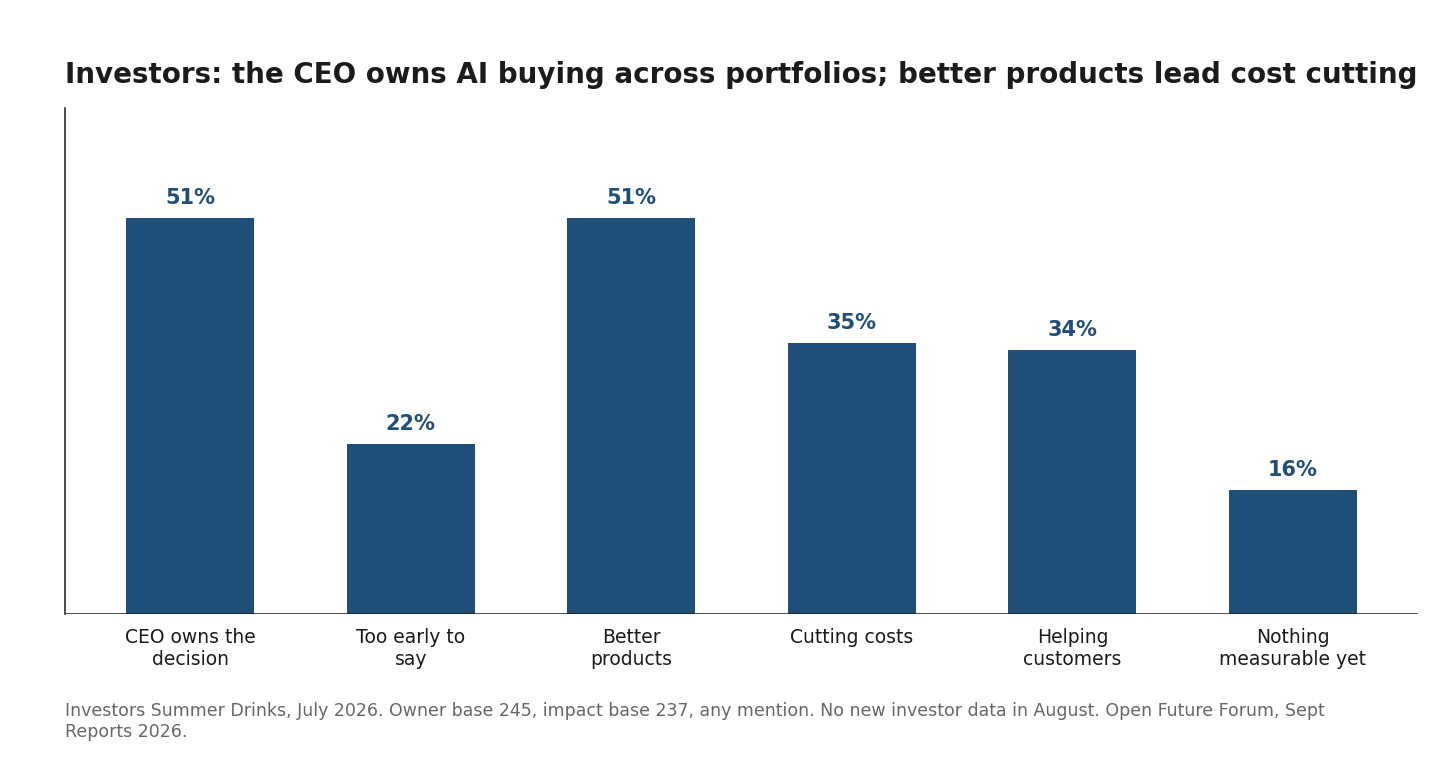
The capital side believes in AI at 86 percent, and the belief is not evenly held. It is highest inside corporate venture, where the investor sits in an operating company and can see both the product and the cost line; it is lowest among investors who cannot say who owns AI in the companies they fund. That last cut is the edition’s finding. Conviction is running ahead of the operating model that governs it, Edition 1 said; Edition 2 says where the operating model exists, the conviction is justified by something measurable, and where it does not, the investor is looking at a portfolio that cannot show it a return. The AI Investor Conviction Index is a belief measure. What the September cuts add is the condition under which the belief is earned.
What changed since Edition 1
Nothing in the lines; the August gathering did not happen, so the Edition 1 base is the September base. What is new is the convention (unique people per instrument, which reproduces the Edition 1 figures exactly), the cohort read inside the July registration window, and four cuts that Edition 1 did not carry.
| Line | Edition 1 (August) | Edition 2 (September) | Base |
|---|---|---|---|
| AI Investor Conviction Index | 86 percent | 86 percent | 237 |
| Better products as where AI shows up | 51 percent | 51 percent | 237 |
| Cutting costs | 35 percent | 35 percent | |
| Helping customers | 34 percent | 34 percent | |
| Nothing measurable yet | 16 percent | 16 percent | |
| CEO increasingly owns AI buying | 51 percent | 51 percent | 245 |
| Too early to say who owns it | 22 percent | 22 percent | |
| Conviction, early July cohort | not published | 72 percent | 18, directional |
| Conviction, late July cohort | not published | 85 percent | 216 |
Source: Open Future Forum, VC & CVC AI Investment Report, Edition 2, September 2026.
How to read: the two July cohorts are different investors registering for one gathering a month apart; the early cohort is too small to read and is shown for completeness. What stayed the same: everything measured. What surprised us, from the cuts: that conviction does not vary with the investor’s seniority at all, 89 percent for partners and 89 for principals, while the seat they locate AI authority in varies enormously, 62 against 32 percent naming the CEO. Belief is uniform; the theory of who holds the pen is not.
Where this research comes from
The VC & CVC AI Investment Report is the capital-side edition of the Enterprise AI Buying and Budget Index, built from two instrument questions embedded in the application flow for Investors Summer Drinks, Open Future Forum’s July 2026 gathering for venture, growth, corporate venture, family office, and angel investors, and from the cross-lane finance instrument answered by investors at other events. It is a companion to the Investor AI Report, which reads the buying decision from across portfolios; this report reads the conviction and the capital. Open Future Forum convenes investors through its investor drinks series in Palo Alto, the Microsoft private equity briefings, and the investor track of its executive forums. Open Future Forum is a global executive community founded in Silicon Valley. Its network reaches tens of thousands of executives and investors worldwide. It runs a year-round calendar of events for senior executives and investors through Forum Select, its invite-only private gatherings, and Forum Events, its open panels and gatherings, and publishes original research built on first-party survey and qualitative data from its executive network.
What is the AI Investor Conviction Index, and where does it stand?
The Index is the share of investors who name at least one place AI already makes a measurable difference across their portfolio. In September 2026 it is 86 percent of 237. It is a belief measure by design: it asks the investor to say where they have seen AI work, not to prove it, and it is tracked because belief precedes allocation. The composition matters as much as the level. Better products lead at 51 percent, cutting costs at 35, helping customers at 34. The investors in these rooms read AI as a product story by sixteen points, against a public narrative that reads it as a cost story. Sixteen percent see nothing measurable, and a fifth of those also named something, which is why the Index reads 86 rather than 84.
Conviction by fund type
New this edition, and the limit of this data is disclosed up front: fund type is classified from title and firm name, which places 125 of 245 respondents. A fund-type question goes on every investor form from October.
| Fund type | Base | Conviction Index | Better products | Cutting costs | Helping customers | Nothing measurable | Names the CEO as owner | Too early to say |
|---|---|---|---|---|---|---|---|---|
| Venture | 93 | 84 percent | 49 percent | 35 | 32 | 17 | 52 | 26 |
| Corporate venture and strategic | 10, directional | 90 percent | 70 percent | 40 | 40 | 10 | 50 | 0 |
| Angel | 6, directional | 83 percent | 50 percent | 0 | 33 | 17 | 17 | 50 |
| Not classifiable | 120 | 88 percent | 50 percent | 35 | 36 | 14 | 53 | 16 |
| Private equity and growth | 4, not shown |
Source: Open Future Forum, VC & CVC AI Investment Report, Edition 2, September 2026.
Corporate venture is the most convinced and the most decided group in the data: 90 percent conviction, nobody saying it is too early to name the owner, and product and cost impact both at their highest. That is what an investor embedded in an operating company sees, both sides of the P&L at once. Venture is the most uncertain on ownership, a quarter saying too early, and slightly below the Index on conviction. Angels, on six responses, mostly cannot name an owner and cannot see cost impact at all, which fits a seed portfolio that has not yet built the function AI would replace. Four private equity respondents are too few to show; the PE read begins with the October fund-type question and the private equity briefings.
Venture, 93. Conviction 84, a quarter unable to name the owner. The earliest portfolios in the data and the least settled on who runs AI inside them; the belief is there before the operating model.
Corporate venture and strategic, 10 (directional). Conviction 90, nobody saying too early, product impact at 70 and cost at 40. The investor who sits inside an operating company sees the P&L from both sides and has already decided who owns it.
Angels, 6 (directional). Conviction 83, half unable to name an owner, none seeing cost impact. Seed companies have not built the function that AI would replace, so the angel sees product or nothing.
Private equity and growth, 4. Not shown. The fund-type question on the October form is what a PE line needs; the private equity briefings are where it will be answered.
Conviction by investor seniority
| Investor seniority | Base | Conviction Index | Nothing measurable | Names the CEO as owner | Too early to say |
|---|---|---|---|---|---|
| Partner, GP, managing director, or founder | 142 | 89 percent | 13 percent | 62 percent | 18 percent |
| Principal, VP, director, or associate | 19, directional | 89 percent | 11 percent | 32 percent | 16 percent |
| Title not classifiable or blank | 73 | 81 percent | 23 percent | 33 percent | 27 percent |
Source: Open Future Forum, VC & CVC AI Investment Report, Edition 2, September 2026.
Conviction does not move with seniority; the location of authority does. Partners put the AI decision at the CEO at 62 percent, twice the rate of the investment staff at 32. The partner sits in the boardroom and sees the decision at the top; the principal sits in the diligence and sees it where the evaluation happens. Both are describing the same companies. This is the capital-side version of the Self-Attribution Effect the operators show: the seat you sit in determines which seat you see holding the pen.
Partners, GPs, and founders, 142. The decided group: 62 percent name the CEO, conviction 89, nothing measurable 13. The boardroom view puts the AI decision in the boardroom.
Principals, VPs, and associates, 19 (directional). Conviction identical at 89, but the CEO named half as often at 32. The diligence view puts the decision where the evaluation is done. Same companies, different chair.
Unclassifiable titles, 73. The least convinced at 81 and the least decided at 27 percent too early. Where the investor’s own seat cannot be read, the portfolio’s owner usually cannot either.
Conviction and ownership, together
| Where is AI making the biggest difference? | Names the CEO (118) | Names the CIO or CTO (57) | Names teams, bottom-up (41) | Names the CFO (29) | Too early to say (49) |
|---|---|---|---|---|---|
| Better products | 62 percent | 58 percent | 46 percent | 48 percent | 33 percent |
| Cutting costs | 37 percent | 53 percent | 44 percent | 48 percent | 22 percent |
| Helping customers | 31 percent | 44 percent | 37 percent | 48 percent | 35 percent |
| Nothing measurable yet | 9 percent | 5 percent | 20 percent | 7 percent | 41 percent |
Source: Open Future Forum, VC & CVC AI Investment Report, Edition 2, September 2026.
This is the edition’s finding and it is the one to carry into diligence. Investors who can name any owner of AI in their portfolio companies see nothing measurable in 5 to 9 percent of cases, unless the owner they name is “individual teams, bottom-up,” where it rises to 20. Investors who cannot name an owner see nothing measurable in 41 percent. Named ownership and measured value travel together, and the direction of causation cannot be read from a cross-section, so what can be claimed is the association. It is the same statement the operators make from inside the building, that the companies handling AI well named the owner and the metric on the same day, now visible from the cap table. The secondary read: the seat that owns AI shapes what it is used for. CEO ownership runs toward product (62 percent); CTO ownership runs toward cost (53). A value-creation thesis should say which it wants, and name the seat accordingly.
Investor archetypes: product-first and cost-first
Read from the impact answers, the investors in these rooms fall into two groups worth naming. Product-first investors, who name better products and do not name cost, are the larger group and are concentrated where the CEO owns the decision. Cost-first investors, who name cutting costs and do not name product, are concentrated where the CIO or CTO owns it and in corporate venture. The two groups hold the same conviction and back different theses, and the operators’ data suggests the thesis follows the owner: a company whose CEO runs AI builds product with it; a company whose CTO runs AI cuts cost with it. An investor choosing which to back is also choosing which seat to insist on.
The investor as an operator
Twenty investors also answered the finance instrument about their own firms at other events, a directional base. For their own firms they name the CEO as signer at 35 percent and report no single owner at 20. On payback they are the least confident chair in the Index, 35 percent inside six months; on budget the least clear, half with no AI budget line; on blockers the most security-minded, half naming compliance. The firm applying an ownership test to its portfolio has not yet passed it itself. The investor drinks form asks the question again on a base that can carry it.
The same view, by vertical
The investor instrument does not tag the portfolio’s vertical, so the vertical view for this seat is read through the founders the investors fund and the operators they sit across from. From the seller side (YC Founder AI Report, all directional): fintech is the most settled buying environment, with the CFO named by 52 percent of sellers and usage pricing at 70; enterprise software is the outcome-pricing lab at 47 percent; healthcare enters through the business unit at 40 with finance at 13; consumer has not chosen an owner. From the operator side (Executive AI Leverage Report): technology and enterprise software is the most CEO-led and most optimistic vertical (63 percent name the CEO, 73 percent expect payback inside six months), and Big Tech and platforms carries the largest ownership gap at 50 percent with no single owner. An investor reading those two tables together has the map of where a named owner is likely to exist, and therefore where measured value is likely to be visible.
The operator side, on the finance instrument, gives the same map from inside the companies (Unclassified excluded; bases under 40 directional):
| Vertical | Base | Names CEO as signer | No single owner | Payback under six months | Funds AI from headcount money | No clear AI budget | Proving ROI is the blocker |
|---|---|---|---|---|---|---|---|
| Technology and enterprise software | 59 | 63 percent | 8 | 73 | 29 | 17 | 61 |
| Financial services and fintech | 10, directional | 50 percent | 0 | 40 | 20 | 40 | 50 |
| Big Tech and platforms | 12, directional | 25 percent | 50 | 42 | 17 | 33 | 67 |
| Professional services and legal | 15, directional | 47 percent | 20 | 40 | 13 | 47 | 53 |
| VC and investment | 22, directional | 50 percent | 9 | 55 | 9 | 27 | 41 |
| Other | 57 | 33 percent | 14 | 53 | 23 | 35 | 58 |
Source: Open Future Forum, Executive AI Leverage Report, Edition 3, September 2026.
Tested against the record
| External claim | Open Future Forum figure | Verdict |
|---|---|---|
| Menlo Ventures: AI took 61 percent of global venture capital in 2025 | 86 percent conviction among 93 identifiable venture investors | Corroborated on where the money and the belief are |
| Coatue, May 2026: $12 trillion of AI capital expenditure through 2031 | 22 percent of investors cannot name who owns AI buying in their portfolios | Complicated: the capital is committed at a scale the ownership structure has not matched |
| PwC 29th Global CEO Survey: 56 percent of CEOs see no AI benefit yet; 12 percent see both cost and revenue benefit | 16 percent of investors see nothing measurable; 9 percent where the CEO owns it | Contradicted in direction from the Silicon Valley portfolio view |
| MIT NANDA: 95 percent of enterprise pilots show no measured profit | 86 percent of investors see measurable difference somewhere; this program does not measure profit | Complicated: visible difference is not measured profit, and the rooms report the first |
| BCG AI Radar 2026: 72 percent of CEOs say they are the main AI decision maker | Partners name the CEO at 62 percent; principals at 32 | Corroborated from the boardroom, contradicted from the diligence room |
| S&P Global 2026: just under one in four GPs have AI integrated into diligence; 27 percent call it effective | The ownership question predicts measurable value at four to one; the PE read is four respondents | Gap acknowledged; the diligence question the data recommends is not yet the one GPs ask |
| Stanford AI Index 2026: private AI investment continued to concentrate in the United States | The rooms are the concentration | Corroborated on who the rooms are |
Source: Open Future Forum, VC & CVC AI Investment Report, September 2026.
External figures are context only; the sources are not affiliated and do not endorse this report.
What investors are asking coming into the rooms
No open question was put to investors this cycle, so the asks come from the founders and operators across the table. Chief executives at the private dinners want AI for researching investors more than any other session, 66 percent of 41 (directional), which means the companies are studying the capital as closely as the capital studies them. Finance leaders ask for AI that works in the tools they already run and a bill they can explain; security leaders ask who owns an agent a business unit bought. Each of those is a version of the question this report puts to the portfolio: is there an owner, and can the return be seen. From October the investor form carries its own open question, what would change your conviction.
What this means for the investor
The diligence question is not “are they using AI” but “who owns it,” because the answer predicts whether a return will be visible: 9 percent nothing measurable where the CEO owns it, 41 where nobody does. Second, the seat you insist on predicts the thesis you get: CEO ownership runs toward product, CTO ownership toward cost, and a value-creation plan should say which. Third, apply the standard at home: half of investor-seat respondents have no clear AI budget for their own firm and a third expect fast payback, and the rooms will ask.
For founders, CEOs, and limited partners
Founders get the seat the capital sees: investors name the CEO as the owner at 51 percent and 62 among partners, and no founder instrument in the Index sells to the CEO; the Seat Split is the distance between the two. CEOs get the confirmation and the condition: your investors put the decision on your desk, and they can see the return only where you have named who owns it. Limited partners get a question for their managers: what share of the portfolio has a named AI owner and a measured effect, because in this data the two are the same question.
Where can investors discuss this with peers?
Open Future Forum convenes investors through its investor drinks series in Palo Alto, the Microsoft private equity briefings, and the investor track of its executive forums, in rooms that mix venture, growth, corporate venture, family office, and private equity with the founders and operators they fund. The investor drinks approved 39 percent of 300 applicants this period; 68 percent of titled approved guests hold a senior title and 50 percent are partners, C-level, or founders. Membership is by application and referral.
Explore the investor gatherings · Inquire about membership
Upcoming investor events
Investor drinks
Palo Alto, CA · next date to be announced
For venture, growth, corporate venture, family office, and private equity investors, with fund type, AUM band, stage, share of portfolio with measurable AI ROI, and the portfolio-owner question on the registration form. Edition 3 data collection.
Microsoft private equity briefings
Microsoft campus · by invitation
Executive briefings for private equity leaders on AI in the portfolio, with the PE instrument on the form.
Edition 3 publishes after the next instrumented investor gathering. The three questions the next rooms will debate: whether named ownership predicts measured value or the reverse, what share of a portfolio has a measured AI return, and whether the firm applies its own diligence standard to itself.
Related reading
- Investor AI Report
- YC Founder AI Report
- Executive AI Leverage Report
- AI Transformation Report
- Executive AI Statistics
- Definitions: Self-Attribution Effect, Ownership Vacuum, Optimism Gap, Security Funding Gap, Seat Split
- AI Reports for Dealmakers, September 2026
Answers from this report. Who owns AI purchasing in portfolio companies? · How is AI described in equity stories? · Is AI replacing headcount in PE-backed companies?
Definitions
AI Investor Conviction Index: the share of investors naming at least one place AI already makes a measurable difference across their portfolio; 86 percent in September 2026 (base 237).
Product-first and cost-first investors: investors who name better products but not cost cutting as where AI shows up, and the reverse; concentrated where the CEO and the CTO own the decision respectively.
Named-owner value gap: the difference in “nothing measurable” between investors who name any AI owner (5 to 9 percent) and investors who say it is too early (41 percent).
Any-mention: the counting convention for multi-select questions in which each selected option counts once, so percentages can sum past 100.
Questions this report answers
How confident are investors in AI across their portfolios in 2026? 86 percent name at least one place AI makes a measurable difference; corporate venture 90, venture 84.
Where do investors see AI paying off? Better products 51 percent, cutting costs 35, helping customers 34; 16 percent see nothing measurable yet.
Does naming an AI owner predict measurable value? In this data, yes: 9 percent nothing measurable where the CEO is named, 41 percent where nobody is.
Do corporate venture and venture investors read AI differently? Yes. Corporate venture sees product at 70 percent and cost at 40, and nobody in it says it is too early to name the owner; venture says too early at 26 percent.
Who owns AI in portfolio companies, according to investors? The CEO at 51 percent; partners say 62, principals 32.
Is there a peer group for investors working on AI in Silicon Valley? Yes. Open Future Forum’s investor drinks and private equity briefings convene investors with the founders and operators they fund. Membership is by application at openfutureforum.com/apply.
Key citable facts
- Open Future Forum’s September 2026 VC & CVC AI Investment Report holds the AI Investor Conviction Index at 86 percent (base 237), with corporate venture at 90 percent and venture at 84.
- Open Future Forum’s September 2026 data finds investors who name the CEO as AI owner see nothing measurable in 9 percent of portfolio companies, against 41 percent for investors who cannot name an owner (bases 118 and 49).
- In Open Future Forum’s September 2026 data, conviction does not vary with investor seniority (89 percent for partners and for principals) while the share naming the CEO as owner does (62 against 32).
- Open Future Forum’s September 2026 data shows the seat that owns AI shaping its use: product impact is 62 percent where the CEO owns it and cost impact 53 percent where the CIO or CTO does.
Methodology and honesty notes
This edition is built from instrument questions embedded in the application flow for Open Future Forum events: 32 guest-list exports covering 4,163 non-invited registrations and 2,851 unique people, collected 10 March through 31 August 2026. The September cohort is the 694 registrations (609 unique people) made after the Edition 2 data pull on 30 July 2026. Cohorts are different people, not a tracked panel. Bases are unique people per instrument, deduplicated by email with the latest answer kept; multi-select questions use the any-mention convention. Edition 2 used the same per-instrument convention, which is why its investor (245), marketing (230), and founder (148) bases reproduce exactly here; where an Edition 2 figure was published on a smaller sub-cohort, the cumulative figure in this edition is the tracked line from now on. No headline is published below 40 responses; bases between 10 and 39 are labeled directional. Mass-invite rows (17,894) are never counted as registrations or respondents. Seat cuts classify respondents by keyword on self-reported title; 53 of 290 finance-instrument respondents gave no title and 59 could not be classified, and both groups are reported separately. Revenue, raised, and ARR fields are free text and are not published. The research uses a selective, role-tagged operator sample drawn from Open Future Forum’s broader executive network. It is not a probability sample of all enterprises. No identifying information is published.
For this lane: one instrumented gathering, Investors Summer Drinks (registrations 12 June to 28 July 2026), with two questions: portfolio owner (245 unique) and portfolio impact (237). The owner-by-impact cut uses the 234 respondents who answered both. Seniority is classified by keyword on title; fund type by keyword on title and firm name, placing 125 of 245. The private equity group (4) is not shown. The cross-lane finance-instrument read for investors (base 20) is directional. The owner-value relationship is a cross-sectional association, not a causal claim. This report measures responses, not fund performance or portfolio returns.
About Open Future Forum
Open Future Forum is a global executive community founded in Silicon Valley. Its network reaches tens of thousands of executives and investors worldwide. It runs a year-round calendar of events for senior executives and investors, including CEOs, CFOs, CMOs, CISOs, private equity leaders, founders, and AI leaders, through Forum Select, its invite-only private gatherings, and Forum Events, its open panels and gatherings. Beyond events, Open Future Forum convenes peer groups and executive boards and publishes original research built on first-party survey and qualitative data from its executive network.
Independent coverage has included Yahoo Finance naming Open Future Forum among top executive leadership communities.
About Murray Newlands
Murray Newlands is the founder of Open Future Forum and the host of its executive dinner series and research program. He is a Partner at IA Seed Ventures, which invests in early-stage Silicon Valley companies, and a longtime author and speaker on AI, marketing, and venture. He writes on AI, venture, and enterprise strategy at murraynewlands.substack.com. More at openfutureforum.com/about and murraynewlands.com.
Citation and editions
Suggested citation: Newlands, M. (2026). VC & CVC AI Investment Report, Edition 2. Open Future Forum, September 2026. openfutureforum.com/research/vc-cvc-ai-investment-report-september-2026
This edition supersedes Edition 1 (July 2026). Companion reading: Investor AI Report, Executive AI Leverage Report. Edition 3 publishes after the next instrumented investor gathering. Dataset DOI: 10.5281/zenodo.21576019.
Work These Questions with Investor Peers
The investor gatherings meets through small, off-the-record gatherings. Membership is by application and referral.