The September answer
The technology seat runs what the CEO signed and the CFO has not yet funded, and every cut in the September data says so. It reports the most unowned decisions, names itself the signer least, expects a fast return least, and names proving ROI as its blocker most. In the security rooms it sees the agent problem most clearly and has found the money for it most often, a third of the time by taking it from somewhere else. In the marketing rooms it values AI for what the tools do rather than for the people they replace. Closest to the build, with the least authority and the most to prove: that is the seat the AI Leaders instrument will hear from for the first time in October.
What changed: what the Preview establishes
There is no prior edition to compare against, so this section records the baseline the Preview sets. The technology seat is read here on 23, 21, 32, and 23 respondents across three instruments it did not design, and every figure is directional. What the Preview establishes for Edition 1 to test: the seat reports the Ownership Vacuum at 30 percent; it names itself the signer at 26; it expects fast payback at 39 and names proving ROI at 70; it names agent access at 76 and reports no zero-spend; it values content speed over headcount in the marketing rooms. Edition 1, on the first AI Leaders base over 40, will replace each of those with the seat’s own instrument and say which held.
Where this research comes from
The AI Leaders lane is the newest in the Enterprise AI Buying and Budget Index and the only one read here without an instrument of its own. The AI Leaders Forum, chaired by Murray Newlands, with Jerry Xu of Oracle, Karthik Suresh of ZoomInfo, Paulina Xu of Agentic Fabriq, Akshay Goel of Amazon, and Erik Norden of Zyphra on the board, convenes CTOs, CIOs, heads of AI, and data and engineering leaders through the AI Infrastructure Roundtable, the Enterprise AI at Microsoft briefings, the data-agents and fintech-engineering panels, and the CTO golf gathering. This Preview reads the seat through the cross-lane instruments (who signs, budget source, blocker, payback; security problem and funding; agentic status and impact) wherever a respondent holding a technology title answered them, and through the rosters and interest questions of the AI Leaders events. Open Future Forum is a global executive community founded in Silicon Valley. Its network reaches tens of thousands of executives and investors worldwide. It runs a year-round calendar of events for senior executives and investors through Forum Select, its invite-only private gatherings, and Forum Events, its open panels and gatherings, and publishes original research built on first-party survey and qualitative data from its executive network.
Who owns the AI decision, seen from the technology seat?
Not the technology seat, by its own account. On the finance instrument, technology-seat respondents name the CEO at 26 percent, the CFO at 30, the CIO or CTO at 26, a business unit at 9, and no single owner at 30. Three things stand out. No other operating chair fails to name itself first; the CEO seat names the CEO at 70 and the finance seat names the CFO at 63. It reports the Ownership Vacuum at 30 percent, fifteen times the CEO seat’s 2. And it names the CFO more than the CIO or CTO, which is the finance-lane consolidation of August seen from below. The seat that implements AI is describing a decision made above it that it cannot always locate.
| Technology-seat answers on the finance instrument | Technology (23, directional) | CEO/Founder (80) | Finance (52) |
|---|---|---|---|
| Names the CEO as signer | 26 percent | 70 percent | 31 percent |
| Names the CFO or finance | 30 percent | 30 percent | 63 percent |
| Names the CIO or CTO | 26 percent | 15 percent | 10 percent |
| No single owner yet | 30 percent | 2 percent | 15 percent |
| Payback under six months | 39 percent | 70 percent | 42 percent |
| Not sure on payback | 26 percent | 4 percent | 12 percent |
| Net-new money as the source | 35 percent | 39 percent | 44 percent |
| Reallocated from other software | 30 percent | 15 percent | 19 percent |
| Funds AI from headcount money | 22 percent | 34 percent | 19 percent |
| No clear AI budget | 26 percent | 19 percent | 25 percent |
| Proving ROI is the blocker | 70 percent | 54 percent | 60 percent |
| Data readiness is the blocker | 26 percent | 18 percent | 33 percent |
Source: Open Future Forum, AI Leaders AI Leverage Report, Preview Edition, September 2026.
Two more reads from the table. The technology seat reallocates from other software most, at 30 percent, which is the seat that owns the software budget finding the money inside it. And it names proving ROI as the blocker at 70 percent, above finance at 60: the seat furthest from the signature is the seat under the most pressure to justify it.
The technology seat in the security rooms
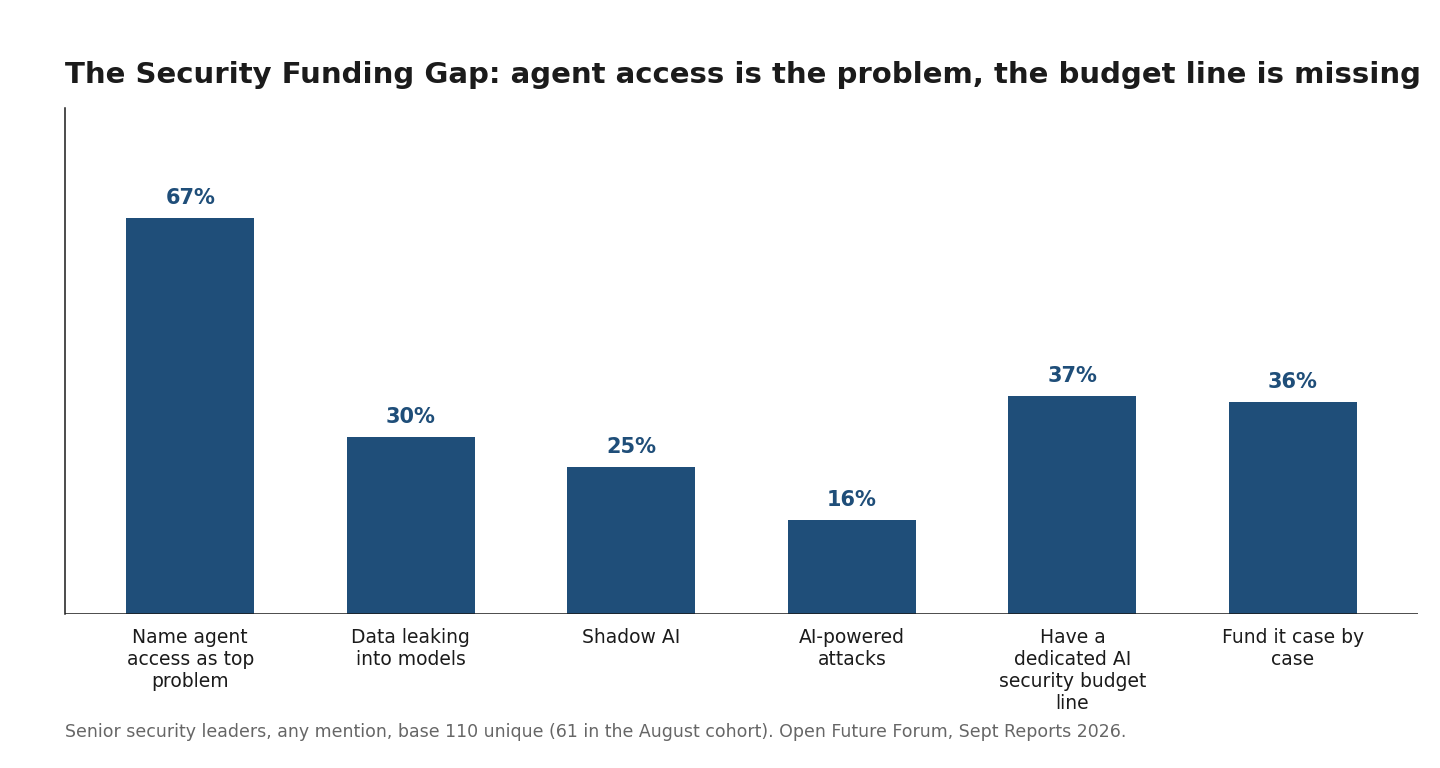
Twenty-one technology-seat respondents answered the security instrument (directional). They name agent access as the top problem at 76 percent, the highest of any chair, data leakage at 33, attacks at 24, shadow AI at 14, the lowest. On funding: 33 percent hold a dedicated AI security line, 33 fund case by case, 33 carve it out of the existing security budget, and nobody reports zero spend. The technology seat sees the agent problem most sharply because it runs the infrastructure the agents sit on, and it has found the money more reliably than the security seat itself (24 percent with a dedicated line), a third of the time by taking it from something else. Between July and August, on very small bases, the technology seat’s agent-access share moved from 67 to 82 percent.
The technology seat in the marketing rooms
Thirty-two technology-seat respondents answered the agentic-status question and 23 the impact question (directional). On the ladder: 34 percent building agentic products, 31 piloting, 19 running in production across the business, 16 exploring. On impact: content speed 61 percent, customer knowledge 52, doing the work of more people 30, nothing measurable 9. That ranking is the reverse of the marketing seat’s own (headcount 57, content 53, customer 33). The people building the tools value what the tools do; the people buying them value who the tools replace. A vendor pitch built on speed is landing in a function measuring itself on people, and the technology seat is on the speed side of that line.
Who is in the AI Leaders rooms
Four events in the period: AI Agents for Fintech Engineering Teams (243 registrations, 167 approved), Building Data Agents Enterprise Can Actually Trust (207, 114), the AI Infrastructure Roundtable (105, 37), and the CTO and Tech Golf Gathering (33, 13). Together: 588 registrations, 553 unique people, 323 approved, 193 declined, 55 percent approval, the least selective of the executive lanes because three of the four are open Forum Events. By seat: technology titles 92, founders and CEOs 79, investors 20, marketing 7, and 118 with other or blank titles. By vertical: technology and enterprise software 47, Big Tech and platforms 42 (Google, Intel, Microsoft, Amazon, PayPal, Morgan Stanley among the employers), VC and investment 24, financial services 18. Asked what they are working on that AI touches, the technology-seat answers are agents almost without exception: agentic planning, agent platforms, agentic layers for recommendations, agent operating systems, data generation for enterprise models.
What AI leaders want to learn next
Across the AI Dev side event and the CTO golf gathering, 77 percent of 249 respondents said yes to learning more about securing AI agents, 78 percent at the side event and 63 at the golf gathering. The AI Infrastructure Roundtable’s stated agenda, compute, interconnect, memory, storage, power, and the question of when the bottleneck moves from GPUs to everything around them, is the supply-side version of the same interest. The seat wants to know how to make agents safe and how to make them run, in that order.
The same view, by vertical
The technology seat is too thin to cut by vertical on any instrument. What can be said: technology and enterprise software is the most CEO-led and most optimistic vertical in the operator data (63 percent name the CEO, 73 percent expect fast payback), and it is where 48 percent of marketers are building agents; Big Tech and platforms, the second-largest vertical in the AI Leaders rooms, carries the largest ownership gap in the Index at 50 percent with no single owner (base 12, directional). The AI leader at a platform company is the most likely person in this data to be running AI nobody has been assigned to own.
Who is in the AI Leaders rooms, by vertical
| Vertical | Approved guests | C-suite, founder, or partner share |
|---|---|---|
| Technology and enterprise software | 47 | 49 percent |
| Big Tech and platforms | 42 | 10 percent |
| VC and investment | 24 | 46 percent |
| Financial services and fintech | 18 | 56 percent |
| Security | 9 | 100 percent |
| Infrastructure and data | 7 | 29 percent |
| Other | 54 | 59 percent |
| Unclassified | 115 | 17 percent |
Source: Open Future Forum, AI Leaders AI Leverage Report, Preview Edition, September 2026.
The operator read, by vertical
| Vertical | Base | Names CEO as signer | No single owner | Payback under six months | Funds AI from headcount money | No clear AI budget | Proving ROI is the blocker |
|---|---|---|---|---|---|---|---|
| Technology and enterprise software | 59 | 63 percent | 8 | 73 | 29 | 17 | 61 |
| Financial services and fintech | 10, directional | 50 percent | 0 | 40 | 20 | 40 | 50 |
| Big Tech and platforms | 12, directional | 25 percent | 50 | 42 | 17 | 33 | 67 |
| Professional services and legal | 15, directional | 47 percent | 20 | 40 | 13 | 47 | 53 |
| VC and investment | 22, directional | 50 percent | 9 | 55 | 9 | 27 | 41 |
| Other | 57 | 33 percent | 14 | 53 | 23 | 35 | 58 |
Source: Open Future Forum, Executive AI Leverage Report, Edition 3, September 2026.
The AI Leaders rooms are the network’s most platform-heavy: Big Tech and platforms is the second-largest vertical and only one in ten of its guests is C-level, because the platforms send their engineering leads and AI practitioners rather than their chief officers. The technology and enterprise software guests are half C-level and come from the vertical the operator data reads as most CEO-led and most optimistic. Financial services is a real presence here, 18 guests, more than half C-level, drawn by the fintech engineering panel, and it is the vertical whose finance seat the CFO report could not yet cut.
Tested against the record
| External claim | Open Future Forum figure | Verdict |
|---|---|---|
| Cisco AI Readiness Index: 15 percent of networks are fully ready; 54 percent cannot scale AI workloads | The technology seat names proving ROI as the blocker at 70 percent and integration at 9; agent access at 76 in the security rooms | Complicated: the rooms name proof and access, not capacity |
| ICONIQ, July 2026: companies use 3.1 model providers on average; inference is a rising share of cost | The technology seat reallocates from other software at 30 percent, the highest of any chair | Corroborated in direction: the money is being found inside the existing stack |
| McKinsey State of AI 2026: large companies scaling agents rose from 27 to 40 percent; 7 percent fully scaled | 19 percent of technology-seat respondents run agents in production across the business; 34 percent are building them | Complicated: the rooms sit between the two |
| Stanford AI Index 2026: agent benchmarks and inference costs both moving fast | 77 percent of 249 want to learn about securing agents | Corroborated on what the seat is asking |
| Ramp AI Index: coding-agent subscriptions and token-based spend growing fastest | Technology-seat open answers are agents almost without exception | Corroborated |
| IBM Cost of a Data Breach 2026: 92 percent of AI-breached organizations lacked AI access controls | 76 percent of technology-seat security respondents name agent access first; a third fund it by carving out | Corroborated |
Source: Open Future Forum, AI Leaders AI Leverage Report, September 2026.
External figures are context only; the sources are not affiliated and do not endorse this report.
What this means for the AI leader
The vacuum you see is real and the CEO cannot see it: 30 percent of your seat reports an unowned AI decision against 2 percent of the CEO seat, so the AI leader is the person best placed to name the owner and the worst placed to be believed. Second, the proof burden is yours by every read, 70 percent name it as the blocker, and it will be discharged in finance’s terms: the finance seat wants reliable workflows in the tools it already has and a bill it can explain, which is an integration and cost-visibility problem before it is a model problem. Third, you have already found the money for agent security, a third of the time from somewhere else; the October instrument asks where, and the answer is the case for a dedicated line.
For the CEO, the CFO, and the CISO
CEOs get the seat that disagrees with them most usefully: the technology seat reports the vacuum, the slow payback, and the proof burden the CEO seat does not. CFOs get a partner: the technology seat names proving ROI at 70 percent and sits with finance on payback at 39, closer than to the CEO at 70. CISOs get the chair that shares their problem and has more of the money: 76 percent agent access, 33 percent dedicated line, zero no-spend.
Where can AI leaders discuss this with peers?
The AI Leaders Forum is Open Future Forum’s peer group for CTOs, CIOs, heads of AI, and data and engineering leaders, chaired by Murray Newlands, with Jerry Xu of Oracle, Karthik Suresh of ZoomInfo, Paulina Xu of Agentic Fabriq, Akshay Goel of Amazon, and Erik Norden of Zyphra on the board. Members meet through the AI Infrastructure Roundtable, the Enterprise AI at Microsoft briefings, and the open technical panels. Membership is by application and referral.
Explore the AI Leaders Forum · Inquire about membership
Upcoming AI Leaders events
Enterprise AI at Microsoft
Microsoft campus, Mountain View, CA · date to be announced
An afternoon on what it takes to run AI reliably inside the enterprise: infrastructure, data architecture, governance, and the operational decisions behind production AI, with sessions on agent database access without credentials, large-scale retrieval, and production reliability. The registration form carries the first AI Leaders instrument: agents in production, the bottleneck, how agents access enterprise data, plus the six-question common core.
Edition 1 publishes on the first AI Leaders base over 40. The three questions the next rooms will debate: how many agents are actually in production, where the bottleneck sits when they are, and how an agent should hold a credential.
Related reading
- CISO AI Leverage Report
- Executive AI Leverage Report
- AI Transformation Report
- CMO AI Leverage Report
- Executive AI Statistics
- Definitions: Self-Attribution Effect, Ownership Vacuum, Optimism Gap, Security Funding Gap, Seat Split
- AI Reports for Dealmakers, September 2026
Answers from this report. Who signs off on AI purchases? · What is the biggest AI security problem for CISOs?
Definitions
The technology seat: respondents whose self-reported title is CTO, CIO, VP or head of engineering, data, AI, or architecture, or an engineering or developer role.
The Ownership Vacuum’s visibility gradient: the share reporting no single AI owner rises with distance from the CEO’s chair: 2 percent at the CEO seat, 15 at finance, 30 at technology.
Preview Edition: a report published below the program’s 40-response floor for its own instrument, read through cross-lane data and rosters, and labeled as such until the base clears.
Questions this report answers
Who owns AI purchasing, according to CTOs and CIOs? Nobody, in 30 percent of cases; the CFO in 30; the CEO in 26; themselves in 26 (base 23, directional).
What is the biggest AI security problem for technology leaders? Securing AI agents and their access, at 76 percent of technology-seat security respondents (base 21, directional).
How fast do technology leaders expect AI to pay back? 39 percent inside six months, 26 percent not sure, against 70 percent of the CEO seat.
What do AI leaders want to learn? Securing AI agents: 77 percent of 249 said yes.
Is there a peer group for AI leaders in Silicon Valley? Yes. The AI Leaders Forum meets through the AI Infrastructure Roundtable and the Enterprise AI at Microsoft briefings. Membership is by application at openfutureforum.com/apply.
Key citable facts
- Open Future Forum’s September 2026 Preview finds 30 percent of technology-seat respondents reporting no single AI owner, against 2 percent of the CEO seat (bases 23 and 80).
- In Open Future Forum’s September 2026 data, the technology seat names proving ROI as the blocker at 70 percent, the highest of any chair, and names itself the AI signer at 26 percent, the lowest.
- Open Future Forum’s September 2026 data shows technology-seat security respondents naming agent access at 76 percent with none reporting zero AI security spend (base 21, directional).
- 77 percent of 249 respondents at Open Future Forum’s AI Dev and CTO gatherings said yes to learning more about securing AI agents.
Methodology and honesty notes
This edition is built from instrument questions embedded in the application flow for Open Future Forum events: 32 guest-list exports covering 4,163 non-invited registrations and 2,851 unique people, collected 10 March through 31 August 2026. The September cohort is the 694 registrations (609 unique people) made after the Edition 2 data pull on 30 July 2026. Cohorts are different people, not a tracked panel. Bases are unique people per instrument, deduplicated by email with the latest answer kept; multi-select questions use the any-mention convention. Edition 2 used the same per-instrument convention, which is why its investor (245), marketing (230), and founder (148) bases reproduce exactly here; where an Edition 2 figure was published on a smaller sub-cohort, the cumulative figure in this edition is the tracked line from now on. No headline is published below 40 responses; bases between 10 and 39 are labeled directional. Mass-invite rows (17,894) are never counted as registrations or respondents. Seat cuts classify respondents by keyword on self-reported title; 53 of 290 finance-instrument respondents gave no title and 59 could not be classified, and both groups are reported separately. Revenue, raised, and ARR fields are free text and are not published. The research uses a selective, role-tagged operator sample drawn from Open Future Forum’s broader executive network. It is not a probability sample of all enterprises. No identifying information is published.
For this Preview: the AI Leaders lane has no instrument of its own in this pull. Technology-seat figures come from cross-lane instruments answered by respondents with technology titles at finance (23), security (21), and marketing (32 and 23) events; all are directional. Rosters cover four AI Leaders events (588 registrations, 323 approved). The agent-security interest question was asked at the AI Dev 26 side event and the CTO golf gathering (249 unique). Vertical cuts of the seat are not possible. This Preview publishes as Edition 1 when the Enterprise AI at Microsoft form clears 40 responses.
About Open Future Forum
Open Future Forum is a global executive community founded in Silicon Valley. Its network reaches tens of thousands of executives and investors worldwide. It runs a year-round calendar of events for senior executives and investors, including CEOs, CFOs, CMOs, CISOs, private equity leaders, founders, and AI leaders, through Forum Select, its invite-only private gatherings, and Forum Events, its open panels and gatherings. Beyond events, Open Future Forum convenes peer groups and executive boards and publishes original research built on first-party survey and qualitative data from its executive network.
Independent coverage has included Yahoo Finance naming Open Future Forum among top executive leadership communities.
About Murray Newlands
Murray Newlands is the founder of Open Future Forum and the host of its executive dinner series and research program. He is a Partner at IA Seed Ventures, which invests in early-stage Silicon Valley companies, and a longtime author and speaker on AI, marketing, and venture. He writes on AI, venture, and enterprise strategy at murraynewlands.substack.com. More at openfutureforum.com/about and murraynewlands.com.
Citation and editions
Suggested citation: Newlands, M. (2026). AI Leaders AI Leverage Report, Edition Preview. Open Future Forum, September 2026. openfutureforum.com/research/ai-leaders-ai-leverage-report
This is the Preview Edition; Edition 1 publishes on the first AI Leaders base over 40. Companion reading: CISO AI Leverage Report, Executive AI Leverage Report. Edition 1 publishes after Enterprise AI at Microsoft. Dataset DOI: 10.5281/zenodo.21576019.
Work These Questions with AI Leader Peers
The AI Leaders Forum meets through small, off-the-record gatherings. Membership is by application and referral.